

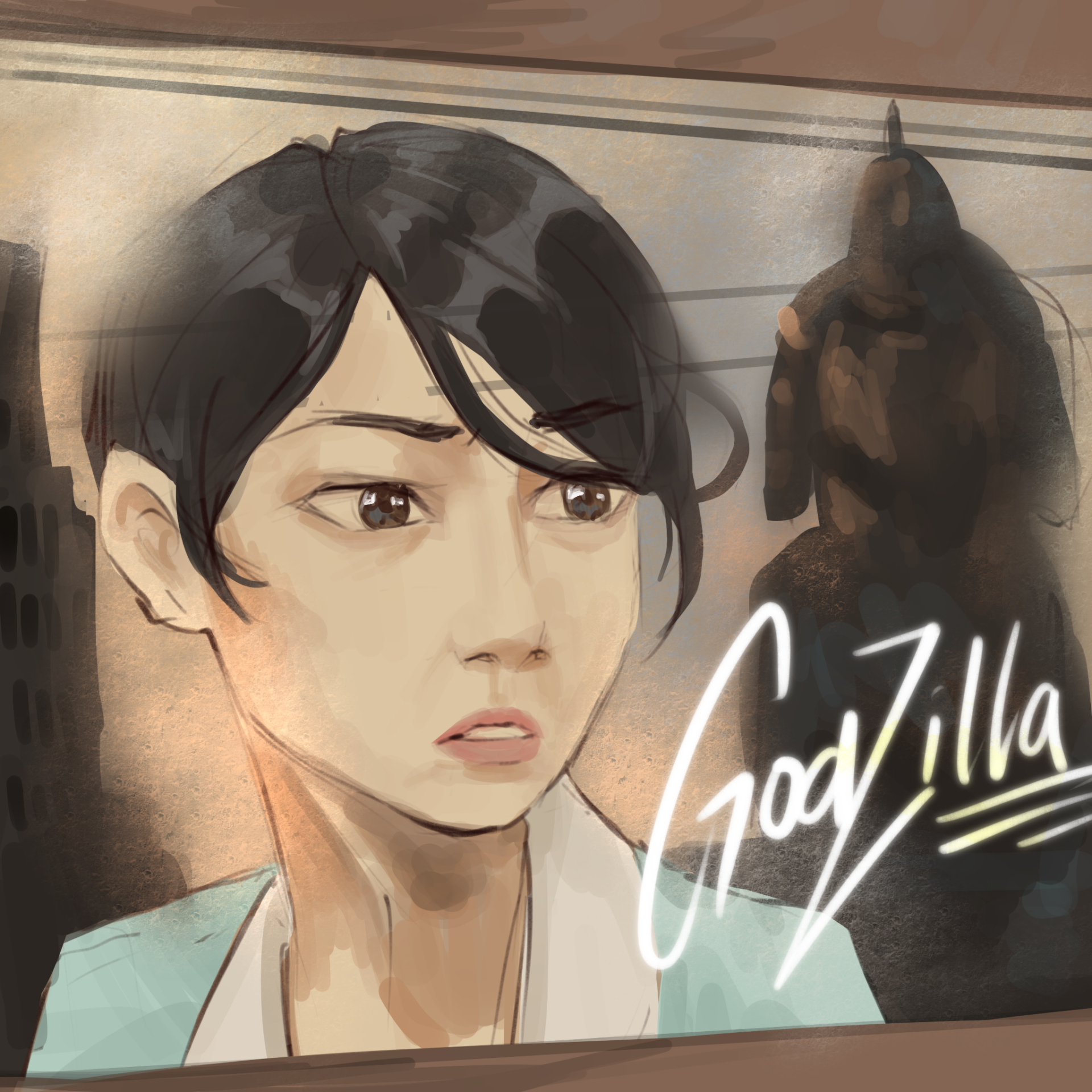

The Godzilla franchise has always been about the spectacle: large monsters fighting as the humans stand and watch in awe. Japanese film “Godzilla Minus Zero,” released in American theaters on Nov. 6, tries to push beyond the pure spectacle of booming, roaring monster movies by bringing in a deeper theme: the price of war.
The film picks up the story of Noriko Ôishi (Minami Hamabe) and Kôichi Shikishima (Ryūnosuke Kamiki), the protagonists of the series’ previous film, “Godzilla Minus One,” after they defeated Godzilla two years ago. As they raise their adopted child, Akiko (Sae Nagatani), they get drawn back into the world of war and monsters when a team of scientists, including head of the Large-Scale Disaster Response Bureau Kenji Noda (Hidetaka Yoshioka), meteorologist Makoto Aoyama (Masami Nagasawa) and biologist Kanji Murakami (Min Tanaka), involve them in a fight with the newest threat: a 3-headed dragon they call Ghidorah. Together, Noriko, Kôichi, Kenji and Kanji must all bring peace back to the world by bringing down Ghidorah, all while facing their trauma from Godzilla and World War II.
In the first film, Kôichi is grieving after surviving World War II as a kamikaze pilot. The newest film similarly tries to bring human stories to the core of a story about fictitious monsters, ultimately bringing war commentary and greater meaning to the movie.
However, in “Godzilla Minus Zero,” the film stretches character trauma across various people, diluting the astute, narrowed trauma of the prior film. For example, it follows Akiko’s fears of abandonment as the others leave her to fight Ghidorah as well as Kenji and Makoto’s guilt over their failures during the war — and subsequently battles with Godzilla and Ghidorah. The darkest part is Kanji’s vengeance against the United States after World War II, and his plans to use Godzilla to give them their comeuppance.
The exploration of these four characters, however, shows the impact of war on families, those who worked during it and those who simply lived through and survived it. But balancing each sub-plot thins them out, until they all seem to be happening in the background while Ghidorah is being taken down.
Due to this and the introduction of another monster, “Godzilla Minus Zero” feels more like a generic monster movie when compared to its predecessor. As the novelty of Godzilla wears off for both the audience and the characters after the first film, Ghidorah has to one-up his horror. To keep the stakes, however, he still has to be feasible to fight.
As the film climaxes to a brawl between Godzilla and Ghidorah, a good portion is dedicated solely to long sequences of Ghidorah growing two new heads or Godzilla regenerating an entire arm. These scenes bring the film back to the intrigue of seeing these large monsters interact, rather than the human side of the story.
Despite this, “Godzilla Minus Zero” continues to stand out within the genre through its aesthetics. Occasionally, extremely creatively framed shots make otherwise standard scenes interesting to watch. For example, during the fight between Godzilla and Ghidorah, a point-of-view shot through Kenji’s broken glasses shows Ghidorah struggling to break free from a liquid nitrogen trap the scientists set up while he struggles to get out of rubble. This once again brings the human perspective into a premise that is fundamentally unrealistic, breaking up the monotonous shots of the monsters fighting with humans watching on the sidelines by highlighting Kenji’s first person perspective.
Not to mention, the score of this film keeps the tension high and audiences at the edge of their seats. Ghidorah’s theme, “Eclipse,” consists of a quick punch of intense violins, bringing the perfect amount of shock and anxiety whenever he comes on screen. On the other hand, Godzilla’s classic booming theme, “Godzilla Suite,” powered by percussion and brass instruments perfectly contrasts Ghidorah’s music. This distinguishes the two characters when they’re on screen and signals to the audience who has the upper hand and who they should really be afraid of.
Overall, “Godzilla Minus Zero” is a beautifully crafted, more intense version of a monster movie. With incredibly serious themes of war and trauma, the film brings in human elements to a genre that usually lacks them. However, by trying to follow every character’s arc, some of these themes get diluted by the others. This results in an emotionally confusing film with the overall look of a classic Godzilla movie, but with an array of underlying darker commentaries, leaving audiences contemplating the effects of war rather than just the spectacle of Godzilla.
Shannon Kunz is an Arts & Entertainment Intern for the fall 2026 quarter. She can be reached at skunz1@uci.edu.
Edited by Corinna Chin and Geneses Navarro.

Interested in becoming an intern or a contributing writer for the Entertainment section?
Contact us at entertainment@newuniversity.org!