

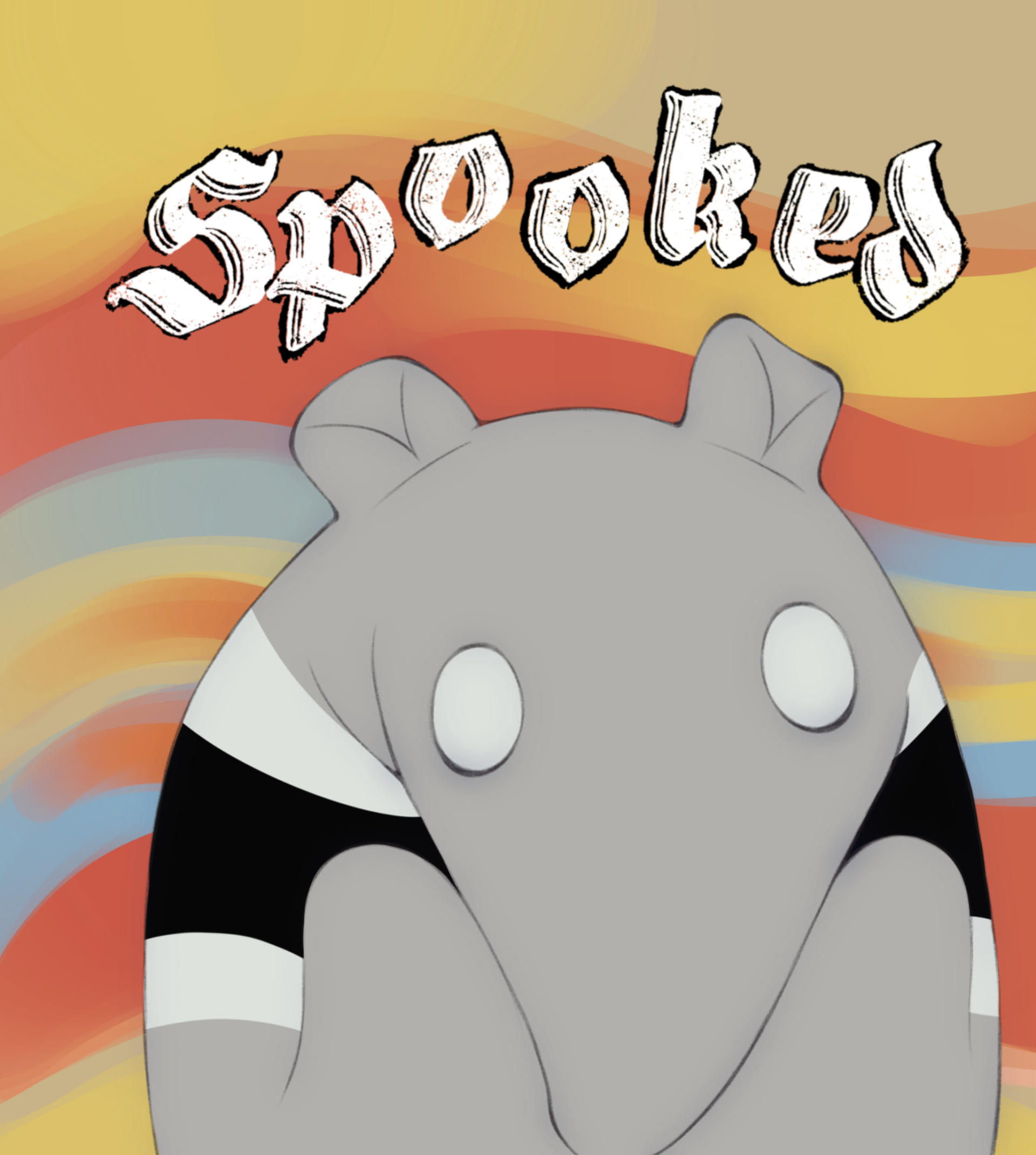

The doorknobs rattling in the wee hours, murmured, wordless conversations, a blurry silhouette through the shower’s frosted glass; these chilling scenes come from the latest season of KQED and PRX’s “Spooked,” the acclaimed podcast hosted by charismatic producer and storyteller Glynn Washington. Kicking off on Oct. 2 with “Goblins of Eastern Kentucky,” season 11 has come to a head in its latest story “The Shadow Guest,” released in two parts on Oct. 16 and 23 respectively. Yet, these are only the latest in a near-decade long legacy of supernatural storytelling.
Originating in Sept. 2017 as a segment on NPR’s podcast “Snap Judgment” — also hosted by Washington — “Spooked” had modest beginnings as “Campfire Tales,” where short true-life supernatural stories were told firsthand in anticipation of Halloween. However, as fans’ desire for ghost stories grew, the segment was soon developed into its own podcast. As Washington describes it, “Spooked” is something of a sister podcast to “Snap Judgment,” which mixes true stories with a cinematic, immersive sound design. But where the latter is for listeners who “like [their] storytelling in the bright light of day,” the former offers stories of a darker, paranormal nature.
“The Shadow Guest” follows the story of “Spooked” guest Angelo and his wife Leanne. In 1989, the couple acquired land on the edge of the Blackfoot Reservation in Montana, where they would cultivate a community center with trailers providing emergency housing for families facing eviction or needing housing support. To make ends meet and support his own family, Angelo took a job with the local mortician — a job that often consisted of picking up the deceased. “The Shadow Guest” begins one dusky evening in the foothills of the Rocky Mountains, when Angelo passes the aftermath of a violent car accident on his way back from a pickup. Further down the road, he finds his childhood friend Jason walking alone with a duffel bag. Except he’s acting odd; strangely detached and eerily silent, Jason isn’t being Jason.
A striking aspect of “The Shadow Guest” — indeed, “Spooked” as a whole — is the sense of authenticity in its storytelling. Sound design is measured and tactful, embellishing rather than hyperbolizing the narrative. Sound effects further immerse listeners, bringing them closer to Angelo’s haunting reality. In the soft hum of crickets, a thumping heartbeat, a rapping on the removal van door, the story comes to life.
What is even more effective, however, is how the sound design punctuates the emotional tone of the narrative. Scratchy, droning tones crescendo, dissonant with eerie, minute plucking, making the hairs on one’s neck stand on end. Whether tuning in while cooking, cleaning or on the move, these powerful moments of aural intensity will have listeners glancing over their shoulders, no matter how certain they are that they’re alone in the room.
Admittedly, skeptics may be characteristically skeptical at the notion of “true ghost stories,” and the term may even seem oxymoronic. Yet, “Spooked” does not aspire to persuade its listeners to believe in the supernatural. Indeed, this writer is reluctant to describe the podcast by the conventional genre labels of “horror” or “thriller” because of its very refusal to shout “horror” or “thriller” to its audience. The horror genre typically uses violence, paranormal beings or distorted perception to elicit fear and shock. This term feels too audacious for “Spooked,” best reserved for “The Conjuring” movies or many a Wes Craven flick. Thrillers are aimed towards building anxiety and tension, often more grounded in reality and involving mental puzzle-solving, à la David Fincher’s “Se7en.”
Where a horror movie will show bloodthirsty evils and a thriller will bring life-or-death stakes, “Spooked” modestly walks a middle path. Lacking any overindulgence in graphic imagery or a protagonist/antagonist dichotomy, each story feels distinctly lived. Whether listeners believe that the stories are real or not is another question altogether — one that “Spooked” humbly asks rather than answers.
To that end, many episodes of “Spooked” conclude with the guest’s appraisal of their experience. After the ghost story has been told, they often reflect on who the spirit was, why they appeared when and where they did and even thoughts of compassion. This closing touch in each story is itself a bid for connection; regarding the unknown — a mercurial, cryptic, primordially frightening concept — with empathy is an act of profound humanity. The storytelling in “Spooked” refuses to wield violence to make audiences feel more alive — though there is certainly a time and a place for Michael Myers. “Spooked” instead opts to consider our fear with curiosity, suggesting that when we humanize the other, we empower ourselves to learn from what frightens us.
This is the case with “The Shadow Guest,” in which Angelo pieces together the mysterious fragments of his story. He contemplates the strange events he’s witnessed since welcoming Jason into his home. Perhaps, as the beyond reached for one of their unclaimed, his family was merely caught in the middle. But even as his doubt turned to desperation, Angelo responded with tenderness. Meanwhile, his mother has a prophetic dream of him and Leanne helping an unknown man, highlighting the simple power of humble generosity.
Of course, not every episode of “Spooked” boils down to the love story within the ghost story. Some episodes are downright bizarre, as if out of “The Twilight Zone” — see “Time Warp Saloon” from “Spooked” season one, episode two: “Lost In Time.” Capable of inflecting stories in different tones, the podcast explores from diverse angles the questions surrounding the supernatural: to what extent do we carry the past with us? Who is listening when we pray to the unseen? Through every century and on every continent, why does the dark always seem to talk back?
In “The Shadow Guest Pt. 2,” these questions are explored not only through the third act of Angelo’s story, but Washington’s own retelling of the biblical parable of Cain and Abel. Powerfully reformulated, Washington speaks in the voice of Cain, the elder of Adam and Eve’s two sons, who famously slew his brother after being spurned by God. In Washington’s version, however, Cain’s struggle is not a simple battle between sin and virtue; his unthinkable act is preceded by the generational suffering of their parents’ fall from Eden — and the suffering this wrought upon the brothers. Indeed, from beginning to end, Cain ceaselessly acts as his brother’s protector — a sophisticated spin on the question he famously asks God in the bible when questioned on Abel’s whereabouts: “Am I my brother’s keeper?” In this existential reimagining, Washington encapsulates the core of “Spooked.” The factuality of a story becomes irrelevant, because whether it is fact or fiction, it unquestionably contains truth.
As the darker months approach in the northern hemisphere, “Spooked” is the perfect impetus to slow down, cozy up and contemplate. While the stories are certainly entertaining, their thought-provoking nature invites deep introspection. “Spooked” astutely executes this key aspect of good ghost stories: in the darkness, when the stakes are high and the variables unknown, we come face to face with what truly matters to us.
Sean Watanabe is an Arts & Entertainment Intern for the fall 2026 quarter. He can be reached at seanlw@uci.edu.
Edited by Corinna Chin and Zara Baker

Interested in becoming an intern or a contributing writer for the Entertainment section?
Contact us at entertainment@newuniversity.org!