

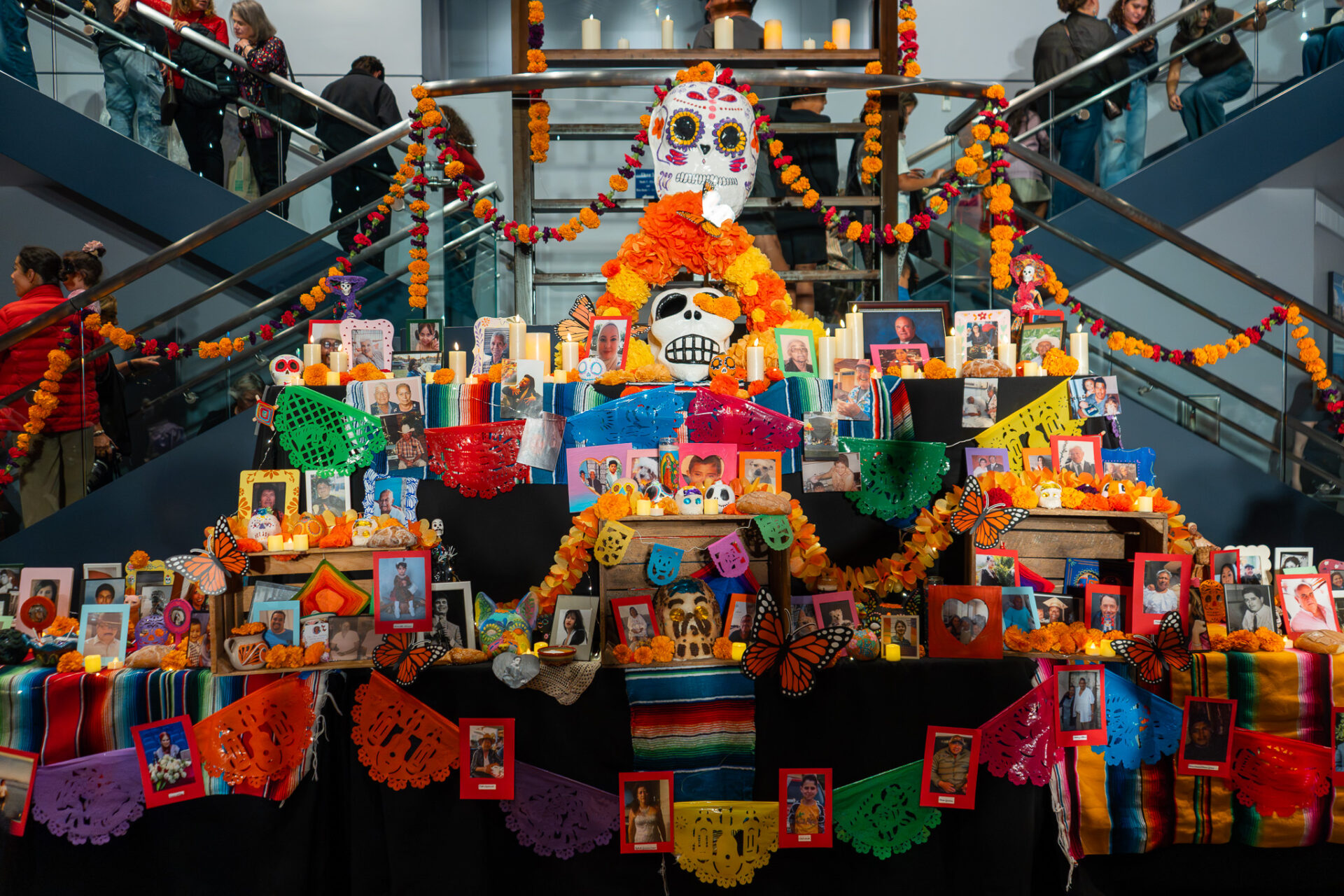

The UCI School of Social Ecology invited students, faculty and community members to remember deceased loved ones through a physical and digital altar for its fourth annual Día de los Muertos celebration at the Irvine Barclay Theatre on Nov. 2.
The smell of steaming tamales wafted through the air as Anaheim Elementary School District All-Star Mariachi, Baile Folklorico de Price Elementary School and Grammy Award-winning Mariachi Divas took the stage. Orange marigolds, “cempasúchiles,” adorned every corner.
The digital altar consisted of photographs and written tributes of up to 100 words submitted online, bringing individual memories into a collection that remains available after the event.
Submissions include a photograph, the deceased person’s name, date of birth, date of death and a short dedication. Organizers also accept tributes to pets, and contributors can participate even if they do not include dates or a written remembrance. A video of the submissions is prepared and runs on large television screens inside the theater.
Director of Communications for the UCI School of Social Ecology Mimi Ko Cruz proposed the digital altar to Dean Jon Gould ahead of UCI’s first Día de los Muertos event in 2023. She wanted the digital altar to extend participation beyond the students contributing to the physical altar inside the Barclay.
“Anyone can contribute, and it’s great because everyone loses someone,” Cruz told New University. “This is not a Mexican thing, it is a universal thing. [It] doesn’t matter what culture you are, what country you’re from, everyone loses someone. This is a good way to honor their memories.”
Cruz estimated that organizers received about 45 tributes this year. She said participation has grown as more people learn about the opportunity, including community members outside UCI.
The photographs also remain online after the celebration, allowing the collection to accumulate across years.
“That stays up on our website forever,” Cruz said. “We’ve had ones that we got from the very first year that are still on there. And then every year we just add whatever comes in. We just keep adding.”
The process of remembering also involves remembering their story and what they passed on to the people around them.
“This is such a great tradition because you take a day or two in the year when you set aside time to think about your deceased loved ones,” Cruz said. “You think about their stories, their hopes and their dreams. You remember the lessons that they’ve taught you. That’s why it’s so meaningful.”
Alongside the digital collection, students from Movimiento Estudiantil Chicanx de Aztlan (MEChA) helped build the physical altar. Fifth-year sociology and Chicano/Latino studies major Aransa Sanchez, one of the organization’s co-chairs, also helped construct last year’s altar.
Sanchez described the work as a responsibility to the people who submit photographs of their loved ones. Preparing the altar requires students to consider whose lives they are honoring as they arrange the materials.
“I think taking the time to build something in a way that’s intentional is really important because you have to remember who you’re doing it for,” Sanchez told New University. “You’re celebrating the lives of so many people’s loved ones because they submit photos for us to print out. It’s something that we take seriously.”
This year, students spent time making decorations, including paper marigolds. They also held a frame-painting activity where participants could bring photographs and decorate frames for their loved ones.
Sanchez emphasized using available materials and making decorations by hand, connecting that work to the time participants devote to remembering someone, rather than purchasing new decorations.
“A lot of what Día de los Muertos is [about is] decorating with what you have and not really going out of your way to buy new things because I think it’s a holiday that, ever since ‘Coco,’ has become very commercialized,” Sanchez said.
Traditionally, food and drinks are part of the altar as offerings that help loved ones on their journey back to the living, as well as “papel picado” or perforated paper, candles, incense and water. The involvement of the four elements is an important aspect of the altar: papel picado as air, candles as fire, copal incense as earth and water.
Preparing the altar can open conversations among friends about people they have lost.
“It’s something that continues to make me emotional because I have friends who have also lost people,” Sanchez said. “I think it’s nice because it kind of opens up a space for us to talk about people that maybe we don’t get a chance to talk about anymore. It tends to be around this time that people are more open to having those conversations.”
Sanchez wants participants unfamiliar with Día de los Muertos to consider the communities behind the tradition.
“I think it’s great that so many people want to engage in this tradition because it really is a beautiful one,” Sanchez said. “But also remembering that our culture doesn’t deserve to be cherry-picked, right?”
Appreciating the celebration should accompany support for those communities and attention to the challenges they face.
“This is a very beautiful thing, but at the same time, if it’s something you choose to celebrate because aesthetically, you find it pleasing or because you like the story behind it, it’s important to understand the struggles that are going on in our community right now with the racialized ICE raids,” Sanchez said.
At the Barclay Theater, the event’s music, dancing and other activities provide a setting for remembering loved ones through celebration. The digital altar allows those memories to remain permanently, even after the holiday ends.
“When they’re looking at the altar, they feel like [their] loved one is not forgotten,” Cruz said. “They will always be living on, and this is one way to show that you remember your loved ones, and you remember their stories … It’s very joyful. It’s not a sad time. It’s a time to remember your loved ones in a very happy, uplifting kind of way.”
Ashley Liau is a Features Intern for the fall 2026 quarter. She can be reached at liaua@uci.edu.
Edited by Ennes Kahf and Geneses Navarro.