


About 230 doctors, students, health care professionals and non-profit members gathered in the lobby of the Beckman Center of the National Academies of Sciences and Engineering for the 12th Annual Women’s Health Summit on Nov. 20.
The summit began in 2012, when the Orange County Women’s Health Project launched the event to bring together health care providers, nonprofits and researchers to address women’s health disparities countywide. The event found a new home at UC Irvine’s Joe C. Wen School of Population & Public Health in 2022.
“While the themes and speakers change every year, the heart of the summit remains the same,” Katelyn Ogawa, communications and media manager and a member of the planning committee, told New University in an email. “One thing that’s familiar is that we continue to sell out and the conversations are always engaged, lively and thought-provoking.”
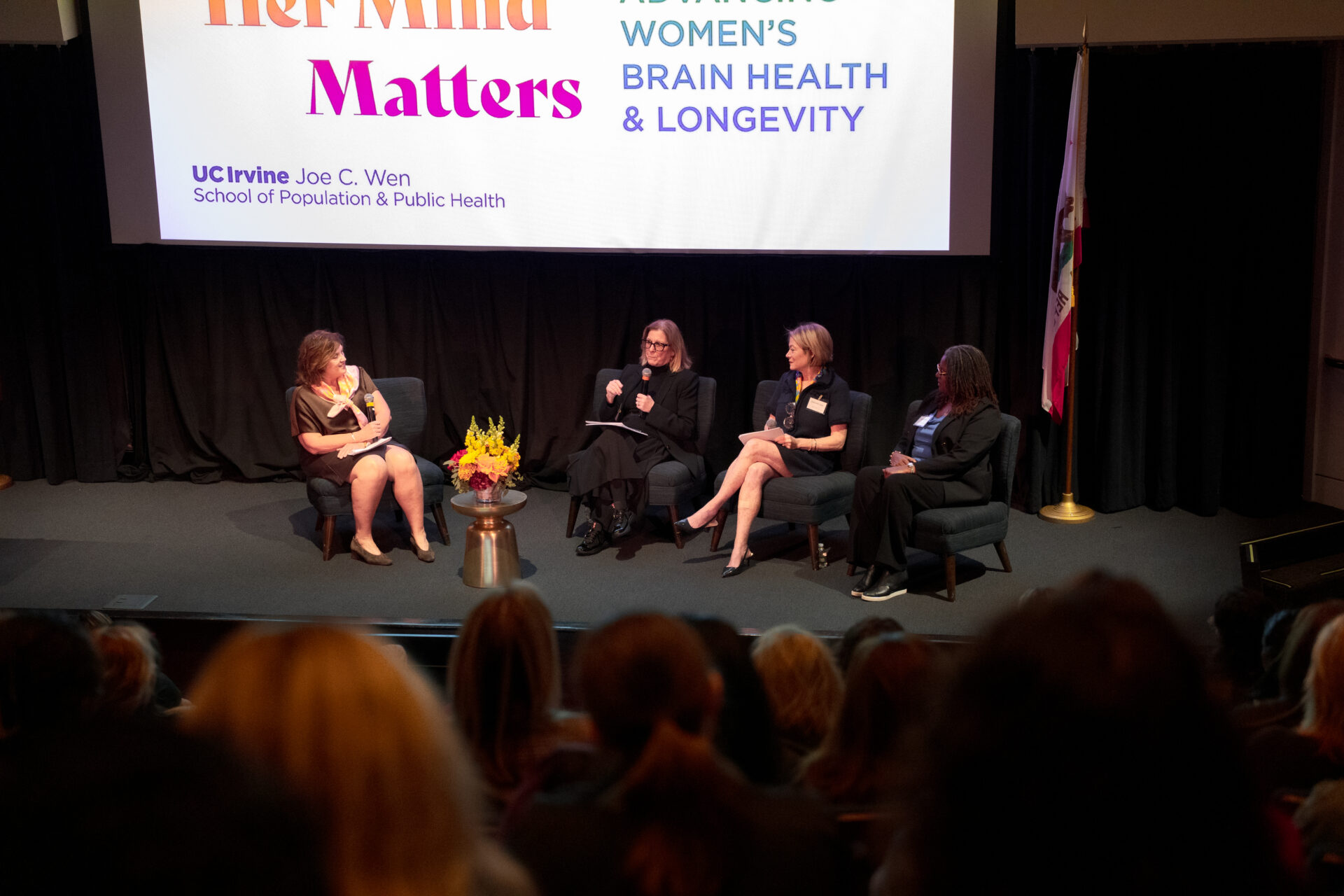
This year’s theme, “Her Mind Matters: Advancing Women’s Brain Health and Longevity,” was suggested by attendees the previous year and selected by the event organizers, a tradition that continues into this year’s summit as well.
“Brain health intersects with so many other aspects of women’s health — from cardiovascular health and hormonal changes to mental health, sleep, social connection and aging,” Ogawa said.
The summit opened with a keynote presentation on women’s brain health and factors that affect it by Stroke Branch chief and Senior Investigator at the National Institute of Neurological Disorders and Stroke Dr. Rebecca Gottesman.
Following the keynote speech, a panel discussion moderated by founding dean of UCI’s Joe C. Wen School of Population & Public Health and professor of health, society and behavior Dr. Bernadette Boden-Albala, featured professionals discussing women’s brain health from their respective fields.
Although the attendees and panelists came from different backgrounds, they were all focused on the lack of attention women’s health care receives. One attendee, Amrita Bedi, a third-year biomedical engineering student at UCI, echoed those concerns.
“You keep hearing about so many advances in cardio or neurovascular [health], but women’s health has just not been keeping up with it,” Bedi told New University.
Bedi and her team, working under Dr. Christine King, an Associate Professor of Teaching in the Department of Biomedical Engineering, presented their research during the summit’s poster session alongside other student researchers.
Their research focused on postpartum hemorrhage, the leading cause of maternal deaths worldwide. For Bedi, the underrepresentation of women’s health was personal.
“I’ve seen women in my family go through it,” she said. “So before even coming to university, I always knew I wanted to be involved here.”
Nonprofits also played an important role in the event. Naomi McKell, events manager at Illumination Health and Home, attended the summit to learn how to better support her clients.
Illumination Health and Home, a homelessness nonprofit, serves Orange County, the Inland Empire and Los Angeles. About 71% of its clients are women, McKell estimated, many of whom are seniors or medically frail. The organization provides care for people recovering after a hospital stay. The gaps in health care discussed at the summit affect many aspects of McKell’s clients’ lives.
For McKell, the challenges women face are interconnected. The relationship between brain health and factors such as race, income, housing and caregiving also emerged during the panel discussion.
Moderated by Boden-Albala, the panel brought together chair of neurology at the UC Irvine School of Medicine Dr. Claire Henchcliffe, professor of environmental and occupational health and director of UCI’s Center for Environmental Health Disparities Research Dr. Karen Lincoln and executive director of the Alzheimer’s Association Orange County Chapter Deborah Levy.
When Boden-Albala asked why women remain underrepresented in clinical trials, Henchcliffe described a gene therapy trial presented at a national conference that included only one woman among 12 participants. When Henchcliffe asked the male researcher why, he said he was unsure and suggested women might be more risk-averse.
“Let that sit with you for a minute,” Henchcliffe told the panel audience. “That’s an explanation that doesn’t really fly.”
Lincoln said that if asked, many people, particularly Black Americans, are willing to participate in clinical trials that affect their health but aren’t given the opportunity.
Boden-Albala said the exclusion of women from research can have real consequences, citing the sleep drug Ambien, which had worse effects on women that weren’t known until after it reached the market.
“This is a matter of ethics. It’s a matter of social justice. It’s a matter of biology,” Boden-Albala said to the audience.
During the panel’s question-and-answer session, an audience member asked how women could get doctors to take their symptoms seriously.
Lincoln challenged the premise of the question, pointing to California Health Care Foundation research on what she called a “triple jeopardy” of race, age and gender. Women already change their behavior to be heard.
“We’re getting smaller. We’re not asking questions. We’re trying not to come off as hostile,” Lincoln said. “We should not have to do that.”
In one of her recent studies on brain health, Lincoln included a measure of how patients felt about their interactions with doctors. She told the audience that patients with positive interactions had better brain health, while those with negative interactions had poorer brain health.
Henchcliffe drew on her own experience as a patient, recalling that an emergency room once diagnosed her “some kind of hysterical woman.” As a department chair, her advice to the audience was to seek another doctor if their current one is not taking them seriously.
Levy, a cancer survivor who cares for an aging parent and a child, said women must prioritize their own health in a system that often overlooks them.
“How many of you put something off for your health this past week because you were taking care of something for somebody else?” she asked. “Nobody’s going to do it for you.”
When Lincoln was asked what should change within those systems, she drew on her and Henchcliffe’s experiences working in research spaces dominated by white men.
“I think women should lead,” Lincoln said. “And I think it needs to be a diverse group of women.”
Lincoln said research that begins with the communities most at risk benefits everyone. She recalled a lesson she regularly teaches in her classroom.
“Your lived experience is your superpower,” Lincoln said.
The lived experiences of the participants, from their work to their education, brought them together at the summit. Students like Bedi had the opportunity to meet and connect with professionals who could help move their work during an event focused on women’s health.
For the organizers, that was the goal of the summit: to connect people and create progress in women’s brain health.
“Learning is important, but action is what ultimately makes a difference,” Ogawa said.
Moksha Kolli is a Features Intern for the fall 2026 quarter. She can be reached at mokshak@uci.edu.
Edited by Aditya Biswas and Tracy Sandoval.