

Earlier this year, a UCI Reddit thread pointed out the appearance of a UCI professor in the Epstein files. Now, UCI Distinguished Professor of Psychology; Criminology, Law and Society; and Law Elizabeth Loftus is the protagonist of a documentary that fails to engage with her critics.
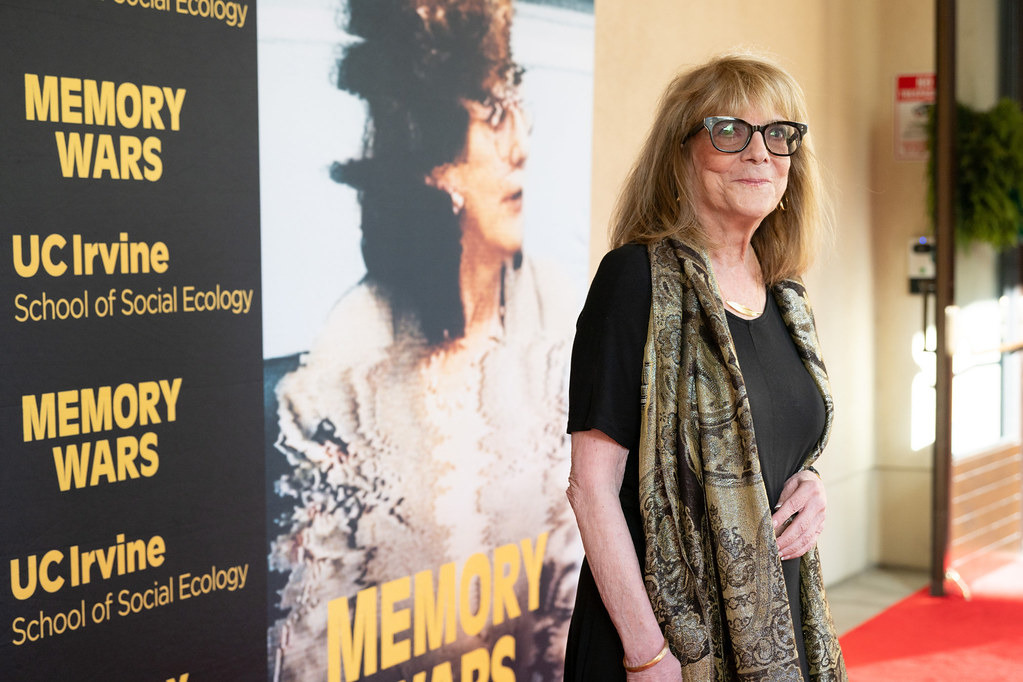
The UCI School of Social Ecology hosted a screening of the documentary “Memory Wars” followed by a panel discussion and reception at the Beckman Center of the National Academics of Science and Engineering on Nov. 12.
It was more than just a film screening, but a celebration of the life and career of Loftus. She posed on a red carpet at the entrance of the venue where she took pictures with attendees — many of them her colleagues and students. She has been prominent in her field since the ‘90s.
She was mentioned in the Epstein files due to her role as an expert witness for the defense of Ghislaine Maxwell in 2021. The case was one of over 300 trials that Loftus has testified or consulted for. She has garnered a reputation for aiding in the defense of some of history’s most notorious criminals like Ted Bundy, Harvey Weinstein, Bill Cosby and even the police officers who beat Rodney King.
Loftus has spent her career researching memory and its fallibility. Specifically, her work centers around concepts such as the misinformation effect, false memories and the flaws of recovered repressed memories. She argues that eyewitness testimony is often not reliable. Her work has been trailblazing for the study of memory, yet highly controversial as it has contributed to the discrediting of child sexual abuse victims.
“Memory Wars,” directed by Hendrik Löbbert, first debuted in German cinemas in September 2025. The film examines the psychologists’ professional and personal life with a focus on Loftus’ role in the “memory wars” of the ‘90s: an intense societal debate over the validity of resurfaced memories of childhood sexual abuse. Loftus led the charge in dismissing recovered memories and asserting that they are often planted by therapists.
Given the divisive topic, it was inherently engaging. But any hopes of an in-depth critical exploration were crushed by its commitment to a one-sided narrative. The film was defanged by the decision to allow Loftus overwhelming control over her portrayal; she dictated the terms through which viewers understood her actions and their consequences. The film only interviews Loftus and fails to take a critical distance from its subject. Löbbert reportedly spent six years working with her. This level of access provided him with a few intimate details of her personal life, yet failed to provide a truly revealing account.
Instead of taking the opportunity to consistently challenge Loftus’ explanations or investigate the perspectives of her critics, the documentary often takes her claims at face value. He could have interrogated her complex legacy. But the documentary only offers a narrow, sympathetic portrait that leaves the most important questions about her work unanswered.
Serious questions, like the role of her financial incentive, are introduced but rarely explored in meaningful depth; for example, moments of tension in her cross-examinations on the witness stand are dismissed or laughed off. At one point, Loftus reads out the hate mail she has received via email. One critic asked her how she would feel if her daughter was a victim of sexual violence, given her position, while another insulted her with profanity. The serious nature of these words is treated as a moment to laugh at the uncontrollable emotions of her opposition, which felt like a missed opportunity to delve into more vulnerable territory.
The narrative that Loftus is unjustly persecuted for her opinions is incomplete because it never seriously engages with her critics. There are contradictions in her claims that are brushed over, such as Loftus stating that she acts with neutrality as an expert witness, committed only to science. The film fails to reconcile this with her focused effort to discredit those who have made accusations of sexual abuse.
The documentary praises her work and career while carefully avoiding mentions of her missteps. She has admitted that her work has never specifically studied the memory of those subjected to trauma, such as sexual assault. Additionally, she served on the advisory board of the since disbanded False Memory Syndrome Foundation (FMSF). The foundation was founded by a husband and wife whose daughter had accused the husband of sexually abusing her. FMSF has been condemned as an organization functioning entirely with the purpose of destroying the credibility of child sexual abuse victims. Additionally, one civil lawsuit and two ethics complaints have been filed against Loftus due to concerns with her personal investigations and public representations of victims.
The approach to Loftus in “Memory Wars” is particularly disappointing given the increasing relevancy of her work surrounding sexual abuse. Given how the crimes of Jeffrey Epstein and his co-conspirator Maxwell have dominated public discussion for the last several years, one might expect the professor’s testimony in Maxwell’s defense to be further explored, but it receives little attention. It would have been fascinating to get a glimpse into Loftus’ perspective on controversial cases after they have been decided, but the film avoids challenging her.
The film moves between many topics before fully fleshing them out. For example, it delves into Loftus’ personal life through the lens of a fire that destroyed her childhood home and her mother’s death when she was 14 years old. The personal tragedy aspect shows Loftus’ vulnerability and garners sympathy for her, but the storytelling does not meaningfully connect these events to the larger narrative of the documentary.
Ultimately, “Memory Wars” is an incomplete portrayal of Elizabeth Loftus. It acts as a defense of her reputation without exploring why she is such a problematic figure in a novel or unique way. It does, however, serve as an intriguing introduction to her research and had the potential to be truly groundbreaking, but it fell short, resolving to take the safer path.
Ayiana Grana is an Arts & Entertainment Staff Writer. She can be reached at angrana@uci.edu.
Edited by Avani Kumar and Riley Schnittger.