
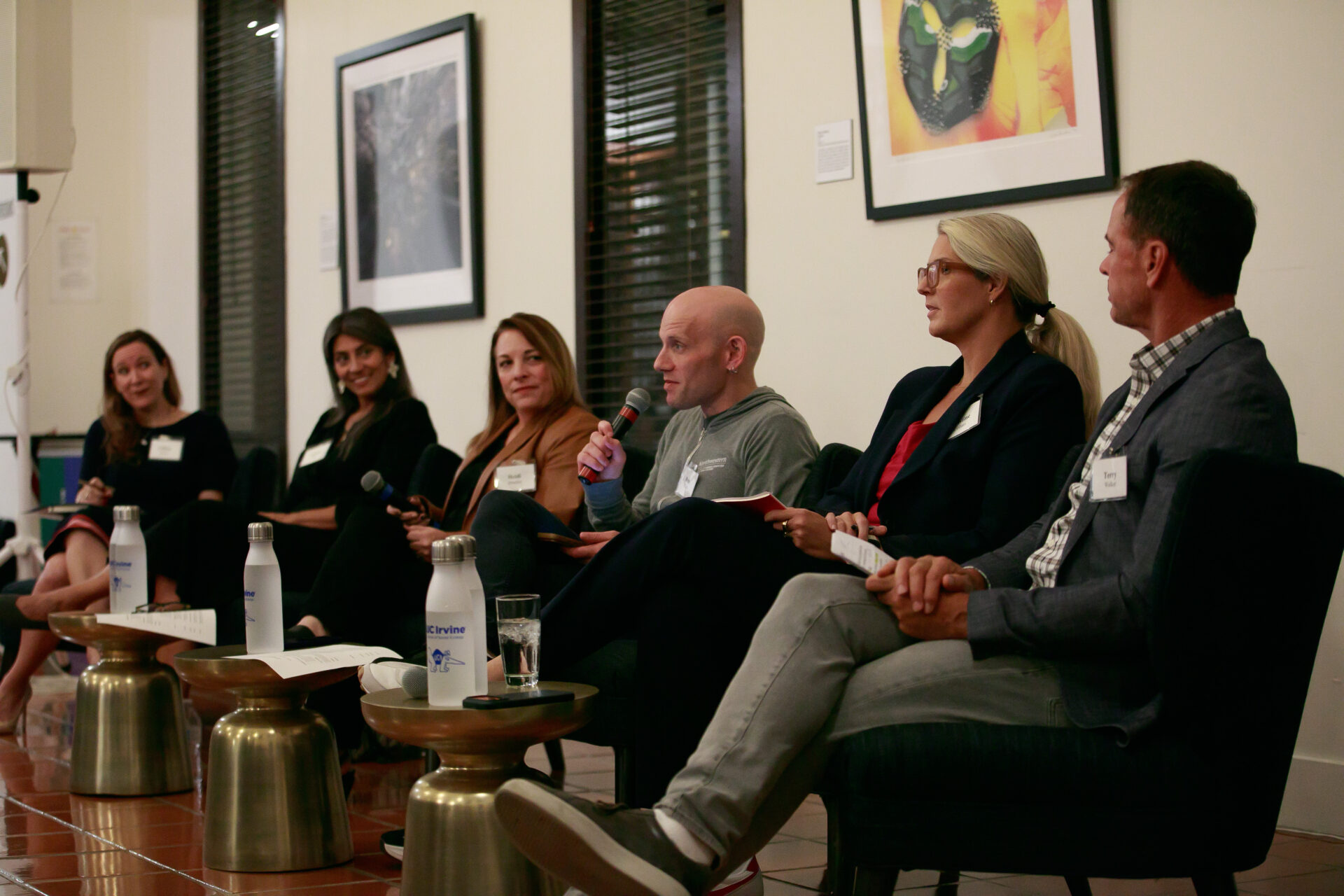

The UC Irvine School of Social Ecology, Donald Bren School of Information and Computer Sciences and Connected Learning Lab joined Connecting the EdTech Research Ecosystem (CERES) to present Beyond Bans: Preparing Our Youth for the Workforce on Nov. 18.
This event, at the Beckman Center of National Academies of Science and Engineering, was the final installment of the four-part “Raising the Next Generation in the Age of AI” series. While previous panels discussed parenting in our digital world, the finale mulled over how AI changes the youth’s education.
The event had five panelists — Project Manager at Google Heidi Bramlet, Dean of Continuing Education at UC Irvine Krissy Collins, Director of Applied Science, Microsoft Partner and Northwestern University Associate Professor Brent Hecht, Research Analyst at Digital Promise Yenda Prado and Orange County Department of Education Senior Advisor for District Relations Terry Walker.
Panelists discussed what human protections they should keep, how educators can respond to this technology and how the next generation can know the difference between artificial intelligence (AI) and human work.
Vice Provost for Academic Personnel and Chancellor’s Professor of informatics Gillian Hayes was the moderator for this event. She opened the panel with a discussion on how critical thinking will help the next generation adjust to AI.
“I do think it’s our responsibility to figure out how to protect the judgment crisis,” Hayes told New University.
Hayes is interested in exploring how K-12 schools are responding to AI technologies in their classrooms. She discussed with parents and Parent Teacher Associations (PTAs) to help plan more evidence-based policies.
“One of the groups that I’m really interested in is the PTAs and the way they sort of exert influence around policy in schools,” Hayes said.
For new tech policies to be evaluated, she believes in thorough research, not just the input of parents and school administrators. In her lab, she is studying how AI could potentially help teachers who have middle school students with behavioral challenges.
She is also co-designing work for teachers and students by adding fitness trackers, Oura rings — a ring that detects sleep, stress and exercise and Large-Language-Model (LLM)-supported analysis of children’s text messages. From these messages, she discovered that children reach out to discuss their stress with college and job search with their peers.
“If you look at what people are stressed about, they’re stressed about getting to college,” Hayes said. “They’re stressed about the environment. They’re stressed about how they’re going to get a job one day.”
Dean of Continuing Education and panelist Krissy Collins is also currently developing programs for teachers and students in response to AI in the workforce. Her career focused on nontraditional education, including the use of nontraditional spaces to help students understand media literacy.
“I think, you know, the way to kind of navigate this is just to be to read as much as you can, consume as much as you can, and form your own opinions and try not to be influenced by everything and the people around you, and just really try to understand how you want to navigate with technology,” Collins said.
Collins said she is concerned about new graduates entering the job market.
“We’re concerned about our new graduates and where they’re going to land, and we’re also concerned about people who are in their career and they’re being disrupted by different technologies,” Collins said.
Hayes said she is worried about AI models with data biases of gender, race and people with disabilities
However, AI can also be beneficial — Hayes said AI can be an assistant in organizing large data and schedules. In her study on the Sandwich Generation, which refers to younger adults who are simultaneously taking care of their kids and parents, many caregivers are managing their finances and data streams through multiple platforms.
“They’re scheduling things like crazy. I mean, they’re interfacing with tons of different systems and tons of different technologies. And I think this is a place where having your own caregiving agent could actually be incredibly useful,” Hayes said.
Collins, on the other hand, said AI can be leveraged in students’ work to help them achieve a work-life balance.
“We could work less and spend more time on our hobbies and with our families and the people we love, and just not be so focused on constant productivity and capitalism, but just really focus on doing a very good job and being thoughtful about our work, but also freeing up some of our time and space to live,” Collins said.
Panelists also discussed agency in how young employees use AI in their workplaces and education.
“They can actually make really thoughtful decisions about how they implement AI in their companies and what jobs they impact and how jobs are rearchitected and changed,” Collins said.
Collins hopes that the next generation can continue to use AI responsibly and work together to navigate these platforms.
“Everything’s going to change. Technology is going to change. The work’s going to change. But what remains is humans, and human beings need to connect and need to work together,” Collins said.
Melody Liao is a Features Staff Writer. She can be reached at liaome@uci.edu.
Edited by Avery Rosas and Tracy Sandoval.

Interested in becoming an intern or a contributing writer for the City News section?
Contact us at citynews@newuniversity.org!