
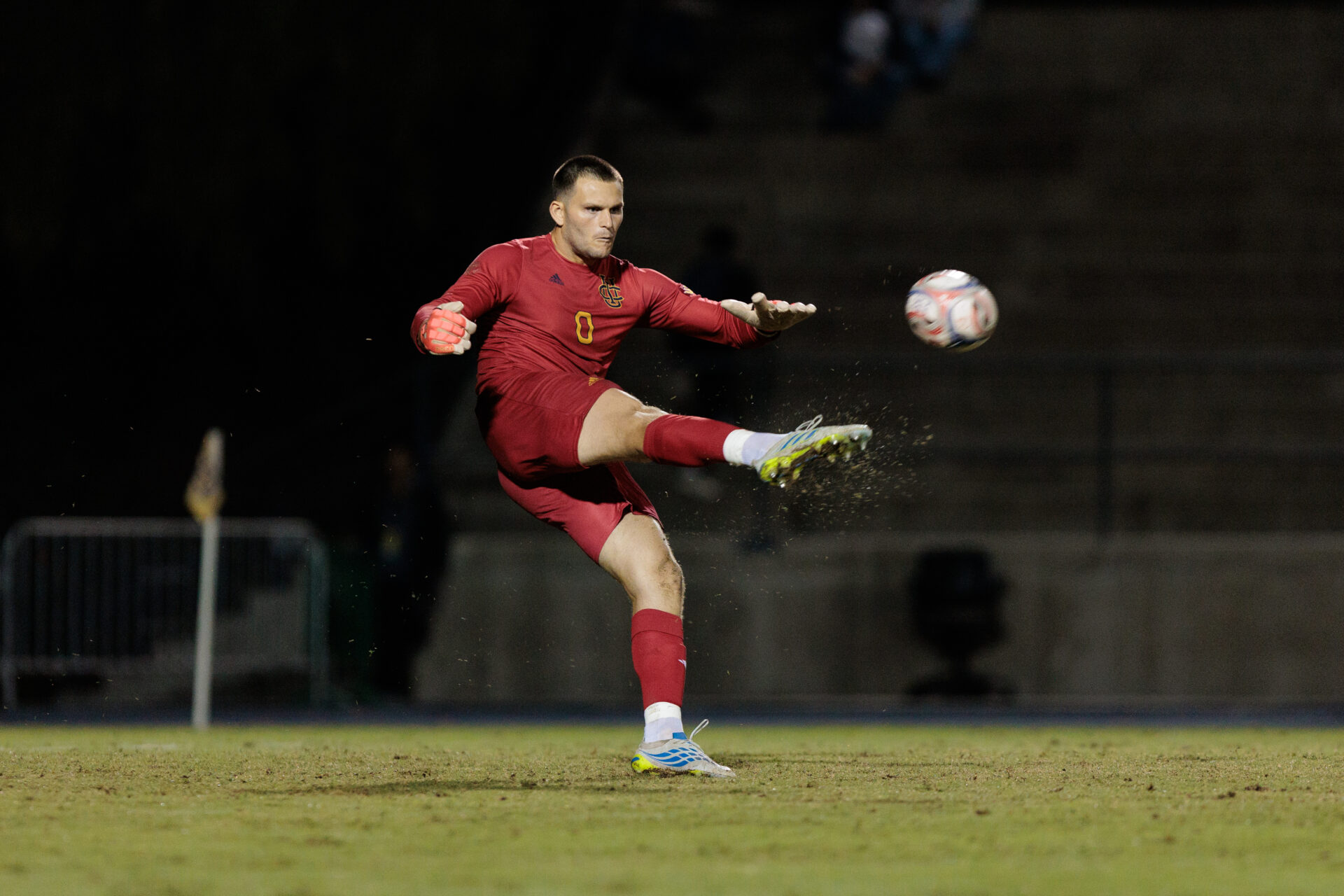

Sixth-year goalkeeper Scott Williams, a business economics major at UC Irvine, finished off a season for the history books as UC Irvine’s primary backstop. He led the Big West in Goals Against Average (GAA), saves and shutouts per game. His campaign culminated in a spot on the All-Conference First Team and his enthronement as the Big West’s Goalkeeper of the Year.
Williams’ resilient story fundamentally underlies his character. Well-spoken, composed and endlessly humble, it carried him through three universities and over five years of relentless struggle.
It all began in his hometown of Cincinnati, Ohio. Born into a tennis family, he says never quite “took to it.” Instead, soccer — and within that, goalkeeping — came much easier.
“Everyone tries all sports, whether it’s basketball, soccer, tennis. So, for me, I had weird sensory issues as a kid. So, I never wanted to play football, but I would always love diving around,” Williams told New University in an interview. “Soccer kind of hit those two categories where I [did] not have to wear a bunch of gear but still dive around.”
After playing with a local youth team, the Cincinnati United Soccer Club, Williams briefly joined the academy team for the Columbus Crew in preparation for his entrance to the University of Virginia (UVA). Joining up with the UVA Cavaliers in January 2021, his tenure was — from the very beginning — fraught with injury. His first surgery — just two weeks before UVA’s preseason — was an operation to repair his meniscus, a vital disk-shaped piece of cartilage that acts to absorb shock in the knee. Benched for the spring, his first chance at college action was snuffed out before it even began.
Out for six months, he suffered another injury that October. This time, it was a tear to his quadriceps tendon from a “freak fall.” It required yet another surgery, one which left him with lasting pain for years as surgeons reconnected the ruptured tissue to his kneecap. It was a difficult reflection for Williams, whose calm tone was betrayed by the nature of his situation.
“Even midway through the rehab process … nothing’s feeling good, and everything hurts. Hell, I don’t know if getting back on the field was even the goal? It was, ‘Hey, can I live pain free?’” Williams said.
In May 2022, with his meniscus still in bad shape, Williams went under the knife for the third time to finish the original repair. His injured leg was measured at just 15-20% strength, according to a physical exam Williams recounted.
“It looked like I had a toothpick for one leg, and then a healthy leg on my other,” Williams said. “My healthy leg on the other side just atrophied so much, but you would expect to see at least some improvement across those six to eight months of rehab, and realistically, there was none, but we just kept on pushing through pain. Shouldn’t have been, and I still had some discomfort in my meniscus.”
He further explained that his weight and sleep changed wildly as he ping-ponged back and forward between Cincinnati and Charlottesville.
“I was fluctuating between like 220 pounds in the summer when I would go home and eat properly, and then I’d go down to like 195 or 200 pounds once I go to school.” he said.
The next couple of months proved difficult. Williams, maintaining composure, acknowledged that he felt “frustration,” and was forced to have difficult conversations with UVA’s health staff, including an unnamed “head trainer.” With recovery stalling, he took a leave of absence, returning home to both recover and get a second opinion from his family’s preferred surgeon.
Over a year and a half removed from his first injury, Williams underwent a fourth surgery to finish repairing his meniscus after going home in December 2022. With the dawn of 2023, Williams finally began to recover in earnest.
But, behind the scenes, UVA was already cutting ties. In June of 2023, a high-level athletic trainer broached the topic of medical retirement, something which left Williams “unpleased.” His case was not helped by a fifth injury: a stress fracture to his femur, attributed by Williams to the rapid physical buildup of his rehabilitation process.
UVA now refused to fund continued physical therapy with Williams’ trainer back in Ohio. His medical retirement was all but finalized over a devastating Zoom call when a sixth injury, a rehabilitation setback, forced him to shut down for another one to two weeks. Enrolled in the Spring of 2021 until the Summer of 2024, Williams hadn’t played a single minute on the field, had endured four surgeries and was now considered medically disqualified.
“On that call was my surgeon, who had said previously that I was okay — or that I would be fine — that head athletic trainer and then one of the other team [doctors]. So, how it happened? Even me and my family, we don’t really know. We don’t understand it. But maybe ‘I was just a bill to them at that point, and they didn’t want to keep me around’ is the best way that we’ve been able to make sense of it,” Williams said.
It was a difficult moment for the senior. His father, who Williams cited as being immensely supportive, was with him as he stared down the potential end to his college career. At best, his time as a Cavalier was over.
Williams refused to give up. Picking up interest from various teams thanks to his coaches’ outreach efforts, he managed to transfer to the University of New Hampshire (UNH) and played his first full season in college soccer as a fifth-year senior for the 2025 season. Reminiscing on his first match on Aug. 21, not even the composed Williams could hold back his emotions.
“It was a one-nil loss at home to Boston University after they got a lucky break and a lucky goal, kind of midway through the second half, late in the second half,” Williams said. “But I was so happy, I was so happy to have finally been able to make it to that point, to start a game, to play again, in pretty much four years. That was pretty special.”
At UNH, Williams performed admirably, finishing with a GAA of 1.28 in thirteen games played. But, by end-of-season, Williams felt he needed a change of scenery. UCI, led by head coach Yossi Raz, proved a good match as he looked for schools that winter.
“It’s not like … schools will do the homework and watch you,” Williams said. “They’ll want to see stuff that maybe you’ve made about yourself and your clips. [UCI] didn’t need that. They had seen everything at that point, and just really talking to them and getting to know Yossi, getting to know [Assistant Coach] Yonha [Adrabi], that’s where I felt really comfortable.”
Now an Anteater and fully pain-free, Williams accomplished his dream and more. At UCI, his GAA was 0.48, less than half when he was in New Hampshire. His breakout was complete. During the interview, he maintained that his own actions were a small part of his success, crediting “everyone around [him]” — from family to trainers, coaches and medical staff — for getting him to his current stage.
Although the ‘Eaters were knocked out in the first round of the Big West Championship, Williams cemented himself for the short season he was present. Through trials and tribulations, he pulled off an incredible feat, rekindling a decade-long dream to pursue professional soccer. With his final year of eligibility expired, he once more has destiny in the palm of his gloves.
Stanley Shi is a Sports Staff Writer for the fall 2026 quarter. He can be reached at szshi@uci.edu.
Edited by Jaylynn Tsui

Stanley is a second-year Global Studies and History double major. He began as a sports intern in the Spring 2026 quarter. Stanley is an avid fan of the Los Angeles Dodgers and enjoys watching both baseball and ice hockey. In his free time he also reads non-fiction.