

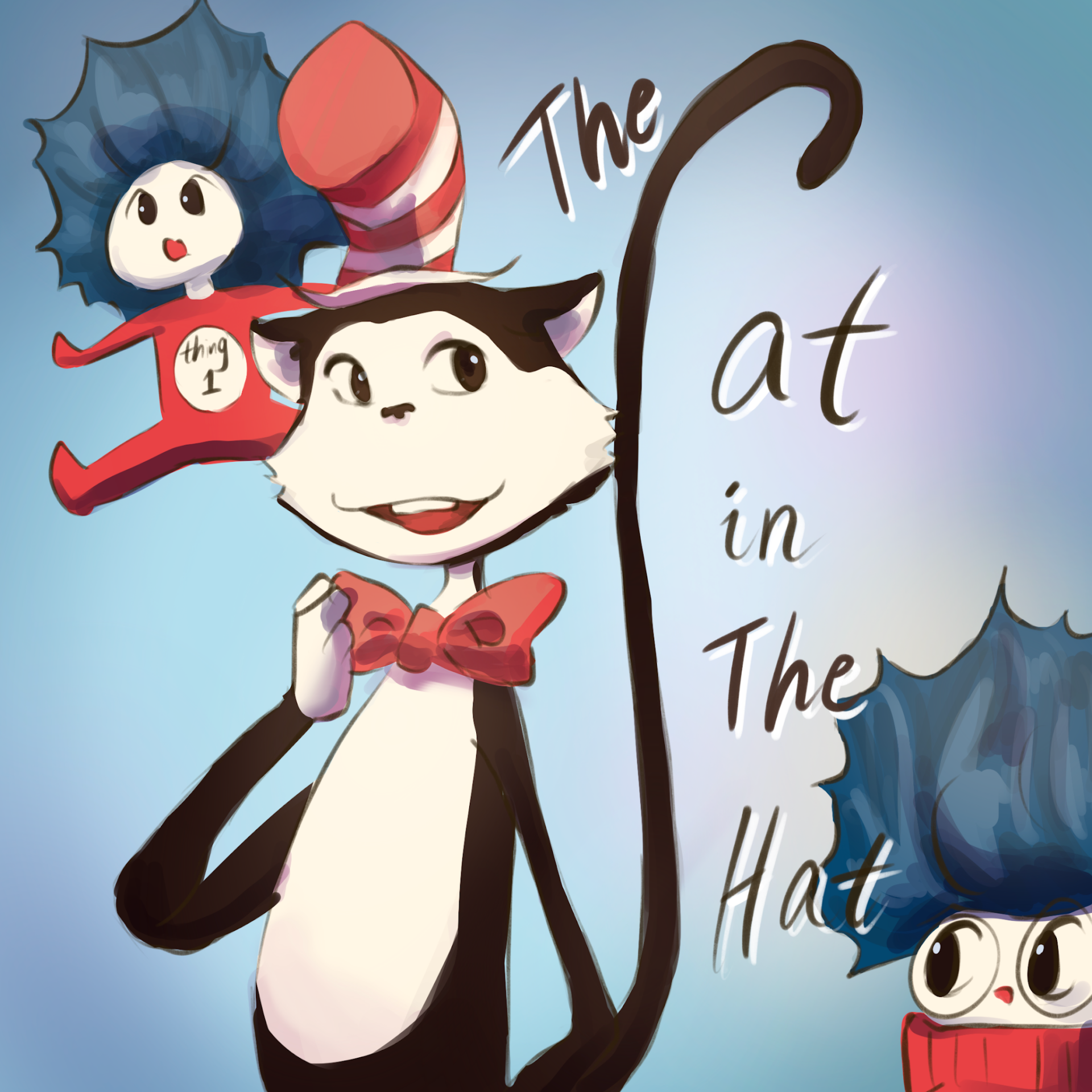

Each new Dr. Seuss film adaptation trends as less charming than the last, running on the dwindling fumes of the success of “The Lorax” adaptation from 2012. Currently, 2026 audiences are greeted by a revamped, partially-3D Cat in the Hat film with all of the typical fixings of a soulless cinematic cash-grab adaptation. Warner Bros. Pictures released the nearly two-hour film adaptation of Dr. Seuss’s “The Cat in the Hat” on Nov. 6.
The last time audiences saw Dr. Seuss’s beloved and mischievous Cat on the silver screen was in the massively over-hated 2003 live-action edition featuring Mike Myers. There is something tastefully campy about Myer’s luscious manga lashes and anthropomorphically strange cat-face. The movie was in on the joke and self-aware of the general absurdity of a live-action “Cat in the Hat.” The films’ fluorescent colors were, notably, a genuine joy to gaze upon as well.
What distinguishes these two adaptations is their intended audiences. The 2003 adaptation is a movie that could be enjoyed across all age demographics. However, 2026’s version is undoubtedly a movie for kids, with its overall sanitization and spoon-fed morals. For a movie with such playful source material, it refuses to stretch any limits, doling out the typical patronizing moral lectures to kids that would require the Cat in the Hat to come and abate their boredom in the first place.
In the original “The Cat in the Hat” picture book from 1957, there is no explanation behind why a hat-wearing cat with extraordinary linguistic inflection exists or breaks and enters the homes of children to cure their boredom. However, the 2026 film adaptation addresses this unanswered question by making The Cat in the Hat work for the Institute for the Institution of Imagination and Inspiration, LLC (I.I.I.I.) which employs magical creatures to inject joy and whimsy into the lives of miserable children. If this rings a bell conceptually, it is probably because the plotline feels inspired by “Monsters Inc.,” where the monsters use children’s fear to fuel their city. In “The Cat in the Hat,” however, the concept of the I.I.I.I. is weaker. It uses the same childish fear of creatures behind doors but replaces them with unconvincingly altruistic monsters whose sole aim is to create joy.
The movie begins with The Cat in the Hat (Bill Hader) being nearly fired by his boss, Hoogeboom (Giancarlo Esposito). He is given one last chance to prove his worth and is assigned to the siblings Gabby (Xochitl Gomez) and Sebastian (Tiago Martinez), who are adjusting poorly to a move to a new town, due to their mother’s (America Ferrera) job change. Gabby, homesick, is dissatisfied with this new environment, as well as grappling with her insecurity over being perceived as a “band nerd.” Worst of all, the family pet fish, Waffles (Matt Berry), must be hidden from their eviction-happy landlady (Paula Pell). To remedy all of this, Gabby devises a plan to undo the move by using the Cat’s Go-Backer, an object that permits the reversal of time. However, they misplace the Go-Backer and venture to recover it by searching through the pocket dimensions of each family member’s moving box.
All the while, they are under the pursuit of a creature called The Something, which chases them throughout the boxes. During their adventure, the kids discover that their mother, a previous client of the Cat, was actually very creative. This completely mystifies the children, who struggled to reconcile the concepts of “coolness” and “Mother.” Then, the eventual interpersonal conflict strikes — The Cat, who is well-intentioned, albeit havoc-wreaking at the deficit of those around him, is blamed by Gabby for making their mom “boring.” They mistakenly believed that a concert she put on in her youth at a retirement home, which devolved into chaos, led her to feel discouraged towards musical ventures. In reality, the concert was actually a hit, and The Cat helped her discover that her life’s calling was to help people, which led her into nursing.
The film champions the general moral of helping others. However, it does not delegate much time into making audiences care for the characters beyond surface-level. Because of this, the overly-explicit moral message overpowers the story. It expects its nostalgia-bait to do the heavy lifting, while failing to sustain the emotional investment of the audience. For a movie that attempts to repackage an obsolete character for a new generation, it underestimates the ability of kids to decipher well-blended moral and emotional themes. “Inside Out” is an example of a children’s movie that contains a similar coming-of-age moving scenario. However, with a significantly shorter runtime, it successfully balances character, conflict and moral.
While all of these plot antics are predictable, one of the most riveting scenes occurs between the landlady and Waffles the fish before she is about to flush him down the toilet. Moments before his demise, he surprises her with his melodic human voice, then directs her attention towards the message displayed on her bathroom decor — to live, laugh and love. And thus, the previously militant landlady is irrevocably changed. This is arguably the most redeeming comedic bit of the entire film, because it hinges on a sense of absurdity that the 2003 adaptation stylishly wielded.
Aside from the “live, laugh, love” scene, the general humor of the movie is riotous — but only for those eligible for kid’s meals. While the 2003 adaptation is rife with adult jokes, and for those unmoved by such jokes — enough absurdity to draw anyone’s intrigue — 2026’s “The Cat in the Hat” has been aggressively scrubbed. It is capitalizing on an older generation’s nostalgia for a Seussian character, at the expense of needlessly coddling the internet-savvy Generation Alpha. As a movie that is catered to kids, there is nothing to fault with this, but as a Cat in the Hat film, it falls flat.
At the end of the movie, Gabby accepts her band nerd identity and peace is made with the move. The Something, which turns out to be the missing Thing 2 — one of the Cat’s iconic, mischievous helpers — is reverted to his original form and reunited with the rest of the Things. The Cat even keeps his job at the Institute for the Institution of Imagination and Inspiration, LLC. While this resolution is neatly tied up, the movie itself was particularly bland, lacking any distinctive stylistic signature or compelling feature that would make it hold its own alongside its more iconic cousins, like “Monsters, Inc.” or “Inside Out.” It harps upon the obvious morals and themes of a kids’ movie, with a surface-level conflict resolution plotline, delivered with strained humor. This is not inherently bad, but the film’s longevity suffers; it is no cult classic.
While unintended, for adults, the sole takeaway from the film may be its function as a birth control reminder; the prospect of one’s own children using a time machine to reverse a new job opportunity is bone-chilling.
Tessa Kang is an Arts & Entertainment Staff Writer. She can be reached at tokang@uci.edu.
Edited by Travis Foley and Geneses Navarro.