

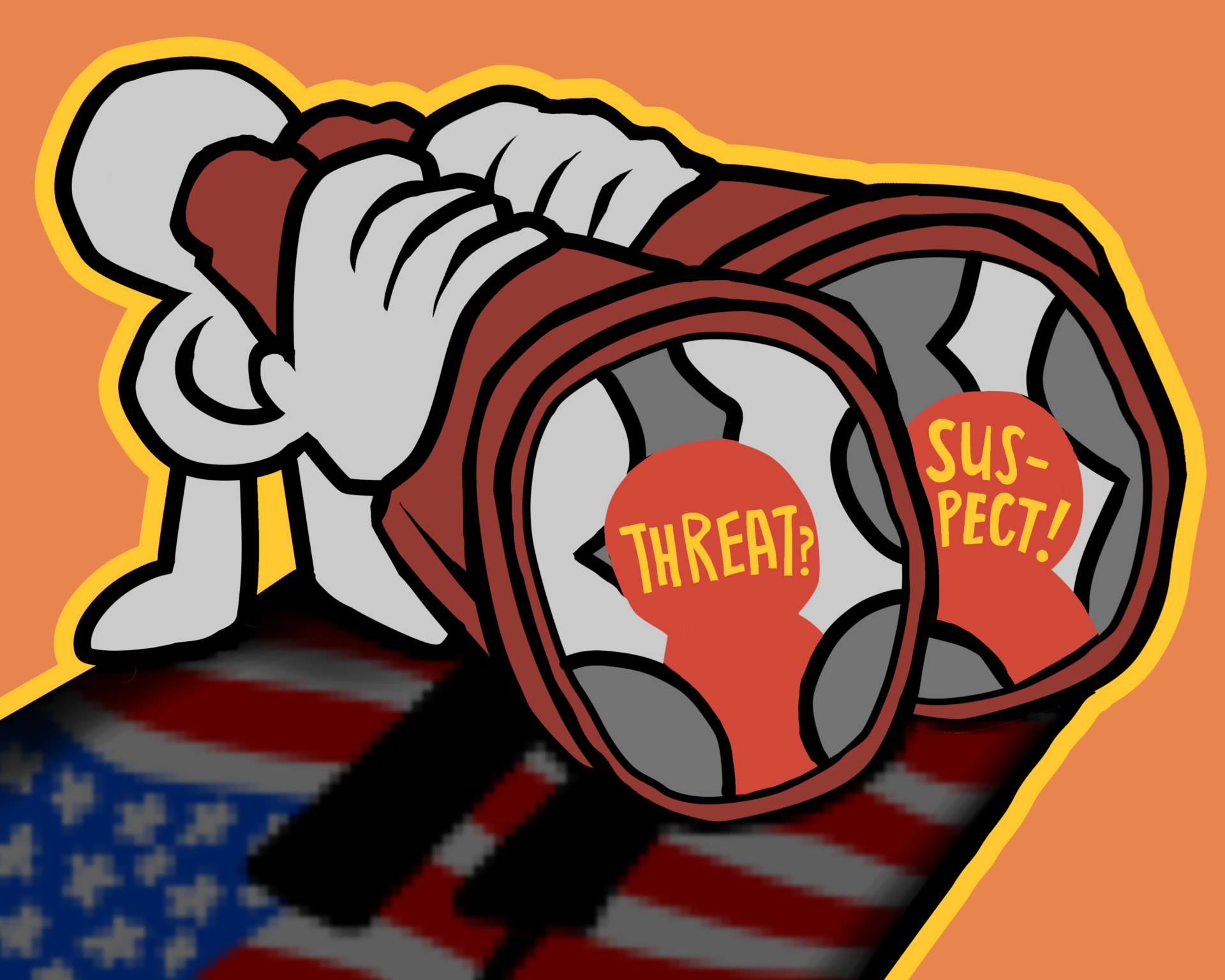

Twenty-five years after Sept. 11, one of its clearest cultural effects remains visible: it is essential for people to pay attention to those around them. In the years following the attacks, vigilance was increasingly presented as civic responsibility. Post-9/11 America changed the social legitimacy of suspicion by teaching Americans that surveilling their fellow citizens is a responsibility towards their country.
Unfortunately, this rhetoric also gave existing prejudices the language of public safety. The federal “If You See Something, Say Something” campaign eventually carried that message across public spaces, with the Department of Homeland Security (DHS) campaign materials describing ordinary citizens as defenders of their communities. A dormant, discriminatory fear of a stranger could now be labeled as rightful public caution. That approach made keeping strangers under suspicion feel like a contribution to collective safety.
As vigilance became part of responsible citizenship, ordinary people gained greater authority to interpret who appeared threatening. Research on vigilant citizenship shows that public surveillance programs can associate responsible citizenship with harmful racial assumptions and biased threat perception. Race and religion already influenced who Americans associated with danger; surveillance culture makes that prejudice easier to defend as concern for public safety.
Public opinion after Sept. 11 shows how quickly vigilance became connected to racialized suspicion. A 2002 Pew survey found that 28% of Americans had grown more suspicious of people they perceived as Middle Eastern after 9/11, that share has since increased to 36% as of June 2022. Another Pew poll that year found that 59% supported additional airport screening for passengers who appeared to be of Middle Eastern descent. These statistics show how easily judgments about danger become attached to appearance and perceived identity rather than evidence of threatening behavior.
Vigilance culture shaped the communities who became targets of harassment and violence. An Oxford Academic study found that hate crimes targeting Arabs and Muslims rose dramatically during the months following Sept. 11, while the Justice Department records document more than 800 incidents involving violence or threats against Muslims, Sikhs and others perceived to belong to Middle Eastern or South Asian communities. Perceived identity carried more weight than evidence of wrongdoing, as attempts at public safety gave way to public harm.
Federal guidance now acknowledges a central risk of post-9/11 vigilance by separating suspicious conduct from personal identities. DHS guidance tells citizens to report behavior connected to possible terrorism while explicitly stating that race, ethnicity and religion provide no legitimate basis for suspicion. Although the distinctions are clearer now than they were 25 years ago, the campaign still describes public safety as a responsibility of ordinary citizens. Biases have not disappeared, and average citizens are still left evaluating which behavior deserves attention.
The idea of American vigilance quickly moved beyond counterterrorism and into everyday criminality. A 2024 study in “Security Dialogue” described “vigilant citizenship” as an ideal in which responsible citizens watch their surroundings and report suspicious activity. The ideal escaped post-9/11 counterterrorism efforts and influenced contemporary forms of neighborhood policing. The study found that these practices can cultivate distrust and reproduce racialized ideas about who appears out of place or dangerous. Prejudice becomes harder to recognize when surveillance and suspicion are normalized behaviors.
Associations formed during 9/11 have survived long after the original crisis. A 2026 Pew survey found that 43% of American adults considered Muslim Americans less patriotic than other Americans, and some respondents directly cited Sept. 11 when explaining their views. Pew also found that FBI-recorded anti-Muslim hate crimes have remained above their pre-9/11 level every year since 2001. Once a group becomes culturally associated with danger, suspicion toward that group can influence the cultural consciousness for generations.
Over time, vigilance culture influences who is readily accepted as belonging and who remains subject to doubt. The burden then shifts onto targeted communities, which are left proving their trustworthiness against suspicions they never created. For countless vulnerable populations, there is an expectation that one is scrutinized even when no threatening behavior occurs. Ordinary presence begins to require explanation. Once suspicion becomes routine, equality erodes under the cloak of public responsibility.
Jacqueline Lee is an Opinion Staff Writer. She can be reached at jacquhl3@uci.edu.
Edited by Ruby Goodwin and Zara Baker