

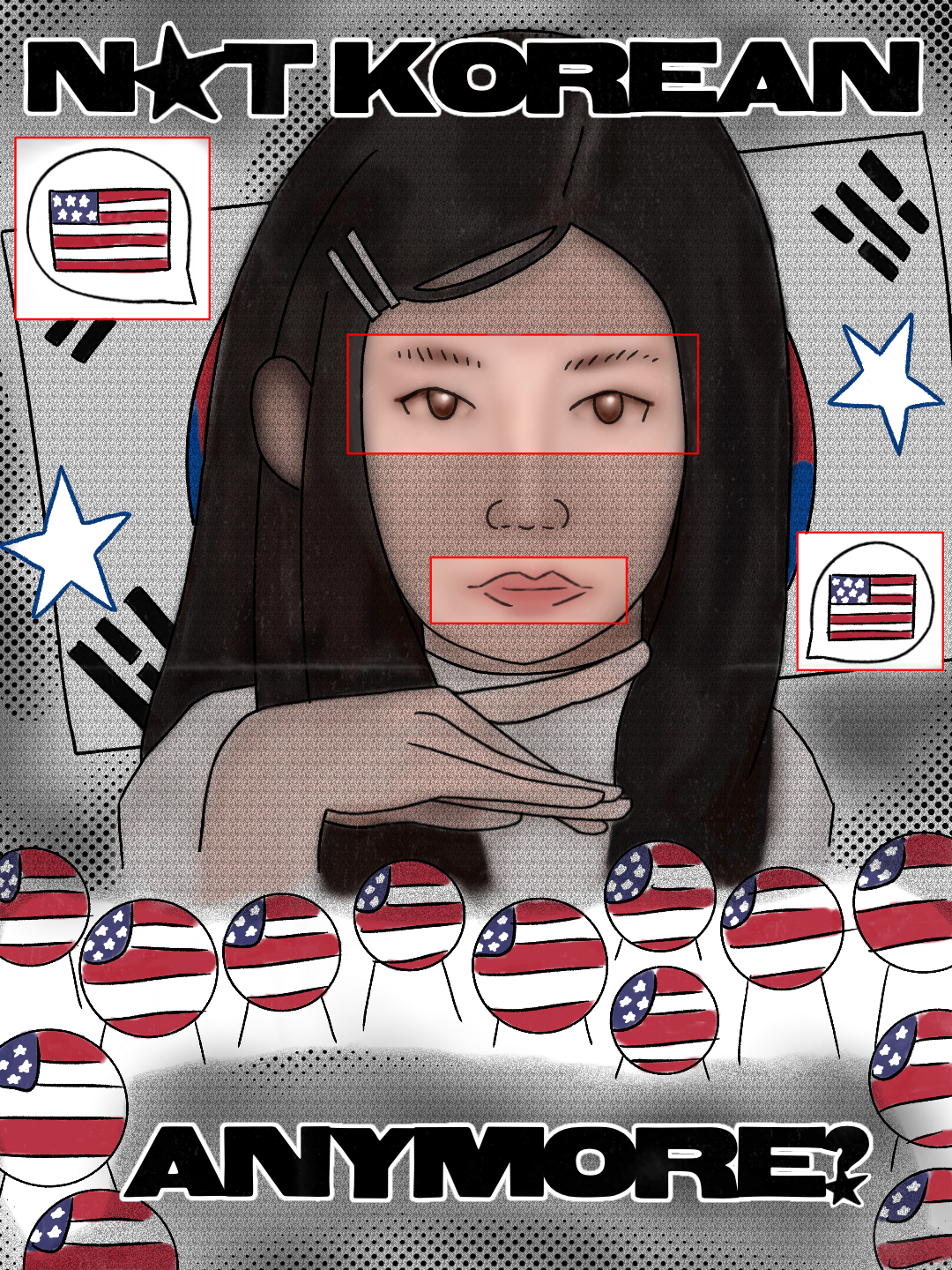

In Korean pop (K-pop), idols have become cultural Build-a-Bears: meet Korean beauty standards, sing English lyrics and perform a marketable version of Koreanness calibrated for Western audiences. As the industry gains global influence, it is constantly straining for both cultural authenticity and Western approval.
K-pop’s attempt to treat cultural identity as a product for sale has gone too far. What the industry deems marketable improperly depends on how smoothly Western audiences can consume it, turning Korean identity and the idols who represent it into a commercial feature. It is more than just English lyrics and American collaborations.
The pressure to conform to Western standards carries particular weight in light of K-pop’s history. The industry developed through foreign power. Japanese colonial authorities censored recorded music during their occupation of Korea, while American cultural influence expanded through the American Forces Korea Network broadcasts. Korean musicians adapted American genres through local performance traditions, changing domestic tastes and creating hybrid forms that eventually developed into contemporary K-pop.
Such a history makes K-pop’s growing orientation toward Western markets especially significant. When American-leaning groups gain international success, it increasingly encourages companies to emphasize musical and linguistic choices already familiar to English-speaking audiences.
The 1997 financial crisis intensified this problem by changing the economic environment in Korea, as well as the surrounding culture. South Korea accepted an International Monetary Fund program that accelerated financial liberalization and restructured their economics, encouraging policies that treat entertainment as a source of economic growth and export. Inkyu Kang in his book “K-pop — The International Rise of the Korean Music Industry” connects the modern idol system directly to this neoliberal restructuring, arguing that deindividualization benefits employers more than idols, who came to be treated like other Korean export products.
In South Korea, neoliberal restructuring refers to the post crisis shift toward a more liberalized and globally competitive economy. The change was made possible through overall financial reform and greater labor market flexibility. Under that logic, the performer — even one in a culturally meaningful genre like K-pop — becomes valuable if they are able to adapt to the market.. Their appearance and public personality can both be reorganized around profitability.
The Western market has become one of the clearest forces determining which sounds and images are deemed profitable. Circle Chart found that English accounted for 41.3% of lyrics in girl group songs during the first half of 2023, compared with 22.4% during the same period in 2018. Research published by Cambridge University Press similarly describes English as gaining a larger foothold as K-pop expands among Western audiences, linking language choices to the genre’s internationalization.
English lyrics are not the issue on their own, since multilingual music can expand artistic expression. The concern begins when language is strategically adjusted to make Korean music more commercially legible to Western audiences and institutions. In this way, global success depends on reducing cultural hallmarks into forms that Western markets already know how to recognize, reward and consume. Many key aspects of Korean music culture are sacrificed for an expanded consumer base.
The same commercial logic reaches beyond songwriting, as overseas success now carries enormous financial importance. Data from the Korea Customs Service shows that K-pop album exports reached $301.7 million in 2025, with the U.S. accounting for $64 million and ranking among the industry’s largest overseas markets. An industry built around international revenue has every incentive to study which sounds and personalities sell, then reproduce those traits across new groups. Global popularity therefore creates a pressure towards familiarity, even when the product continues carrying a Korean label.
That logic eventually reaches the artists directly, expanding cultural conformity beyond music alone. Kang argues that deindividualization is only useful to employers, while newer studies show how an idol’s relational labor can itself become a commodity when their behaviors are controlled through platform systems and commercial contracts.
Bubble is a subscription based messaging platform that allows fans to receive messages from idols, meaning the idol sells perceived intimacy in addition to music. The idols’ time and attention become revenue-producing assets to the companies. Research in the Journal of Consumer Research describes K-pop’s global strategy as one that balances cultural distinctiveness with international accessibility, showing how the difference between an idol’s culture and market can be made into a product.
Once personal identity becomes part of the export, Western marketability can influence far more than musical style. Each artist becomes responsible for embodying a version of Korea that remains distinctive without becoming commercially irrelevant. They are pressured into high-stakes performances each day, mixing exoticization and relatability into their conversations with total strangers.
K-pop’s global reach should be acknowledged as a major shift in cultural power, especially for a country whose modern history includes colonialism and major foreign influence. However, that prominence loses some of its significance when the industry treats Western acceptance as the reason that Korean industries deserve investment. Cultural exchange can produce something creative when artists control what they borrow and transform, but neoliberalism changes that exchange by making survival dependent on market approval. Korean success becomes harder to celebrate when Korean identity — and the artists who carry it — are treated as adjustable products, preserving only the differences that global capitalism is willing to buy.
Jacqueline Lee is an Opinion Staff Writer. She can be reached at jacquhl3@uci.edu.
Edited by Ruby Goodwin

