

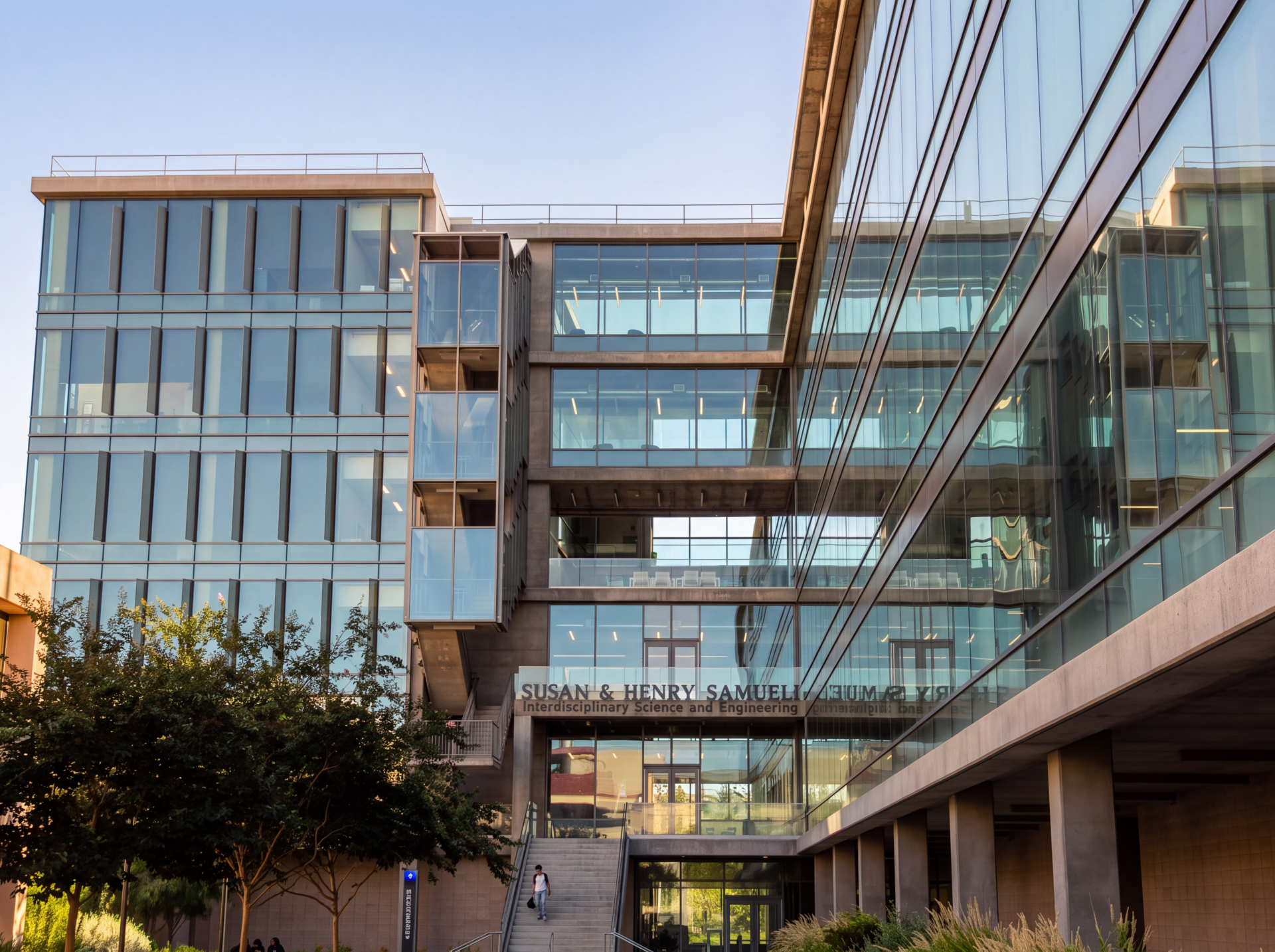

UCI researchers working in quantum science and cybersecurity are now navigating a federal push that could reshape how their work is funded, conducted and secured.
President Trump signed two executive orders on June 22 directing federal agencies to expand quantum research and development and accelerate the federal government’s transition to post-quantum cryptography.
The executive orders, “Ushering in the Next Frontier of Quantum Innovation” and “Securing the Nation Against Advanced Cryptographic Attacks,” mark a first of their kind in a two-pronged push. One funds the advance of quantum computing itself; the other defends against the threat that same computing power poses to current encryption.
In Washington, the effort drew rare bipartisan backing. The government’s 2035 target for completing the switch dates to a 2022 national security memorandum under the Biden administration, and the new orders speed up that timeline for the most sensitive federal systems.
At UCI, where federally funded quantum and cybersecurity research already spans multiple labs, the stakes have less to do with D.C. politics than with what happens inside those labs.
The orders push agencies to replace that encryption before the necessary quantum technology is available , which can lead to a years-long overhaul that universities are expected to help research and staff. The orders could also decide how much grant money reaches campuses, how many researchers and graduate students labs can afford to support, and whether the international students who make up much of the research workforce will be eligible for the new jobs the push creates.
UCI’s involvement in quantum research began before the Trump administration’s latest push. The university has spent years building its quantum research infrastructure, with the help of private investment. Since 2020, the Eddleman Quantum Institute has funded more than 25 graduate fellowships at UCI through a $64.7 million gift from the estate of the late Roy Eddleman.
The signing drew executives from IBM and other major technology companies to the Oval Office. IBM CEO Arvind Krishna, who attended, called the executive orders “vital to sustaining U.S. quantum leadership and technological resilience.”
Ro Cammarota, an associate professor of computer science at UCI whose research spans post-quantum cryptography and encrypted computing, said the urgency behind the orders is easy to misread.
The tight deadlines can make it sound as if quantum computers are already able to crack today’s encryption. They aren’t, Professor Cammarota clarified. The rush exists because replacing that encryption across government systems will take years, and the work has to be done before such a machine arrives.
The timeline is set by two overlapping clocks: how long sensitive information needs to stay secret and how long it will take to update the government networks, cloud platforms and billions of connected devices that still run on today’s encryption.
“If sensitive information must remain secret longer than it takes, both for the threat to arrive and for us to complete the migration, then waiting is already a risk,” Cammarota said.
The question is not whether algorithms are ready, but whether institutions like UCI are. Cammarota said choosing new algorithms is only part of the challenge; the larger task is safely moving an entire technology ecosystem onto them without leaving data exposed or knocking critical systems offline in the process.
Cammarota says most organizations, UCI’s own labs included, don’t have a full inventory of where their cryptography lives or who’s responsible for maintaining it. Experts call that challenge crypto-agility: the ability to swap out cryptography while leaving the rest of a system’s infrastructure intact.
That gap isn’t unique to campus labs, as FedTech has found the prevalence of this issue across the government. Bill Newhouse of NIST’s National Cybersecurity Center for Excellence has said inventory mandates are practical for some agencies but less practical for others.
Stephen Hunt, chief technology officer for federal markets at HCLSoftware, described the resulting blind spots. Ownership often lapses once an audit closes, inventories go stale within weeks, and “cryptography lives in places that tools or manual searches never reach.”
Cryptography, the practice of encoding information so that only its intended recipient can read it, secures much of daily online life, from web browsers and messaging apps to online banking and other financial transactions.
Quantum computers use counterintuitive properties of physics to perform calculations no classical machine can replicate.
Classical computers store information in bits that are either zero or one, but quantum bits can exist in any combination of the two at once, Angela Robinson, a mathematician at the National Institute of Standards and Technology, told New University.
That capability is what eventually gives quantum computers the potential to break some of the mathematical systems that currently secure internet communication. Robinson said most people rely on cryptography “dozens, if not hundreds of times a day” without realizing it.
Cryptography, the practice of encoding information so that only its intended recipient can read it, secures much of daily online life, from web browsers and messaging apps to online banking and other financial transactions.
Adversaries are already exploiting that eventual threat through what’s known as “harvest now, decrypt later” attack.
“The idea that somebody could be just saving up troves and troves and troves of data that’s been encrypted under a weaker encryption scheme in hopes that they can break it in 10 years and recover all of that data is pretty scary,” Robinson said.
That threat is what the second order is designed to head off. It puts the Office of Management and Budget and the National Cyber Director in charge of the federal migration, directs the Department of Commerce, the National Security Agency and the Department of Homeland Security to speed it up, and encourages foreign governments to follow the U.S. lead.
Cammarota said the two executive orders are designed to work together: one accelerates quantum computing itself, with applications in fields like genomics and medicine, while the other pushes federal agencies to adopt practical cryptography and trains the workforce to carry it out.
For a public research university like UCI, he said that translates into a direct role in both halves of the mission. “We built prototype and testbed that we can nourish as part of our curriculums, as we align our directions with U.S. government directions and work with industry and government to educate engineers who can actually implement the transition,” Cammarota said.
He noted the federal government’s own migration deadline of 2035 gives universities nearly a decade to bridge industry and federal priorities, and calls on schools like UCI to act as an “independent evangelist and executor” of the transition alongside federal agencies.
Some of that money is already reaching campus. Sandy Irani, a UCI professor of computer science and an Eddleman Quantum Institute affiliated faculty member, said in an email to New University that she received a new National Science Foundation (NSF) grant in July 2026, a month after the orders were signed.
“The federal government supports a variety of different efforts, from near-term applications to more fundamental questions on the nature and capabilities of quantum computing,” Irani said, adding that representatives from major hardware developers including Google, Microsoft and IBM regularly attend conferences on the mathematical foundations of the field alongside academics doing more foundational work.
That grant sits alongside older federal investment in adjacent UC research. UCI led a $10 million NSF funded center focused on protecting personal data privacy beginning in 2020, and three Eddleman Quantum Institute physicists won NSF CAREER awards worth roughly $660,000 each in 2021 for quantum materials research.
The administration’s migration mission depends on money UCI doesn’t control. The executive orders will only reach the lab if Congress appropriates the money and agencies like the National Science Foundation distribute it through programs and partnerships, which depends on those agencies securing their share of the funding.
The broader federal research-funding environment could complicate that opportunity. According to a July analysis by the Association of American Universities (AAU), the National Science Foundation has made only 2,179 grants nationwide so far for the 2026 fiscal year, compared to an average of 5,865 awards by the same point in the year between 2021 and 2024.
The slowdown hits close to home for UCI’s quantum researchers. NSF’s Directorate for Mathematical and Physical Sciences, which funds the foundational physics behind information science, has made only 550 awards this fiscal year, compared to 1,350 on average in past years.
The Directorate for Computer and Information Sciences and Engineering, which funds work like Cammarota’s, made 474 awards against a usual 838. Congress ultimately appropriated $8.75 billion to NSF for the year, but the AAU reports that some university officials are seeing proposal wait times stretch past a year before funding decisions come through.
Alisha Mishra, a rising senior majoring in data science and president of UCI’s Women in Cybersecurity chapter, said that slowdown is exactly what worries students working in the field. She said UCI, as a public university, relies heavily on government funding and NSF grants since it lacks the private endowments that fund research at private universities.
“There is this interesting tug of war with the government in the last couple of years, pulling back funding and making it harder to get research grants for researchers,” Mishra said, even as the new orders promise to send more money toward the same labs.
There is a demographic reality that shapes who can do this work. A large share of UCI’s PhD researchers in this space come from abroad. Nationally, the pattern is well documented. According to the NSF’s Survey of Earned Doctorates, temporary visa holders earned the majority of new PhDs awarded in 2024 in computer and information sciences (61%), a prominent field which feeds quantum and post-quantam research.
“A big part of the orders has to do with national security and making sure our work doesn’t get leaked,” she said, adding that even as the push creates new research jobs, “there might be restrictions on who gets those jobs.”
UCI’s investment in quantum research and training predates the executive orders. Since 2020, the Eddleman Quantum Institute, a partnership between UCI, Caltech and UC Santa Barbara, has funded more than 25 graduate fellowships at UCI alone, and UCI Chancellor Howard Gillman has credited the gift with having “confidence in our researchers’ ability to positively impact the world with their work.”
Asked to sum up his outlook, Cammarota returned to the tension running through the entire migration. “The appropriate response to the quantum risk is not to panic, but also not to delay,” he said.
The orders set deadlines of 2030 for critical infrastructure and 2031 for higher-impact environments, pushing institutions to begin preparing before quantum computers can pose an immediate threat.
Aadya Mishra is a News Intern for the summer 2026 quarter. She can be reached at aadyam2@uci.edu.
Edited by Brinda Popli and Geneses Navarro.

