

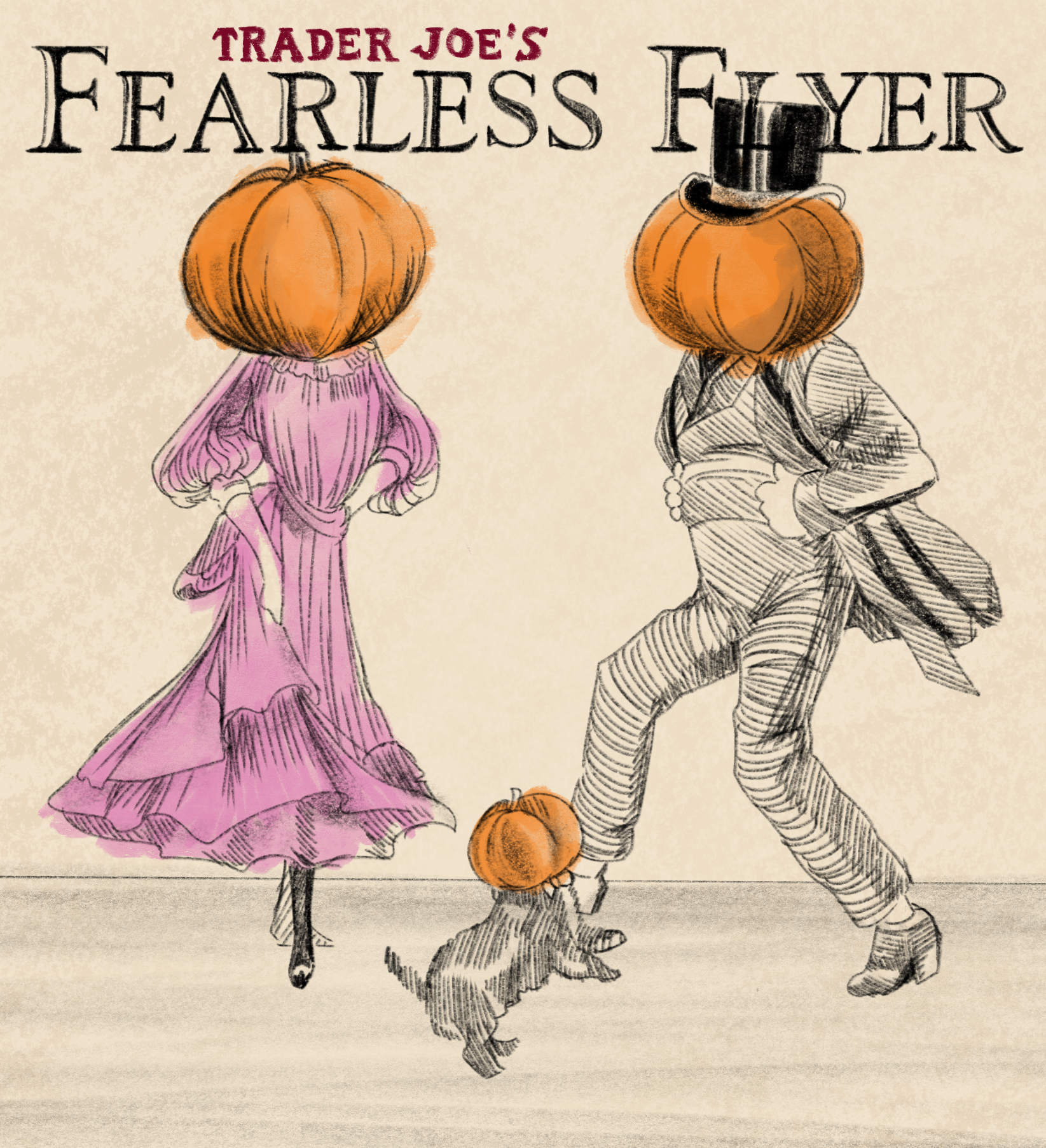

The grocery store chain Trader Joe’s released their Thanksgiving issue of their “Fearless Flyer” on Nov. 2. The publication is printed and distributed intermittently throughout the year and marketed as “always free and worth every penny.” Two parts catalog and one part newsletter, the flyer announces their most recent seasonal goods, with the latest issue officially dubbed their “Thanksgiving Guide.” It is curated to encourage readers to purchase multiple seasonal products and, indeed, some of their fall additions are worth trying. But more broadly, the “Fearless Flyer” is an engaging case study in the role of art in advertising, raising questions about the relationship between cultural image and ethical commerce. Trader Joe’s has a very distinctive reputation, but how consistent is this with their real-life business practices?
While patently a tool to boost sales and centralize brand identity, the flyer is admittedly entertaining. Between the many listed items, droll cartoons cleverly reference the products while stirring a few laughs. Some are endearing enough to be repurposed as charming wall stickers, filling the gaps between one’s larger posters. Take, for instance, the bespectacled boar on the front page, ironically proclaiming “These [sausage] links are delish!” The flyer even has a crossword puzzle — cruciverbalists come hither — for which some of the hints are the names of their new products.
Among them is Trader Joe’s Creamy Corn, sold frozen and ready to cook. Sourced from an “Italian supplier,” the corn can be cooked on the stovetop in a saucepan, in the microwave or in the oven. The result is a simple dish of sweet corn kernels served in a flavorful cream sauce that can be easily compounded with household staples, from spinach to mushrooms. Especially for students busy studying for their midterms — and voting in the midterms — this dish is low effort and high reward.
Another standout from November’s “Fearless Flyer” is Trader Joe’s Sticky Toffee Flavored Cheddar. Imported from “an expert cheesemaker in southern England,” the flyer describes this as an “ideal indulgence for the holidays” and pairs well with their Fuyu Persimmons, which they endorse as “a striking addition to a cheese board.” The cheddar elegantly composites sweet and savory flavors, blending toffee, raisins and dates with the rich curds. This combination begets a cheese that is simultaneously nutty, fruity and aromatic, all above a thick, full-bodied base. Indeed, it will be fast friends with many a seeded cracker at fall gatherings.
College students fueling their mornings with coffee may appreciate Trader Joe’s Maple Pecan Cold Brew Concentrate, a spicy spin on their non-seasonal Cold Brew Coffee Concentrate. Made from 100% Arabica beans, the flyer advises mixing one part concentrate with two parts water, dairy or non-dairy beverage. While the coffee’s piquant aroma may bring to mind scenes from Wes Anderson’s “Fantastic Mr. Fox” as it swathes one’s kitchen, the fragrant notes of nutmeg, cinnamon, maple syrup and pecan are more understated on the tongue. Furthermore, beware the heedless patron whose refrigerator stands milkless — dairy or non-dairy — as the concentrate combines joylessly with water into an astringent, ill-humored pond water.
But while these November goods are generally palatable, if not delectable, what stands out is the image that these products cultivate for the Trader Joe’s name. It is one of eclecticism, playfulness and farm-to-table novelty. The “Fearless Flyer” is shrewd marketing because it creates synergy between art and advertising; pathos invites readers to spend more money at their local Trader Joe’s. Fostering this unique, quirky appearance through an almost Norman Rockwell-esque realist style is an undoubtedly clever business strategy.
It is worth considering, then, how accurately this meticulously curated veneer maps onto Trader Joe’s real-world commercial practices. We can begin by scrutinizing their procurement approaches. Green America, an environmental non-profit, rated Trader Joe’s with one of the lowest scores on their Chocolate Retailer Scorecard, which grades major US chocolate companies on their ostensible expenditures to address child labor — a fraction of the exploitative patterns of our globalized economy. They also found that retailers take up to 44% of sales profits, while farmers often receive closer to 6.6%. Moreover, Trader Joe’s has a poor history with transparency and leaking dangerous pollutants.
Perhaps even more concerning are reports of Trader Joe’s involvement in union busting. Like employees at other multi-billion dollar corporations such as Amazon and Starbucks, unionized Trader Joe’s workers have faced retaliation, intimidation and discrimination. Its executives have demonstrated that they are not willing to protect their workers.
These revelations are troubling, especially in the context of their sophisticated, house-brand image, earning them the highest rank in the American Customer Service Index Supermarkets Report. Yet we should not condemn the customers who enjoy their Chili & Lime Flavored Rolled Corn Tortilla Chips, especially considering their products are often the most affordable option for middle and working-class shoppers. Multi-billion dollar businesses have proven that they cannot be trusted to reliably self-regulate their sourcing or labor practices. This leaves the measured involvement of federal regulatory bodies to truly hold these corporations accountable to their consumers. A critical political dilemma, all masked by the privatized journalism of the “Fearless Flyer.”
Perhaps the responsibility of the consumer, then, is to have a more multifaceted awareness of the practices of our local grocery chains and let it inform the kind of political governance that we demand. Meaningful reform depends on the civic choices we make and whether we insist on a culture of accountability for the private, public and social sectors. And after all, there’s nothing wrong with pairing Trader Joe’s Sticky Toffee Cheddar with persimmons from your local farmer’s market.
Sean Watanabe is an Arts & Entertainment Intern for the fall 2026 quarter. He can be reached at seanlw@uci.edu.
Edited by Avani Kumar and Riley Schnittger.

Interested in becoming an intern or a contributing writer for the Entertainment section?
Contact us at entertainment@newuniversity.org!