

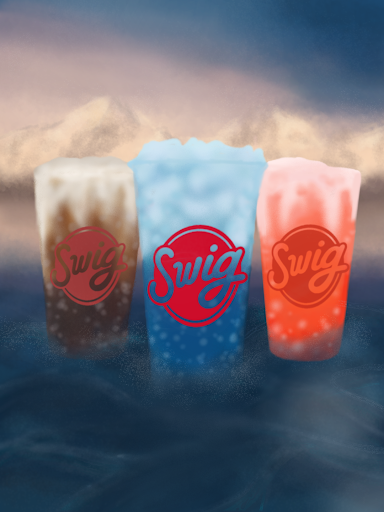

If you’re from California, Swig might sound like alien slang to you. Is it a verb? Possibly an adjective? Maybe Swig is a feeling you get. Well, those are all fair guesses, but Swig is something far more interesting. It’s a soda drive-thru company that has taken over Utah and left plenty of non-Utahns curious for what the excitement is all about.
Swig originated in St. George, Utah when founder Nicole Tanner opened a small drive-thru soda shop in 2010 with the intention of giving people a quick, personalized drink experience. What started as a modest operation selling basic fountain sodas eventually became the birthplace of the now-famous dirty soda.
The concept is relatively simple: take a classic soda, add flavored syrups, fruit, cream or other mix-ins, and suddenly you’ve got an entirely new drink. Swig has since expanded its menu to include customized energy drinks, refreshers, cookies and other sweet treats. It’s also physically expanded, opening locations in over seventeen states. What began as a little soda shop has grown into a recognizable brand with a following that extends well beyond Utah.
More recently, Swig has experienced another wave of popularity thanks to its frequent appearances on the reality television series “The Secret Lives of Mormon Wives” and the endless “Come to Swig with me” TikTok vlogs, which take viewers along for the entire experience, from ordering at the window to taking that first sip.
Swig represents something more than just a soda drive-thru — it offers a glimpse into Utah culture. With a significant portion of Utah’s population identifying as members of The Church of Jesus Christ of Latter-day Saints, religious practices have helped shape the state’s relationship with food and beverages. Many members abstain from coffee, tea and alcohol as part of their religious observance. While soda isn’t necessarily a replacement for coffee, specialty soda shops offer a social alternative to the coffeehouse culture that has become so commonplace elsewhere.
I found myself at the Salt Lake City International Airport, surrounded by missionaries heading off to serve their missions and noticeably fewer coffee stops than I was accustomed to seeing. That’s when I remembered what Swig was. Its allure prompted me to book it from one side of the airport to the other. I had thirty minutes before my connecting flight, a thirst to be quenched and an inkling that I was about to participate in something much bigger than soda.
Beside gate 39B, there it was — a small soda shop that had opened just one day prior. Sparkling, brand-new and partially in its infancy as Swig stood before me. After researching the most popular drinks, I settled on two: the Texas Tab and Shark Attack, both of which appeared to reign supreme among customer favorites.
The employees seemed just as new to the establishment as the store itself. The cashier anxiously took my order and informed me, upon request, that they weren’t serving any food products just yet. A disappointing discovery, considering the pretzel bites had received some pretty high online accolades.
Nevertheless, my Texas Tab and Shark Attack were on their way. I stood by and watched as the young employee prepared my drinks. He mixed my drink, dispersing the flavorings into what was mostly Dr Pepper. As he moved onto the Shark Attack, I overheard the cashier ask the other employee whether he was getting the hang of things — he shook his head. Still, he managed to squeeze in a lemon and pop it atop the bright blue mixture. The drinks were ready to be consumed.
The Texas Tab tasted exactly as you would imagine based on its description. It was Dr Pepper with a hint of vanilla and a generous helping of coconut syrup. Refreshing, but ultimately underwhelming given the hype surrounding it.
The Shark Attack, on the other hand, evoked its name with force. The sprite and lemonade base fizzed and popped with every sip, and the blue raspberry was the only flavor prevalent. Quite frankly, it was intense. The sour and sweet profiles were fighting one another, and its closest equivalent would be drinking the leftover blue raspberry syrup at the bottom of a snow cone — only with the addition of an aggressive amount of carbonation.
As I carried my Texas Tab toward my next gate, I noticed missionaries gawking and eyeing my Swig. One girl even yelped the company name in excitement. The flight attendants seemed to completely understand my slightly late arrival as I stood there with my drink comfortably in my hand, explaining my very urgent need to try it. Swig appears to be a symbol of belonging in Utah, an understanding of the status quo.
It is deeper than simply preferring soda over coffee. Swig exists as a cultural experience, a quick beverage spot and a gathering place that fits comfortably within the routines of many Utah residents. Interestingly, the relationship between Mormonism and soda is not as straightforward as outsiders might assume. NPR’s 2016 segment, “Can Mormons Drink Coca-Cola?,” explores the varying interpretations of the church’s guidelines surrounding caffeinated beverages — a cultural gray area that Swig has arguably turned into a multimillion-dollar business. Rather than simply recognizing that many Utahns enjoy soda and finding a way to profit from it, Swig has built a business around something that already holds a place in the community. Visitors might find the concept unusual, but for regular customers, stopping at Swig is a highlight of their daily routine.
The relationship between Mormonism, modern culture and the idea of loopholes has also become increasingly relevant, particularly following the premiere of “The Secret Lives of Mormon Wives.” The show brings viewers into the lives of Mormon women who don’t necessarily fit the more traditional image many people associate with the religion.
These women don’t always dress modestly, they openly discuss risque sexual activity and literally use the word loopholes to describe some of their choices in relation to their religious beliefs. They understand that certain aspects of their lifestyles may be harshly judged by more conservative members of their community. What emerges is a group of women navigating the desire to participate in modern life while still holding onto a religion with deeply established traditions and expectations.
With the Nov. 12 premiere of The Secret Lives of Mormon Wives: Orange County, a spin-off of the original Utah-based The Secret Lives of Mormon Wives, conversations surrounding the women and their personal dramas are bound to continue, this time with a new set of social dynamics unique to Orange County. Unfortunately, there are no Swig locations in California, meaning no more Swig runs or sipping away their anxieties with suspiciously specific dirty sodas. Looks like we’ll all have to make our own at home.
Swig isn’t an otherworldly vocabulary word, but the culture and context surrounding it might be to some. What looks like an ordinary soda shop to an outsider is, in many ways, a reflection of the community that made it a phenomenon.
Jordan Salter is an Arts & Entertainment Staff Writer for the fall 2026 quarter. She can be reached at jasalter@uci.edu.
Edited by Avani Kumar and Riley Schnittger.

Interested in becoming an intern or a contributing writer for the Entertainment section?
Contact us at entertainment@newuniversity.org!