

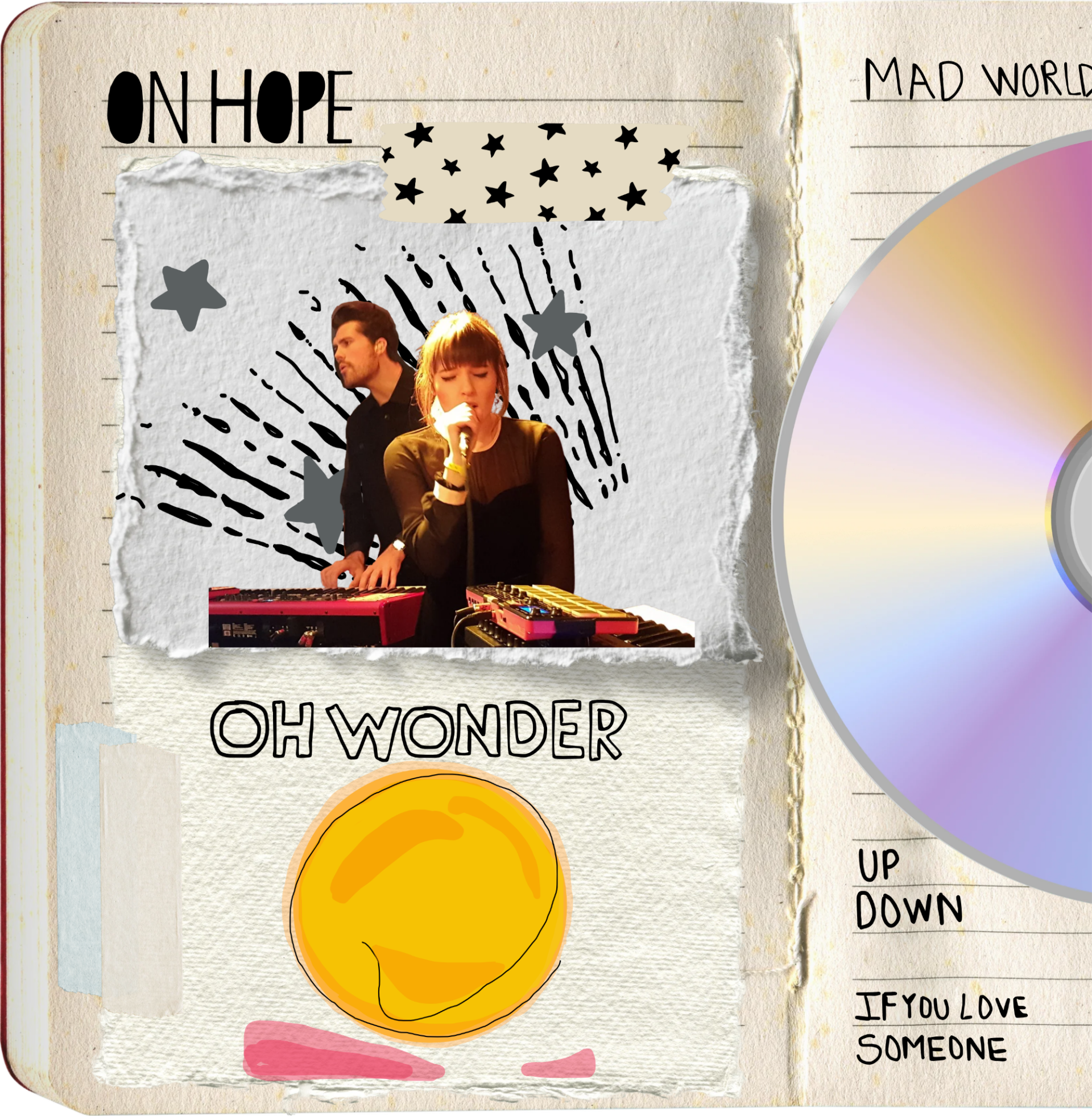
Love, in all its beautifully inconvenient forms, has always made for compelling songwriting. But on their newest extended play (EP) “On Hope,” Oh Wonder approaches the subject with a particularly luminous sensibility, treating optimism not as a naive disposition but as something worth cultivating.
The British indie-pop duo, best known for their 2010s hits “Without You” and “Lose It,” as well as their feature on Lil Uzi Vert’s “The Way Life Goes,” released this new EP on Nov. 13. Delicately balancing the familiar with the experimental, “On Hope” preserves the sonic idiosyncrasies that have made Oh Wonder so distinctive, while venturing into today’s musical landscape with a refreshed perspective.
The EP comprises three tracks: “Mad World,” “Up Down” and “If You Love Someone.” Together, they examine affection, vulnerability and hope amid collective pessimism.
The EP’s message requires little interpretative excavation; hope is presented as an antidote to fear. Beneath this lyrical optimism lies a more intricate sonic narrative. Through instrumental textures and vocal delivery, Oh Wonder gives form to idealism’s apprehension. The lyrics advocate optimism as the music reveals the contradiction of looking on the bright side while watching the world grow dim. That friction gives the EP its most interesting dimension — its songs do not sound entirely convinced by the reassurance they offer, and that uncertainty makes the message feel earned.
The intention behind “On Hope” becomes clearer alongside the duo’s Instagram announcement: “The world feels weird, but we have music, love and each other.” The accompanying handwritten notepad juxtaposed two inventories. One listed contemporary sources of despair — “AI, climate change, screen addiction, tech billionaires, war, natural disasters, surveillance, robots, data centres” — while the other associated hope with “positive psychological outcomes, higher subjective well-being + improved mental health.” The image captures the EP’s framework: acknowledging what makes optimism feel untenable, while insisting it remains worth pursuing. It is an unusually candid promotional image, one that makes the project’s premise legible before a listener presses play.
This interplay is particularly pronounced in “Mad World,” where the arrangement assumes a character of its own: conflicted, relentless and seemingly searching for an answer that the lyrics insist is within its reach. Anchored by a modest guitar melody and delicate percussion, the song gradually accumulates instrumental layers as the chorus approaches, eventually swelling into something resembling a symphony. The transition initially feels like a breakthrough, but the release proves fleeting. The arrangement retreats to the verses’ subdued state, creating emotional recurrence: one step forward, two steps back.
Lyrically, “Mad World” confronts contemporary anxieties with disarming directness. Its opening establishes a pessimistic worldview.
“When is heaven gonna come back? / No more bullets in the haystack / Wanna override the soundtrack / How about that?,” Josephine Vander West and Anthony Vander West sing.
The pre-chorus introduces love as resistance to this seemingly inescapable reality: “The sky’s on fire, our time is up / Let’s crawl into the arms of love / The dark is wide, the ocean rough / Let’s crawl into the arms of love.” By the chorus, hope becomes both declaration and defiance: “In a mad world / Even in a mad, mad world / In a mad world / I know we’re gonna find a way.”
The song suggests love might help us navigate a mad world. Where the lyrics articulate its redemptive potential, the sonics expose the tension of sustaining that conviction amid uncertainty. “On Hope” does not simply celebrate optimism — it interrogates the labor required to sustain it.
Despite its deeply personal sentiment, “Mad World” is not a track I would necessarily queue up. Rather than escape the anxieties its title evokes, it sometimes feels like an invitation to revisit the things people turn to music to forget. Its earnestness leaves little room for the kind of cathartic distance some seek in music. Still, it feels perfectly suited as a Hulu limited-series needle drop track or in a minimalist coffee shop playlist, where its contemplative melancholy might find a natural home.
Of the three tracks, “If You Love Someone” is the one I would be most inclined to revisit. It is no all-occasion song; it belongs on a reflective Spotify DJ spin requiring precise atmospheric alignment. It should be raining. You should be surrounded by pine trees. It should be winter. Under these admittedly specific conditions, the song reveals itself, as though its emotional register depends as much on the landscape as on the listener.
Sonically, “If You Love Someone” operates in near opposition to “Mad World.” Its arrangement begins reticently, asking the lyrics to carry the emotional weight while a restrained piano provides the foundation. However, minimalism does not immediately translate into intimacy. The opening verse feels inert, while the prechorus and chorus gain momentum. While no elaborate crescendo is needed, the pacing is the only thing that lends the song a compelling architecture.
The timid opening departs from the idiosyncratic arrangements that distinguish the duo’s most popular sounds. In seeking to establish a degree of individuality across the EP, the duo sacrifices some of the textural intricacy that might otherwise have given the track greater dimension. What remains is a composition whose structural simplicity exposes the rather delicate framework beneath it.
At its core, “If You Love Someone” is a sentimental meditation on courage: the courage to confess affection, to remain emotionally available and — perhaps most importantly — to extend that same tenderness toward oneself. Its message is sweet, even sincere, but sincerity alone does not necessarily constitute distinction. The song’s appeal ultimately rests in its capacity to accompany a particular mood rather than transcend it, making it a fitting addition to a reflective playlist, but a less compelling centerpiece for an EP whose ambitions are otherwise so sonically and thematically expansive. By the final notes, its sentiment begins to resemble the emotional equivalent of a greeting card: heartfelt, uncomplicated and perhaps a little too close to the words “every kiss begins with KAY.”
The final track, “Up Down,” brings its predecessors into a more cohesive conversation, marrying the instrumental expansion of “Mad World” with the straightforward lyricism of “If You Love Someone.” It is the most complete distillation of the ethos presented in “On Hope” and Oh Wonder’s trademark composition. A heartfelt declaration of solidarity, the song takes its purpose from the desire to “pull you up when you’re down,” turning a familiar sentiment into something intimate and restorative. It delivers the EP’s message without sacrificing the duo’s musicality, offering a hand through modern contradictions and making optimism feel like an act of care.
Ultimately, “On Hope” does not ask listeners to linger in hopelessness, nor pretend three songs can dismantle the anxieties of a disquieting world. Instead, it asks what might exist alongside them. Oh Wonder presents hope as neither effortless nor guaranteed, but as something sustained through affection and companionship. Even when the world feels grim, there is something in the people who make it worth enduring. “On Hope” offers not an escape from the present, but a gentler way of inhabiting it.
Jordan Salter is an Arts & Entertainment Staff Writer. She can be reached at jasalter@uci.edu.
Edited by Travis Foley.

Jordan Salter is a junior at UC Irvine and a staff writer for the Arts & Entertainment section of New University. Jordan is originally from Los Angeles and has a background in acting and screenwriting, which sparked her lifelong love of all things entertainment. When she’s not writing, you can usually find her watching reality television while expanding and organizing her ever-growing collection of 19th-century antiques.