

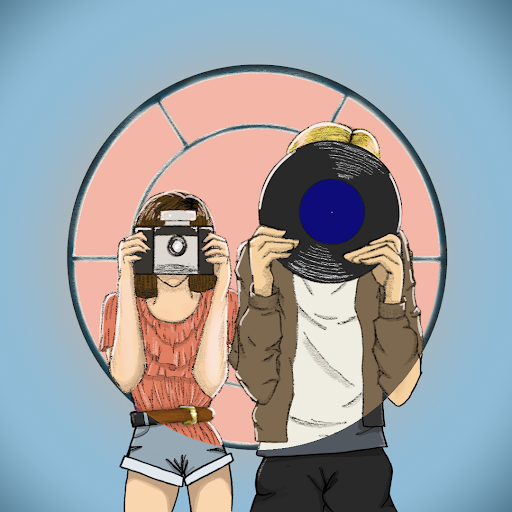

It’s 2012. Barack Obama has just been re-elected, The Hunger Games is ruling the box office and Mumford & Sons are making banjos sound like a reasonable life choice. You’re playing Toca Boca in the backseat or scrolling Tumblr on a MacBook Pro, and listening to music that makes the world feel like one long coming-of-age montage. The foretold Mayan apocalypse, thankfully, never happened. Life is alluring, and more than anything, optimistic.
Tiktok has dubbed this feeling the “millennial optimism era”: a romanticized, selectively edited vision of the early 2010s that Gen Z has constructed as it grows older, seeking an escape from the present. It’s complete with collages of hipster fashion, whimsical bedrooms and an unshakable belief that everything might just work out.
The trend initially surged in December of 2025 and has since resurfaced, turning a decade that feels like yesterday to some, and ancient history to others, into a portal of reminiscence.
What makes the millennial optimism trend particularly revealing is that many of the people romanticizing the 2010s were actually children during them. They are not necessarily remembering the decade as it was. They are remembering an idea of it.
For Gen Z, those years precede the pandemic, mounting economic anxiety and social media’s near-total saturation. The 2010s can now appear to occupy a sweet spot between the internet’s novelty and its ubiquity. Online culture felt more personal and experimental, rather than algorithmically optimized. Its music seems to belong to that same world of imperfection and earnestness, indie-folk offered more than personal introspection; it fostered a sense of community through adversity.
However, beyond the nostalgia for Peter Pan collars and the overall aesthetic of Zooey Deschanel, lies a deeper longing for the sense of community that the era’s music exudes, an abstract feeling that visual signifiers alone cannot induce.
Edward Sharpe & The Magnetic Zeros’ “Home,” Of Monsters and Men’s “Little Talks,” The Lumineers’ “Ho Hey” and, most importantly, The Middle East’s “Blood” have become musical shorthand for an era that seems almost aggressively hopeful in retrospect.
Grab your wired earbuds, queue up a Spotify playlist with “optimistic,” “twee,” or “millennial” in its title and listen closely. A pattern begins to emerge. Acoustic guitars, hand claps, banjos, whistling and communal vocals make these songs sound as though everyone involved has gathered around some random campfire, united by a shared commitment to spontaneity, intimacy and being a little imperfect. Pull out your emergency tambourine, learn three chords and join in.
This music is built around togetherness, suggesting a world where connection comes easily and the night is not just young, but as it goes in indie rock group Fun. ‘s hit: “We Are Young”. The biggest problem? Deciding which owl necklace to buy. It is an appealing fantasy, especially when the present feels considerably less straightforward.
Nostalgia is not new. It turns the past into a cultural scrapbook, preserving whatever makes it seem simpler or more authentic. Gen X may romanticize the 80s through Billy Idol but they tend to forget the serial killers.
Cultural theorist Svetlana Boym offers a useful way to understand this longing. In The Future of Nostalgia, she distinguishes between restorative nostalgia, which seeks to reconstruct an idealized past, and reflective nostalgia, which dwells in the longing itself. The millennial optimism trend seems closer to the latter. The aesthetic provides a way to express dissatisfaction with the present without having to articulate exactly what has gone wrong.
Boym described nostalgia as a longing that can encompass, “the unrealized dreams of the past and visions of the future that became obsolete.” Her point is especially relevant to an era remembered for its faith in technological possibility and cultural experimentation. The endurance of the decade lies not simply in its optimism for the future but primarily in the music’s vision to experience that future together.
There is a difference between nostalgia for an aesthetic and nostalgia for an emotional condition. You can buy ballet flats or build a playlist of acoustic shout-alongs. What you cannot purchase is the feeling of not knowing what the next fifteen years will bring.
Perhaps that uncertainty is precisely the point. Childhood becomes a period of relative innocence in retrospect, while adulthood arrives with a steady stream of reasons to be anxious. Social media packages that longing into a repeatable escape to a past that was never quite so simple.
The distinction is not that music was more authentic then or that pop has somehow lost its soul. Rather, these songs offer a different emotional proposition: the promise of belonging to something beyond yourself.
In today’s attention economy, streaming platforms and social media often reward songs that make an immediate impact, creating a different environment for music than the one early-2010s indie folk emerged from.
What feels missing is not the emotion itself, but the sense that it might spill out of the speakers and pull everyone in with it. That particular sound is difficult to reproduce; it seems to operate by different rules. It takes its time. It leaves room for a voice to crack, a guitar to ring out or a chorus to gather momentum.
Even artists like Noah Kahan and Hozier, whose music draws from folk traditions, offer a different kind of emotional experience. Kahan captures folk’s earthy intimacy, with an introspective songwriting narrative rather than the communal optimism of folk’s anthemic choruses. Hozier’s newer releases such as, “Francesca,” still carries that familiar ache, but its more elaborate production can feel like a polished shell around the raw yearning that is embedded in his 2010s hits, “Take Me to Church” and “Work Song.”
The millennial optimism era may be a TikTok trend, but its soundtrack has taken on a life beyond the algorithm. These songs transport listeners to an imagined moment before adulthood hardened into responsibility and before the future felt quite so crowded with consequences.
“Home” sounds like belonging and “Ho Hey” reduces romance to a few exuberant declarations. Even when these songs contain sadness or uncertainty, their arrangements make those feelings feel shareable.“Blood” has devastating lyrics, but its hopeful harmonies make grief feel reciprocal, as though mourning can become an act of connection rather than a process to endure alone.
The irony is that the early 2010s were never as carefree as the playlist suggests. Every era has its hardships; nostalgia simply turns down their volume. But when those opening guitar chords return, the world briefly widens and the future feels a little less decided.
Maybe Gen Z does not want 2012 back. Maybe it just wants to believe for five minutes and twenty-six seconds, that the best is still ahead.
Jordan Salter is an Arts & Entertainment Staff Writer for the fall 2026 quarter. She can be reached at jasalter@uci.edu.
Edited by Avani Kumar and Zara Baker.

Jordan Salter is a junior at UC Irvine and a staff writer for the Arts & Entertainment section of New University. Jordan is originally from Los Angeles and has a background in acting and screenwriting, which sparked her lifelong love of all things entertainment. When she’s not writing, you can usually find her watching reality television while expanding and organizing her ever-growing collection of 19th-century antiques.