


“The Hunger Games: Sunrise on the Reaping – The Album,” the companion soundtrack to the newly released film of the same name, dropped a week before the film on Nov. 13. Because it is accompanying the highly anticipated movie, it risks being eclipsed by it and overlooked by audiences altogether. Nevertheless, the record is a critical text within “The Hunger Games” canon. Music is central to “The Hunger Games” author Suzanne Collins’ core messaging, underscoring how her world reflects political reality, not just mere allegory.
“The Hunger Games” is set in the post-nuclear nation of Panem, a totalitarian state in North America divided among 12 districts and the despotic Capitol. After years of violent civil war, the victorious Capitol uses military force to subjugate the districts, extracting goods and labor from them to feed their exorbitant wealth. To further cement their supreme authority, the Capitol annually holds the Hunger Games, where one boy and one girl between the ages of 12 and 18 are reaped from the districts as tribute and forced to fight to the death in an arena of the Capitol’s increasingly sadistic design. The games function as entertainment and pageantry for the Capitol and a reminder to the districts of their powerlessness.
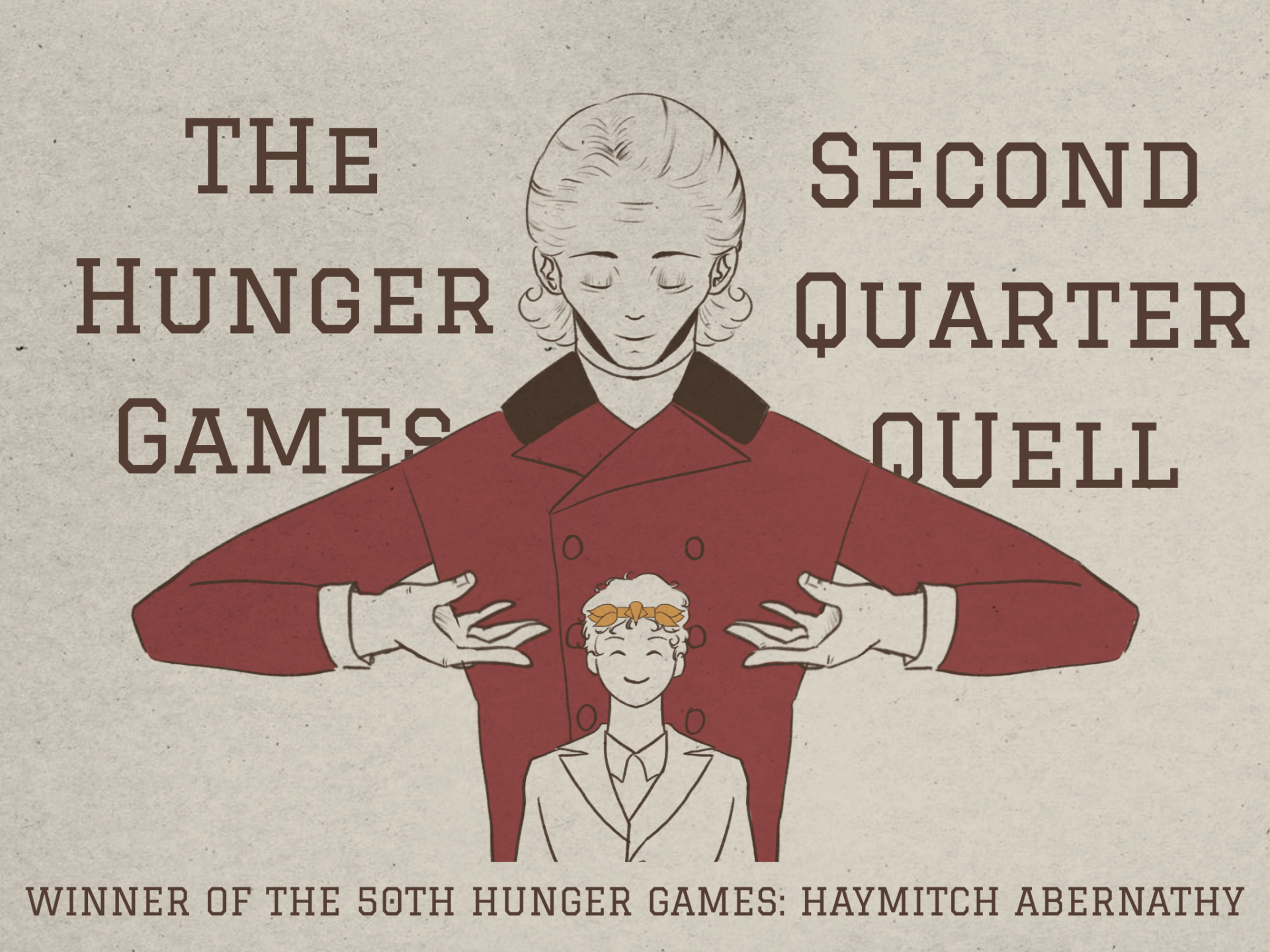
Collins’ latest prequel “Sunrise on the Reaping” (“SOTR”) follows Haymitch Abernathy (Joseph Zada), the victor of the 50th Hunger Games, or the “Second Quarter Quell” — a year marked by the reaping of not 24, but 48 tributes in celebration of the Capitol’s supremacy.
With 29 tracks featuring 27 artists/bands, the soundtrack is as immense as the Quarter Quell itself. While the Capitol holds total control over the narrative in Panem, music gives voice to the oppressed Districts. The companion record creates a twilight zone between music’s function in Collins’ fictional world and in our political realities. Like the companion album for the film adaptation of Collins’ earlier prequel “The Ballad of Songbirds and Snakes” (“TBOSAS”), the record accompanying “SOTR” asserts the unique ability of — and need for — music to speak truth to power.
While the album maintains a loyalty to the folk music heritage of the established canon, it has a decidedly heavier rock influence than tracks accompanying “TBOSAS.” This could reflect that “SOTR” is set forty years after “TBOSAS,” mirroring the real lineage of folk as a musical and ideological predecessor to rock in American history.
Haymitch is from District 12, just like Katniss Everdeen (Jennifer Lawrence) — the protagonist of the original trilogy — and Lucy Gray Baird (Rachel Zegler) from “TBOSAS.” It’s the most impoverished district, tasked with mining and exporting coal. And there are deep regional influences in Collins’ storytelling. Canonically, District 12 is located in Appalachia, as indicated by its mountainous, forested terrain and the Appalachian English dialect of its inhabitants. As such, many tracks reflect Appalachian folk sensibilities, while others manifest rock styles that emerged from their folk predecessors. The companion album demonstrates a commitment to narrative authenticity, fortifying its relevance to real-world politics.
That being said, several featured tracks come from within the film’s diegesis. For example, “The Old Therebefore,” a dirge from District 12 first introduced by Lucy Gray in “TBOSAS,” is reprised in a haunting rendition sung in the film by Burdock Everdeen (Scot Greenan) during a burial. This deepens the heritage of District 12 and further asserts its distinctively rural identity. Longtime fans of the series may also recognize “Deep in the Meadow,” sung by Jennifer Lawrence, a District 12 lullaby first appearing in “The Hunger Games,” when Katniss sings it to her younger sister Prim (Willow Shields). The self-referential nature of these songs demonstrates how music is inextricably woven into our historical, social and political truths.
In contrast, tracks like Noah Cyrus’ “Ash and Snow” enrich the storytelling of “SOTR” by assuming the narrative voices of its characters. Sung from Haymitch’s perspective, “Ash and Snow” is a searing promise. Unlike Haymitch’s central promise to his beloved Lenore Dove (Whitney Peak) — a promise of legacy and honor to end the games, referenced in Lizzy McAlpine’s galvanic “The Wheel” — the promise in “Ash and Snow” is one of wrath and personal retribution. Also of note is “Half Alive,” written and performed by Mckenna Grace, who plays Maysilee Donner, another tribute from District 12 and a key deuteragonist of “SOTR.” “Half Alive” is a deeply personal ballad, revealing the fear and vulnerability beneath Maysilee’s fiercely stoic and recalcitrant exterior, illustrating Grace’s perceptive commitment to the role. By animating the characters’ inner life, these tracks grant them vivid depth, pushing their story closer to reality.
But the songs that are most integral to the story of District 12 are those which offer themes of resistance to systemic oppression. Indeed, many tracks on the companion album read as anthems of protest, offering political critique that applies both within the world of “The Hunger Games” and outside of it.
The most memorable track is Tyler Childers’ “Old Money.” Vocals are set against rattling chains, factory whistles and other sounds of raw industry, situating listeners directly in the assembly line. Childers’ lyrics piercingly rebuke wealth inequality and the institutions that preserve plutocracy. Referencing the “ash of this American Dream,” he denounces the exploitation of working-class labor to feed the fortune of elites: “Expecting you to do it all and basically for free.”
“Old money / Birthing corporations raising them up right / Raising them like people ‘neath the ever-watchful eye / Of a government unwilling to raise the minimum wage,” Chidlers sings in the second verse, criticizing institutional corruption.
He highlights the deep injustice of governing institutions’ loyalty to the wealthy and their faceless corporations over the working-class, whose labor bolsters the entire system. All the while, he asks why — “Why can’t you get ahead?” or “Why’re you up worrying while your youngins are asleep?” — urging the audience to question the system in which they live. His final “Why?” descends into a dissonant, unnervingly prolonged mechanical whirring, echoing the pertinent and provocative notion from Wiress (Maya Hawke) — a past victor from District 3 — that “All machines can be broken.”
In the American epoch of generative Artificial Intelligence, excessive military spending, post-truth media and political violence against children, the parallels between Panem and the real world are upsettingly multitudinous. “The Hunger Games: Sunrise on the Reaping – The Album” illustrates how music offers a verisimilitude that underscores these similarities, empowering the whole of the text — the books, the films, the songs — to transcend mere entertainment to potent political discourse. This encapsulates why “The Hunger Games” has not only sustained mainstream relevance since its initial publication in 2008, but gained traction with audiences: Panem is disturbingly real in our systems and institutions. Music is essential to “The Hunger Games” as a body of work because of its capacity to sing about real-world injustices by singing about fictionalized ones. Nevertheless, the music of the companion album contends that the true arena of our concern is the system of power in which we reside.
Sean Watanabe is an Arts & Entertainment Intern for the fall 2026 quarter. He can be reached at seanlw@uci.edu.
Edited by Travis Foley and Geneses Navarro.

Interested in becoming an intern or a contributing writer for the Entertainment section?
Contact us at entertainment@newuniversity.org!