
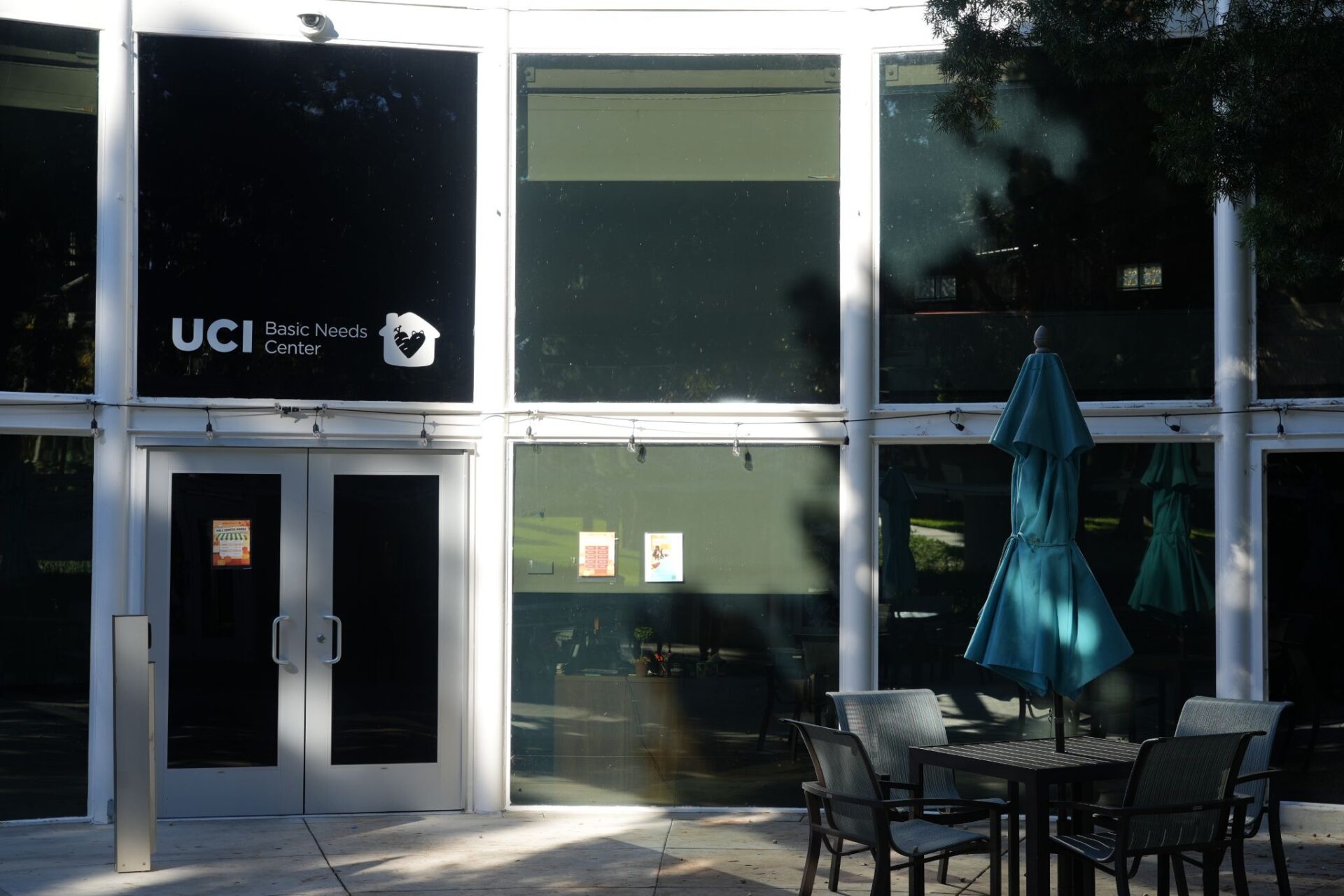

Over the past year, federal changes from President Donald Trump’s “One Big Beautiful Bill”, or H.R. 1, and the devastating loss of funding from a failed legislation has made the future of the Basic Needs Center uncertain. Despite these challenges, the center’s essential services remain available.
According to Andrea Mora, director of the UCI Basic Needs Center, 43% of the students on campus have identified as facing food insecurity in a 2024 UC undergraduate experience survey.
The Basic Needs Center strongly recommends that these students apply for CalFresh, California’s largest food program that provides low-income households with monthly financial support for food purchases. Federally known as the Supplemental Nutrition Assistance Program (SNAP), participating individuals are issued an Electronic Benefit Transfer (EBT) card that can be used to buy food. Students can receive up to $306 monthly in EBT benefits.
As of June 1, all college students enrolled in associates or bachelor’s degree programs at California public colleges are eligible for CalFresh, so long as they satisfy the citizenship or lawful permanent resident requirement and make under a certain income limit.
To help students learn about the program and submit their application, the Basic Needs Center partnered with the County of Orange Social Services Agency (OCSSA) to host CalFresh enrollment parties.
According to Tricia Yong, CalFresh coordinator at the Basic Needs Center, enrollment party attendees bring their required documents, fill out a CalFresh application and then meet with a caseworker who conducts their interview. Normally, a CalFresh application can take over 30 days for processing, but applicants at the enrollment parties receive their case decision on the spot with around 95 to 96% of applicants being approved.
“It’s a really fun event to have,” Yong told New University. “Students really love it because it’s like an expedited process.” OCSSA brings card printing vans to the events, so students can receive their EBT cards immediately after approval.
Elle Tanjuakio, a fourth year applied mathematics student, has been receiving CalFresh benefits. She told New University that the enrollment parties have been very helpful in expediting the application process.
“A lot of my friends had done the enrollment parties before, and they were saying how much faster it is than going through the whole system because it can take up to a few weeks to get fully certified,” Tanjuakio said. “It’s just so much easier.”
Beyond its practical advantages, Yong explained that enrollment parties have destigmatized the use of CalFresh for college students.
“People are more willing to sign up for [CalFresh] and use it, and they don’t feel ashamed,” Yong said. “[Enrollment parties have] really fostered a community of being a lot more willing to depend on our student resources.”
Some students say that receiving CalFresh benefits has been a burden lifted off their shoulders, as they no longer have to worry about accessing healthy meals or going hungry throughout the day.
“I feel like my access to meals is a lot more flexible,” Eisha Singh, a fourth year public health sciences student and CalFresh Lead, told New University. “With EBT and with CalFresh, I was able to buy more groceries. I was able to buy higher quality food.”
Due to the program’s support, Tanjuakio says that meals have not only become more accessible, but healthier as well.
“Groceries in and of itself is already expensive. So if I didn’t have my EBT, I feel like I’d go for the cheaper options of pre-prepared meals or going to fast food,” she said. “But now that I have EBT to cover a lot of the groceries and expenses, I can make home cooked meals that have a lot more nutrients.”
Since the implementation of President Trump’s H.R. 1 bill last fall, which includes $4.5 billion worth in annual cuts to food programs and changes in eligibility requirements, access to food assistance has been threatened nationwide. OC Food Bank Director Mark Lowry said that 40,000 county residents have lost CalFresh benefits over the past year.
UCI and California as a whole has managed to avoid any significant detriments as a result of this bill, but there are still some issues that pose obstacles to those in need of food benefits.
Yong said that one of the biggest impacts of H.R.1 felt by the Basic Needs Center is the loss of CalFresh eligibility for refugees and asylees. Previously, individuals under these statuses were able to qualify for CalFresh. Taking food assistance away from these populations with demonstrably high need has caused significant uncertainty for students who are not citizens or legal permanent residents.
Before H.R.1, recently graduated students could still access CalFresh benefits through waivers. Now, students will lose their food benefits three months from graduation if they fail to meet the work requirements.
Funding for CalFresh has been affected as well. Currently, funds from the federal government completely cover CalFresh benefits according to California Food Banks. But with the implementation of H.R. 1, the state will have to pay a portion of the cost of benefits starting in October 2027. The bill also changed how much the federal government contributes to the administrative costs of CalFresh. Previously, administration costs such as paying staff, printing EBT cards and operating call centers were 50% federally funded. In California, 35% is funded by the state and 15% by counties. Starting October 2026, federal funding will be reduced to 25%, leaving the state to cover 52.5% and the counties to cover 22.5% of funds.
Despite this, California has been handling the reduced funding well due to policy changes within California working to combat the overall impact of the bill.
“There’s a lot of really great…policy work and advocacy being done in California specifically,” Yong commented, citing how this has helped to offset the federal cuts to food programs.
Although the Basic Needs Center managed to avoid direct funding cuts from H.R. 1 itself, the center still faced financial struggles due to a Basic Needs Student Fee referendum failing to pass in last year’s ASUCI election.
Starting in 2016, an undergraduate referendum established a $4 quarterly fee that went towards funding the Basic Needs Center. The fee expired at the end of the 2025-26 academic year, which cost the center nearly $250,000 in yearly funding The 2026 referendum proposed a $15 fee to address the growing student need. Despite 86% of voters supporting the initiative, the referendum did not reach the 20% quorum needed to pass.
During the voting period, the elections website displayed an incorrect quorum calculation that the referendum had met the 20% quorum needed to pass, despite the actual quorum being 18.1%.
“We didn’t get any follow-up communication. We didn’t get any notice beforehand about it, and they were like, ‘Okay, this just kind of happened. There’s nothing else you get. This just happened,’” the student said. “It is what it is, which is really disheartening, given that basic needs is so important on our campus.”
Yong said that the future of the Basic Needs Center for the upcoming school year looked very uncertain. She said they had to consider reducing the food pantry hours to only two days, limiting access to essential groceries.
“It sucks that we had to consider which of these essential resources we needed to cut,” she said.
The Basic Needs Center was later able to secure funding from other sources. The Division of Student Affairs promised to provide up to $173,000 for basic needs services in the upcoming school year, and in June, Governor Gavin Newsom signed $20 million in the California budget in emergency funding for basic needs and disability services for UC campuses.
Though this will allow the Basic Needs Center to avoid making any serious cuts to their resources, the lack of funding from undergraduate student fees “deprives the Center of a budgetary cushion that would better equip them to deal with the anticipated increase in demand for basic needs services, ” the Basic Needs Referendum Co-Directors said.
A student involved in the referendum, who requested anonymity due to being unable to speak publicly about the referendum, explained that its failure to pass has affected the center’s ability to expand services to meet the growing student needs. The student said that the center is still finalizing the budget for the upcoming school year, as they continue looking to secure one-time funding and grants to simply keep existing services operating.
“There’s been a lot of band-aid solutions in order to try and… meet that need of what the referendum is currently not funding,” the student told New University. “Right now it’s a lot of like, ‘how do we shuffle things around?’ ‘How do we apply for external funding in order to meet that need?’”
In light of all these challenges to food assistance at both the local and federal level, students depending on these crucial resources may feel anxious when looking toward the upcoming school year.
“I was concerned,” Singh shared when recalling her reaction to the referendum failing to pass. She reported feeling scared that CalFresh benefits would be cut.
In response to these concerns, Yong reassures students that, though last year brought many changes to the Basic Needs Center and CalFresh, both are here to stay.
“You can still apply for CalFresh today,” she said. “It’s still a really great resource to rely on during your college time and years here.”
In regards to the center’s plans for the upcoming school year, Yong promises that Basic Needs remains committed to ensuring all students are able to put food on the table.
“We’re gonna do our best to be here for you,” Yong said. “We’re going to do everything we can to preserve the services that are most critical to helping our students.”
Nevaeh Medina is a News Staff Writer for the fall 2026 quarter. She can be reached at nevaem1@uci.edu.