
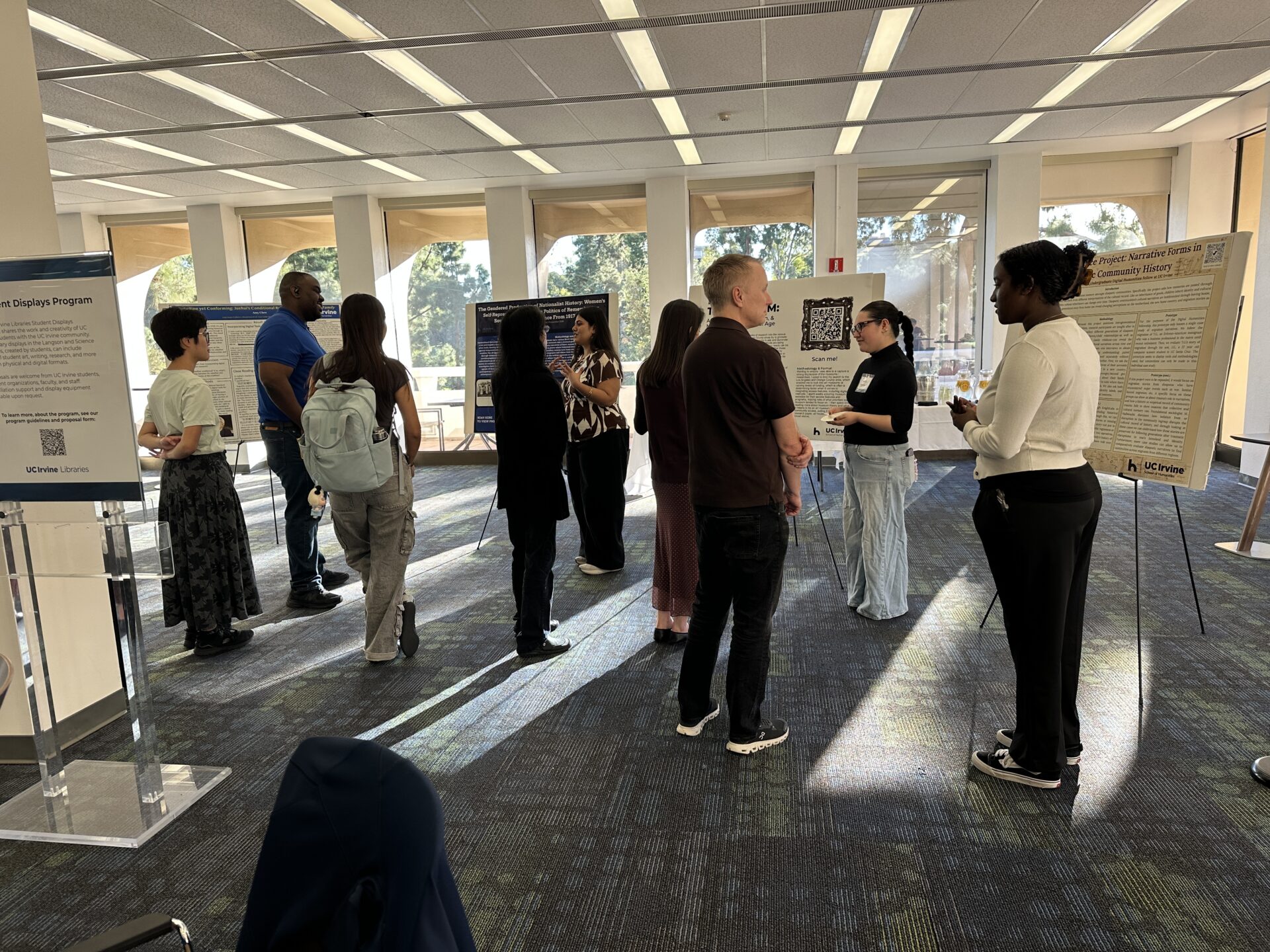

UCI undergraduates presented digital research projects at the Undergraduate Fellowship in the Digital Humanities showcase at the Langson Library on Nov. 6. The poster showcase and reception brought students together to discuss how they used technology to explore humanities questions.
Five students were selected for the 2026 fellowship cohort and provided with $1,250 each to “participate in workshops, conduct research and develop a digital project prototype,” according to the 2026 program details. The School of Humanities coordinates the program in partnership with UCI Libraries and the Digital Humanities Exchange (DHX).
Students learned methods such as mapping, text analysis and website development before applying those tools to their own research. Starting their work in the summer, they continued developing their projects into the fall, when they prepared posters and explained their work to visitors at the showcase.
As a digital humanities fellow this year, fourth-year art history student Makayla Newkirk developed “Meet Me at the Museum.” The project examined the relationship between digital methods, accessibility and the experience of visiting a museum.
Newkirk was inspired by personal experiences at the UCI Langson Orange County Museum of Art, where she guides visitors as they view the artwork. Visiting other museums also prompted her to consider how institutions of different sizes share information with their audiences.
She questioned if digital tools could support information accessibility and whether they change the role of museum employees.
“But making something available digitally and thinking about ways information can be available digitally helps broaden your scope,” Newkirk told New University. “Because I also feel like, especially right now with conversations about AI, people tend to almost stand on two very firm ends of the spectrum.”
Her initial plan focused on collecting information about museums in Los Angeles and Orange County. She wanted to compare institutions that used digital methods with those that approached accessibility in other ways.
An article shared by Amalia Herrmann, Chair of DHX and Newkirk’s internship supervisor, however, prompted her to shift her focus to the theory behind the choice of digitalizing aspects of museums. Newkirk developed a research paper exploring how digital tools fit into museum spaces, using information she had already collected to inform her discussion.
Newkirk then built a website for the first time, considering how its visual presentation could communicate the ideas in her paper.
“That was cool, now being able to work in this new sphere and figure out, okay, how do I visually now represent the vibe of my paper,” Newkirk said. “So that was also a huge digital moment because you’re working with ways of displaying information that you can’t really get just from describing it to someone.”
The fellowship’s workshops introduced additional approaches for Newkirk to consider. Sessions led by Herrmann covered tools such as geographic information systems, which allow researchers to work with location-based information.
Newkirk considered developing a searchable map of museums and their accessibility features. She ultimately returned to her original interest in the relationship between technology and the museum experience, while keeping those other methods in mind for future research.
For Madelynn Dickerson, head of Data, Publishing and Digital Scholarship at UCI Libraries, introducing students to unfamiliar tools has been part of the fellowship’s purpose since its founding.
Dickerson helped design the program in 2022 with School of Humanities professors Yong Chen and Deanna Shemek, as well as librarian Tatiana Bryant. Although she did not work with this year’s cohort, Dickerson described the collaboration as an opportunity for the libraries to extend its digital research instruction to undergraduates.
“We love working with students,” Dickerson told New University. “And a lot of the workshops that we do are for graduate students and faculty, and so [the fellowship] was a good opportunity to reach undergraduates.”
Dickerson described digital humanities as a field with multiple definitions, including using digital tools to investigate humanities questions and thinking about those questions computationally. These methods can include mapping, data analysis and digital storytelling.
“ This is the perennial question, and it’s always difficult to define digital humanities,” Dickerson said. “Some of the definitions are things like answering humanities questions with digital tools, or thinking about humanities questions computationally.”
Students often arrive with a research interest before knowing which tools could help them explore it. Learning to use those methods while developing a project can also cause them to reconsider their plans.
Past fellows have created digital components to complement research papers, giving audiences another way to engage with their topics. The program asks students to begin a project or develop a prototype, recognizing the time required to build a larger digital humanities project.
At the showcase, fellows translated their work into another format. They also condensed their research into posters and discussed their projects with professors, professionals and peers.
Newkirk’s project also encouraged her to consider the range of needs that museums serve and the limits of treating accessibility as a single issue.
“I think for my project specifically, I hope people take away that accessibility doesn’t look like one thing to every sort of person,” Newkirk said. “ It covers a really broad range, and everyone has accessibility needs, even if that’s not necessarily what they think of. And I think in terms of digital humanities, thinking that humanities can really be almost anything you want it to be.”
Past participants have drawn on the skills they learned through the fellowship when presenting at conferences and applying to graduate school.
“ When they come to the program with their own topic, it’s really motivating,” Dickerson said. “They really get to see their idea become transformative.”
Ashley Liau is a Features Intern for the fall 2026 quarter. She can be reached at liaua@uci.edu.
Edited by Aditya Biswas and Jaylynn Zi-Qing Tsui.