

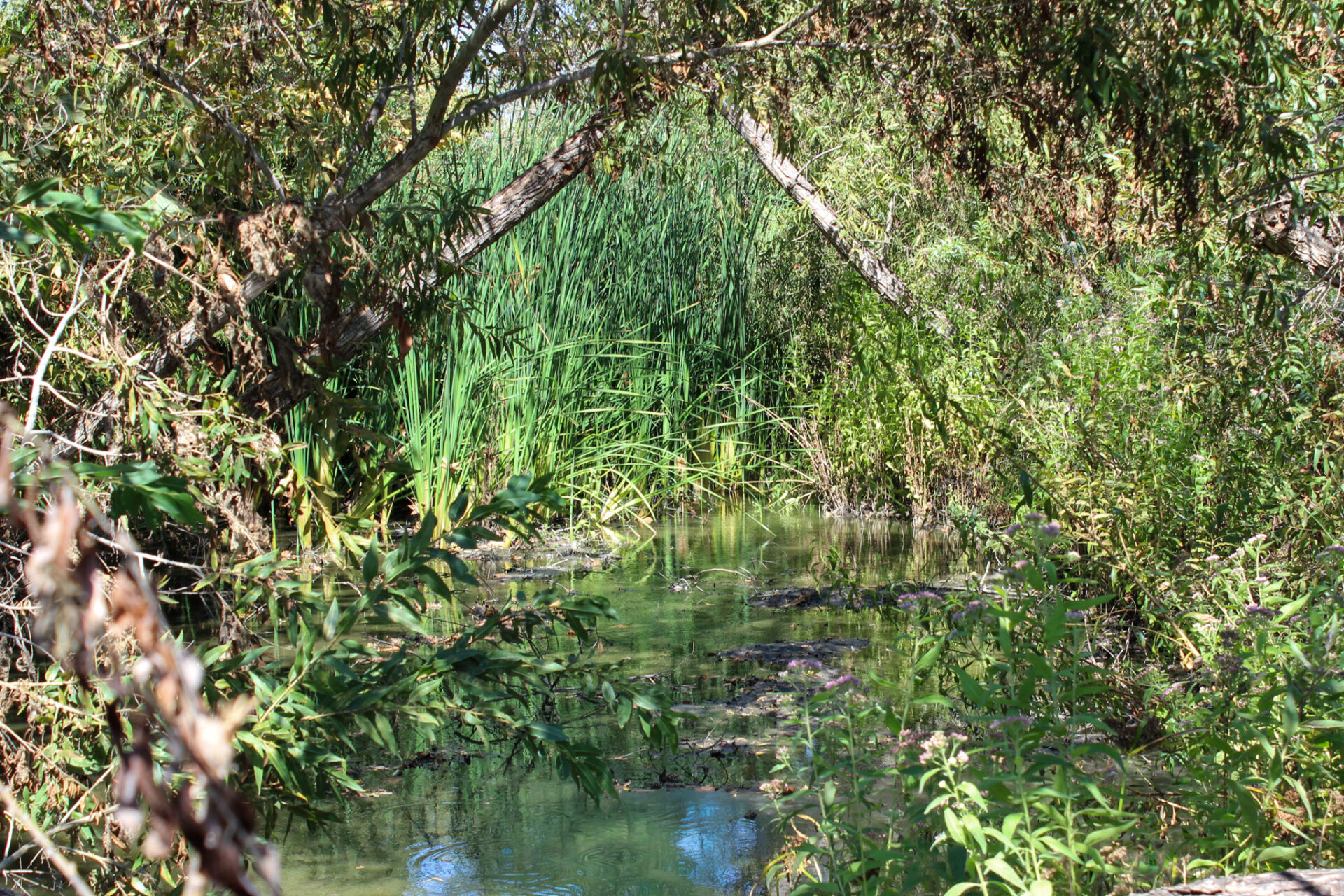

Before the early 1900s, much of Orange County was covered with more than 5,000 acres of dense, richly populated wetlands. Today, the San Joaquin Marsh is one of the last remnants of the once-expansive coastal wetland area, and the marsh is at risk of shrinking even further as climate change intensifies, potentially affecting dependent wildlife, UCI students and the Irvine community at large.
Established in 1969, the San Joaquin Marsh Reserve encompasses 202 acres managed by UC Irvine through UC Nature, a system-wide program that oversees 42 protected UC reserves. The reserve contains freshwater marshlands, shallow ponds, cattails and bulrushes, as well as two endangered bird species and other wildlife that rely on the marsh.
Much of what is now Irvine and Tustin was once an undivided network of wetlands known as la Cienega de las Ranas — the Swamp of the Frogs. After the wetlands were drained in the early 1900s for agricultural use and cleared for duck hunting in the mid-1900s, the marsh area became depleted, significantly shrinking to a present size of about 500 acres, compared to the 5,000 acres it encompassed before the developments. Now, rising sea levels are threatening life in the reserve.
Julie Coffey has worked with UCI since 2018 and manages the San Joaquin Marsh Reserve and the Ecological Preserve, a 60-acre coastal sage scrub and grassland habitat, as the campus reserves manager. She spoke to New University about how the reserve has been affected by climate change, pointing to urban development as the primary reason for Orange County’s wetlands disappearing in the past.
“I think the main insult to wetlands in Orange County, really, was development,” Coffey said. “There’s very little area left in Orange County undeveloped.”
While the marsh remains vulnerable because of development in the past century, wetlands — particularly coastal wetlands — face current consequences due to climate change. Wetland loss rates in the U.S. have increased by 50% between 2009 and 2019, resulting in a loss of 670,000 acres of wetlands, according to a U.S. Fish and Wildlife Service report.
In recent decades, global warming has become the most notable problem for coastal marshes, creating fluctuating weather patterns that lead to drought and flooding cycles.
Wetlands trap carbon dioxide, functioning as what Coffey described as “sinks of carbon.” During droughts, however, wetlands dry out and release carbon into the atmosphere, potentially causing them to function as sources of carbon instead.
“From a climate change perspective … we really want to keep our wetlands wet and keep them absorbing carbon,” Coffey said. Sea level rise can also increase flooding along the coast.
Aside from scouring — erosion from the wetland floor that can be caused by water movement — wetlands located in urbanized areas, like the San Joaquin Marsh, can also be exposed to pollutants and pathogens, including E. coli, during flooding events.
As sea levels rise, the San Joaquin Marsh Reserve faces the challenge of securing enough freshwater to circulate water throughout the reserve.
The marsh reserve is oriented upstream from Upper Newport Bay, a saltwater estuary, and adjacent to San Diego Creek. The marsh typically receives its water by either pumping water into the reserve or allowing water from San Diego Creek to enter.
San Diego Creek connects to Upper Newport Bay and has historically emptied into the estuary. However, as sea levels rise, saltwater from Upper Newport Bay moves farther upstream into the creek, raising its salinity and creating a challenge for the San Joaquin Marsh.
“If [the water from the creek] is salty, we can’t [let it into the marsh] because our plants and animals are going to die from the salt water,” Coffey said. “And once you let salt in, it doesn’t evaporate out, right? The water leaves, the salt stays.”
Maintaining sufficient water levels in the marsh is important, but keeping the ecosystem freshwater is also critical for its wildlife, many of which are specialized to the conditions of the San Joaquin Marsh.
For example, the reserve shelters one of the largest populations of southwestern pond turtles, the only native freshwater turtle species in Orange County. These turtles need a combination of open water, cattails and reeds, suitable nesting areas as well as reliable sources of nutrition. This combination of conditions is difficult to replicate in an urbanized pond.
Another species that has been affected by climate change is the federally endangered Ridgway’s rail, a bird traditionally associated with salt marshes such as those in Upper Newport Bay. According to a 2016 report, only one pair of the species was observed in the marsh. However, as sea level rise threatens salt marsh habitat, Ridgway’s rails have increasingly been observed moving into freshwater marshes.
The contrasting habitat needs of different species, along with the unpredictability of droughts, fires and floods caused by climate change, have emphasized the need for open space around the edge of the marsh, to allow it to adapt to changing environmental conditions.
“Climate change right now in urbanized, fragmented habitats like this — it brings up a lot of really interesting management questions of ‘which species are you trying to manage for?’” Coffey said. She has advocated against developing on the edge of the marsh in the past to preserve its adaptive capacity.
Aside from absorbing carbon and providing habitat for threatened and endangered species, the marsh benefits UCI students at a personal level. UC Nature’s mission is to provide natural resources for UC students, offering field trips, research opportunities and opportunities to engage with local ecosystems.
Erika Willnecker, a third-year biological sciences major, first experienced the San Joaquin Marsh during a cell biology lab field trip to collect samples of the environment.
“I feel like I learned a lot about the wildlife going there,” she said, reflecting on the opportunity to learn about the marsh from a biological perspective. “We learned what all the plants were and what potential animals can come [based on water piling up].”
Irvine residents also benefit from the marsh. In 1995, the Irvine Ranch Water District (IRWD) acquired 300 acres of marsh property adjacent to the reserve, which is now designated as the San Joaquin Marsh Wildlife Sanctuary. IRWD’s public wildlife sanctuary not only provides refuge for wildlife but also harnesses the marsh as a natural water treatment system.
Ian Swift, IRWD’s Natural Resources Manager, explained that the San Joaquin Marsh is the first and the largest of nearly 50 human-made water treatment wetlands made to naturally clean urban runoff before it flows into the Upper Newport Bay and the ocean.
To treat the urban runoff, water is pumped from San Diego Creek into a series of ponds. The ponds then use sunlight, multicellular organisms, nitrogen and phosphorus to remove bacteria The cleaner water goes back into the creek to eventually flow into the ocean, discouraging the growth of potentially toxic algae.
“The Marsh represents IRWD’s commitment to helping provide a sustainable environment for our customers and the public,” Swift wrote in an email to New University, emphasizing the water district’s goals of urban runoff water quality improvement, wildlife habitat restoration and public recreation.
For Coffey, it is important that people not only recognize the marsh, but truly cherish it.
“I think recognizing more that we’re a living landscape that has a lot of problems and challenges that we’re trying to deal with … hopefully folks will value that,” Coffey said.
While the UCI marsh reserve is working on circulating fresh water throughout the marsh, the IRWD marsh wildlife sanctuary has also made several recent restoration efforts.
Over the last five years, IRWD has restored at least 10 acres of marsh habitat, according to Swift, continuing to create a more liveable habitat for its wildlife. The water district has also modeled several reconstructed wetlands after the San Joaquin Marsh to naturally treat urban runoff across Irvine at large.
Jayna Miller is a News Intern for the summer 2026 quarter. She can be reached at millerjy@uci.edu.
Edited by Anika Denny and Tracy Sandoval.

