

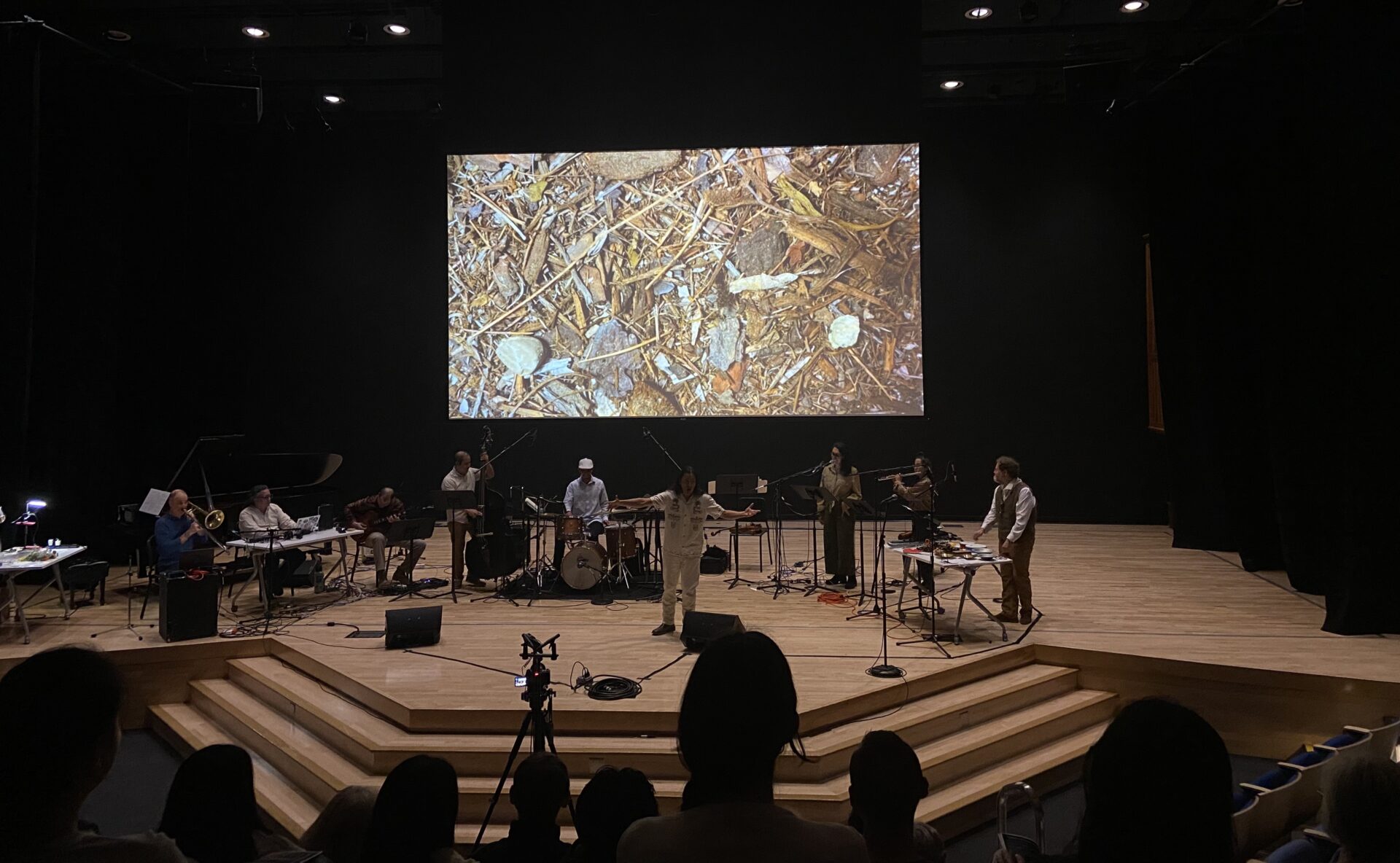

“Cauces Sónicos” brought musicians from Southern California and Baja California together for a free concert at UCI’s Winifred Smith Hall on Oct. 24. The concert featured original compositions that were developed collaboratively between university campuses and professional artists on both sides of the U.S.-Mexico border.
Co-led by UCI Robert & Marjorie Rawlins Chair of Music Michael Dessen and UC San Diego Associate Professor of Music Wilfrido Terrazas, the concert was part of a two-year project of undergraduate courses, traveling performances and musical compositions that explore cross-border interaction.
The ensemble included faculty, graduate students and professional artists associated with UCI, UC San Diego, Universidad Autónoma de Baja California and Ensenada, Mexico. Its members contributed compositions that left room for performers to shape the music together.
Fabricio Cavero, who completed his doctorate in UCI’s Integrated Composition, Improvisation and Technology program in June, served as a composer and performer.
“This idea departed from a group of friends who already had a trajectory playing together and doing things together,” Cavero told New University. “It was nice to feel that whole vibe in all the group when we gathered.”
His composition “Wiskiti” centered on a rhythmic pattern that he associated with traditional music across the Americas. Originally from Cusco, Peru, Cavero connected the pattern to cumbia’s presence across different Latin countries and communities.
The piece began with nine musicians separately improvising around a rhythm. During the first minute, each performer occupied an individual musical space, allowing multiple interpretations to coexist at once. In the second minute, the musicians formed three pairs and a trio, later moving into a quartet and quintet respectively before bringing the full ensemble together in the fourth minute.
Cavero compared the meeting of their improvisations to waterways joining one another.
“All [of] our improvisations about this rhythm, they encounter several rivers getting to the same stream,” Cavero said. “ And out of the kind of little chaos that was there, we end up jamming together and improvising a cumbia.”
The structure finally brought the musicians into a shared cumbia groove, where Cavero invited audience members to dance and sing.
The transition from separate sounds to a recognizable rhythm reflected his interest in giving listeners an entry point into experimental music. He described rhythm as one way to involve audiences who might expect familiar lyrics or musical patterns.
Improvisation also changed how the ensemble approached preparation. Rather than working only toward a fixed sequence of notes, the musicians developed structures that allowed them to respond to one another in performance.
“ I love the spontaneity of being able to play with musicians that understand this style, and it’s also less stressful because rehearsals are easier to manage,” Cavero said. “Every time the piece happens, it’s unique, even in rehearsal or in performance.”
The project, which received a $150,000 UC Alianza MX Award in 2025, included an undergraduate course connecting the three participating campuses and workshops with communities along the border.
Terrazas’ own musical education developed through crossing the border. Growing up in Ensenada, he traveled to San Diego as a teenager for flute lessons, youth orchestras and other musical opportunities.
Those experiences connected him with musicians who became friends and collaborators. When he joined UC San Diego as a professor in 2017, he continued developing projects across the region.
“For me, music-making is about bringing people together and developing connections, relationships, [and] growing up together,” Terrazas told New University. “[It is] understanding what it means to be in different communities, and to look at things from different perspectives and bringing those perspectives into dialogue.”
The ensemble’s preparation combined remote communication with in-person opportunities. Terrazas said musicians shared scores and recordings online, then coordinated rehearsals with workshops and festival appearances in Ensenada.
Some compositions took on different forms depending on who participated. A piece prepared for the concert stage could become a teaching tool for students or an activity developed with community members.
The project’s community work included a collaboration with the UC San Diego Center on Global Justice. Terrazas described creating a song for San Ysidro by writing a melody and inviting residents to contribute lyrics about their neighborhood.
The musicians then performed the song with community members; for Terrazas, the exchange allowed participants to contribute their own experiences to the music.
“Cauces Sónicos” has plans for a musical procession at a migrant shelter in Tijuana. Participants would move through the space in blue clothing, following a route inspired by water flowing down from the mountains.
The image is connected to the project’s name — Cauces Sónicos, or Sonic Channels, draws on the movement of water across a region divided by a national border, Terrazas said.
The Oct. 24 concert presented one part of that wider collaboration. While the ensemble brought different musical backgrounds to the stage, the willingness to learn from other participants was what made the music possible.
“If you are open and willing to connect with those people, your world can become richer and larger, and you can contribute to their world, and vice versa,” Terrazas said. “And that just makes you a better musician and a better person.”
Ashley Liau is a Features Intern for the fall 2026 quarter. She can be reached at liaua@uci.edu.
Edited by Avery Rosas

Interested in becoming an intern or a contributing writer for the City News section?
Contact us at citynews@newuniversity.org!