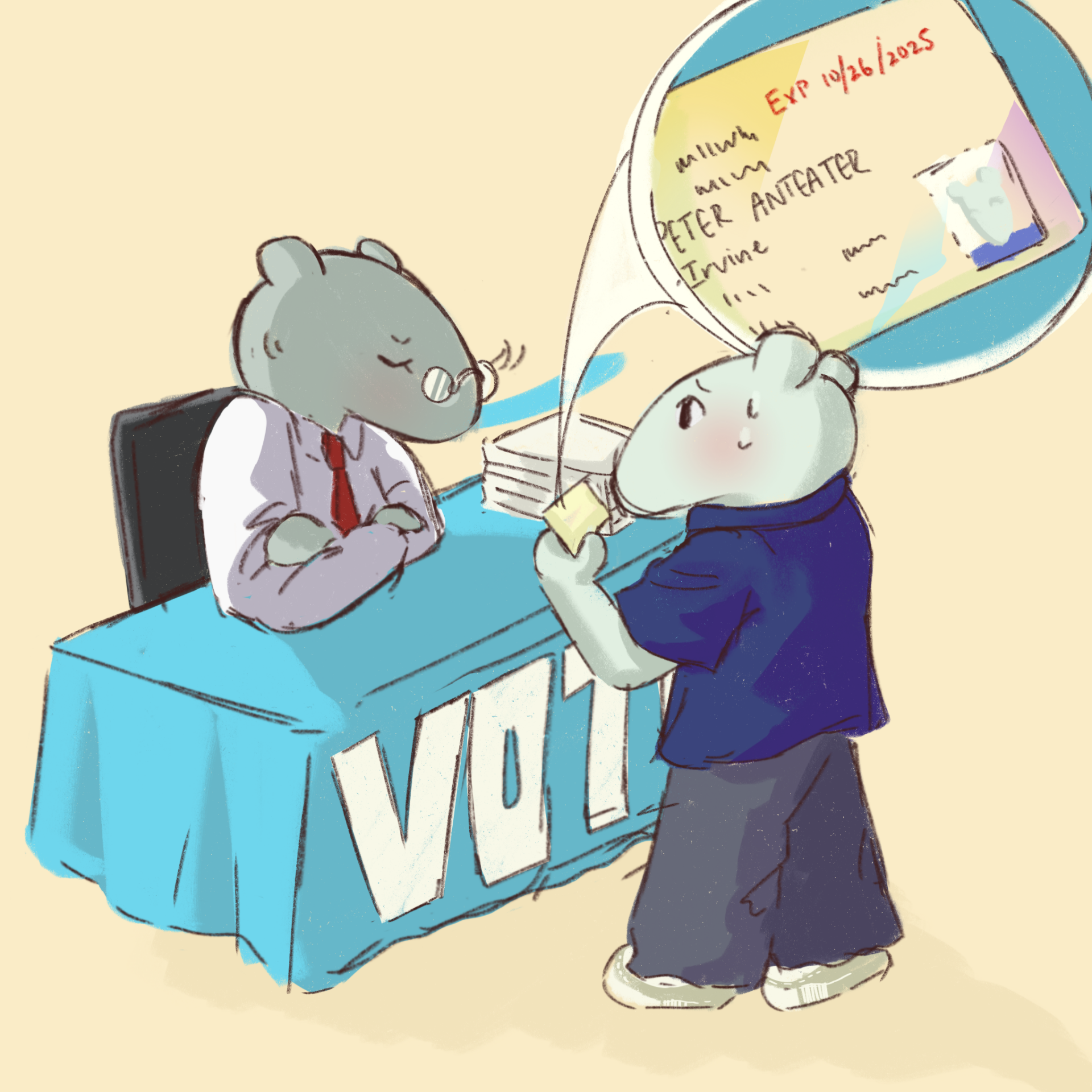

Proposition 39 (Prop 39), which is set to appear on the November 2026 California ballot, will begin requiring citizens to provide a government-issued identification at the ballot box if passed. The aim is simple: promote public trust in elections and flatten voter fraud. Yet, the policy proposal is more political than productive — not only are many claims cited by supporters not truthful, they ignore the fact that voter identification laws, more broadly, regress our elections by further shunning out disadvantaged groups systemically.
The proposition has four main provisions. It begins with the aforementioned identification requirement for in-person votes. In addition, mail-in voting will begin requiring the last four digits of a government-provided identification designated by the voter, such as Social Security. Should these digits not match the numbers under your voting profile, the vote will be immediately invalidated. As to enforcing these provisions, election officials will be required to report on the percentage of voter identification they have verified.
Prop 39 operates on a few interesting claims. The first and most pressing of the few is that there is a need to secure our elections. For sure, the passing of Prop 39 will give the impression that elections are more secure. But our elections are actually solidly secure already: voting fraud is already extremely rare, accounting for approximately 0.0003 percent and 0.0025 percent of all votes, according to The Brennan Center. Say 20 million Californians were to vote in the upcoming November ballot — that’s at its very worst 6,000 fraudulent votes counted, which is very unlikely to change the election result in even the tightest elections in California history. This is the most foundational claim Prop 39 operates on, and it reads as null.
Of course, it would be most preferable to see an attempt to quash all voter fraud, but its translation into reality forces the state to jump over more financial hurdles. The California Secretary of State estimates that the proposition will cost tens of millions of dollars to implement, if not in the low hundreds of millions. For a state with a festering debt concern and a history of continually borrowing rather than patching its gaping financial wound, should this really be the most prevalent issue?
Another frequently cited reason to support Prop 39 is that 36 other states have already adopted some form of voter identification law. Would this mean that California is lagging behind?
The key is to not conflate what is popular with what is effective. The most disastrous of Prop 39’s provisions is that it creates a reason to invalidate a perfectly legal vote otherwise, pushing election results further away from their core purpose: capturing constituent preferences. Should your name be misspelled, your identification number be one digit off or your address not be up-to-date, it is still an unfair punishment to have your vote immediately discarded. Those already disadvantaged — young voters, low-income individuals and people of color — will receive the brunt of these effects. The resulting election outcome will likely, therefore, be less telling of the population’s preferences than before the implementation.
Prop 39 may not be a barrier preventing you from casting your vote. It is, however, a potential reason to not count your vote. Its costs erect hurdles, and its possible passage supplies brewing political theories. At its core, it will distract our elections from achieving their fundamental responsibility of capturing a population’s preferences. No matter that Prop 39 may be favorable on paper, or that 36 other states have voter identification laws, it just is not a voter identification law, or even a type of policy that we should be pursuing.
Brian Lee is an Opinion Intern for the fall 2026 quarter. He can be reached at briancl4@uci.edu.
Edited by Julia Kremenetsky

Interested in becoming an intern or a contributing writer for the Opinion section?
Contact us at opinion@newuniversity.org!