

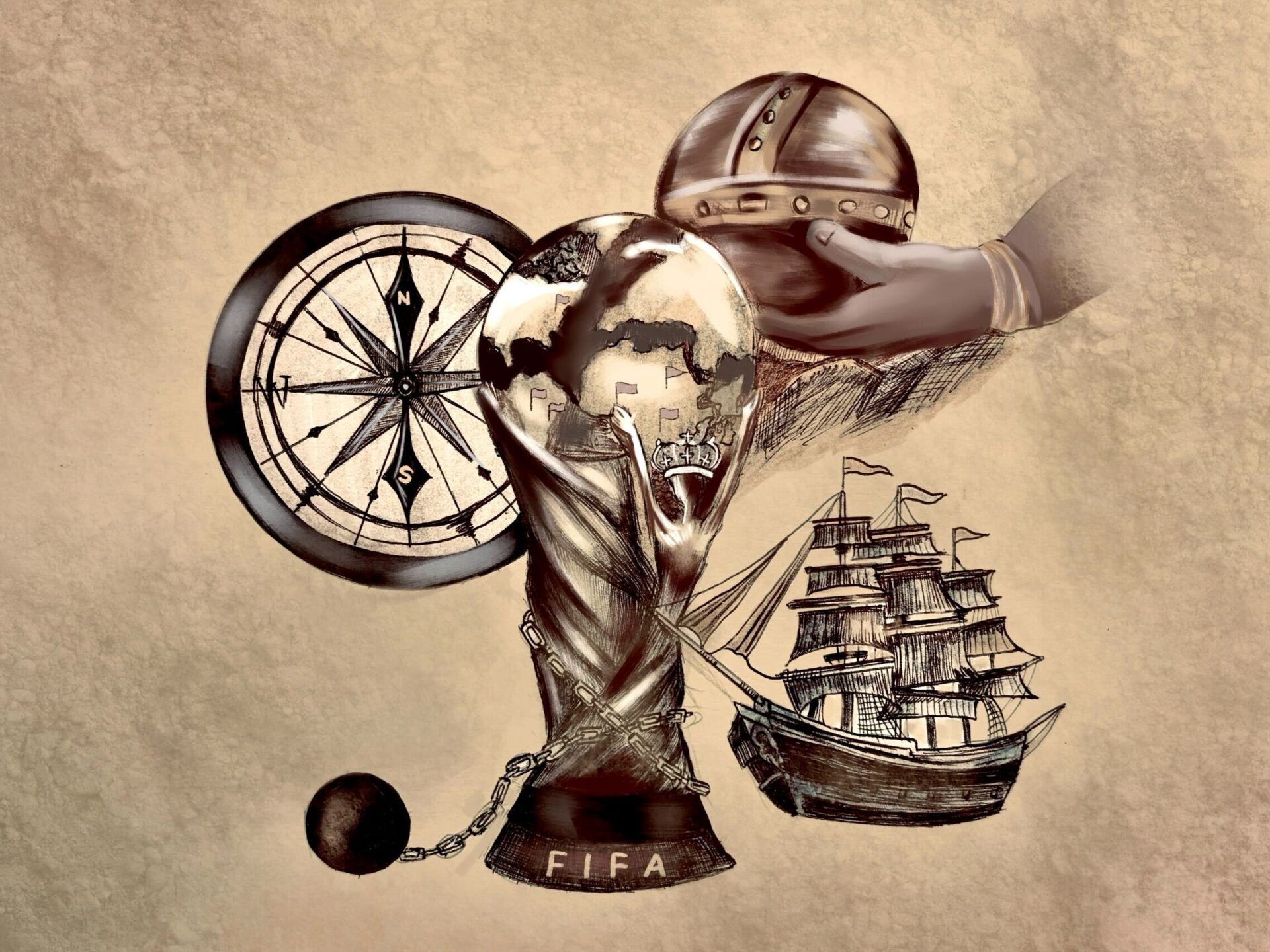


Over the past month, teams from around the globe have tested their mettle in exciting World Cup matches. Unfortunately, some fans have one major complaint: The supposedly meritocratic competition has been tainted by discrimination.
The World Cup is one of the most important sporting competitions in the world, gaining mass viewership in multiple languages and countries. In such a high-stakes event, fans are predictably tough on referees and other officials. But as tensions mount and more fans launch accusations of national discrimination, the Fédération Internationale de Football Association (FIFA) is struggling to prove its impartiality. Due to its board members’ unwillingness to counteract the lasting impacts of colonialism, the World Cup’s competitive and geopolitical goals just hit the woodwork.
While many western countries like to view colonialism as a time past, most scholars agree that colonial practices are directly responsible for the militarism, racism and discrimination of the modern day. During intentional athletic competitions, those immoral legacies are clearly broadcast throughout the globe. Centuries of economic exploitation impact wealth-locked athletic opportunities, and battles for equality are replayed in miniature. But because international athletic leadership is dominated by European men, those sensitive tensions are ignored. The end result is a competition fraught with discrimination.
Many fans believe that FIFA is most biased towards the World Cup’s reigning champions: Argentina. One match between Argentina and Egypt gained significant attention when it appeared that officials were unevenly using refereeing technology — the slow-motion equipped Video Assistant Referee (VAR) — to remove Egypt’s goals. Accusations of national discrimination immediately sprung up across social media platforms.
In online posts, discrimination accusations seem to be strengthened by Argentina’s tense approach to its colonial past. The nation has historically struggled with white supremacy and the glorification of colonialism.
During the World Cup itself, multiple Argentina fans have been accused of racially motivated violence towards fans of African countries like Egypt and Cabo Verde. The mistreatment was particularly frustrating in light of FIFA’s historical discrimination towards African countries. In 1966 the African countries unanimously boycotted the World Cup in order to protest European countries’ higher number of automatic bids; the protest failed, and Africans still face structural inequalities today. To many international fans, it seems as though Argentina’s connection to Europe resulted in preferential treatment from officials.
FIFA also seems to be supporting imperialism off the pitch. Its sitting president, Gianni Infantino, is a known friend of Russian president Vladimir Putin. In December, FIFA gave U.S. President Donald Trump the first-ever FIFA Peace Prize for “unit[ing] the world.” Throughout his second term, however, Trump has repeatedly upset international alliances by attacking countries like Venezuela and Iran. Even during the World Cup, the U.S. utilized its host privileges to control the travel and practice of Iranian players. After one match, a single phone call from Trump was also quickly followed by a rescinded foul. As a result, an American player who had received a red card — preventing his participation in the United States’ next game — was cleared of wrongdoing and allowed to play in the next match. While FIFA is meant to ensure competitive impartiality, it consistently ignores or rewards world leaders who claim national superiority.
The World Cup has also caused a spike in racism online. A senator from Paraguay has launched racially motivated insults at France’s team Captain Kylian Mbappé, while Paraguay’s former goalkeeper has called the French team a “squad from Africa.” Such insults have plagued France since the 2018 Olympics, when public figures implied that Black players of African descent were not truly French. Such claims blatantly ignore the lasting impacts of colonialism, which gave France a strong Black community. Again, the erasure of lingering colonialism enables racism and discrimination — this time, shaming Black French citizens for living in the country they were forcibly relocated to.
The World Cup is not the only international athletic competition to improperly address lingering colonialism. The 2026 Winter Olympics exacerbated a number of global tensions, as Trump demanded that U.S. Immigrations and Customs Enforcement (ICE) be allowed into Italy even as Chinese athletes like Eileen Gu faced vitriolic tweets from American politicians. The International Olympic Committee (IOC) also came under fire for allowing Israel to participate in the Olympics despite its invasion of Palestine, while simultaneously banning Russian participants due to the country’s war with Ukraine. Instead of taking a stance against Israel’s actions, the IOC simply removed its sanctions against Russia. They chose shallow neutrality over the protection of oppressed nations. As a result, imperialist nations have gained further legitimacy and power.
While international sports can unite modern fans — with many World Cup festivities doing exactly that — racism and conflict will continue to appear where colonialism is not addressed. Athletic authorities must work harder to protect players, fans and the spirit of international competition. Governments, organizations and individuals must reckon with the full extent of colonial history and its lasting impacts. Only then can international competitions reach both their athletic and diplomatic potential.
There are two years until the Summer Olympics, and four until the next World Cup. International athletic organizations must get to work.
Ruby Goodwin is an Opinion Staff Writer. She can be reached at regoodwi@uci.edu.
Edited by Julia Kremenetsky.

Ruby Goodwin is a first-year Literary Journalism student. She is interested in writing about American politics, media in sociology, and reforming the public education system. In her free time, she enjoys playing card games and reading mystery novels.