

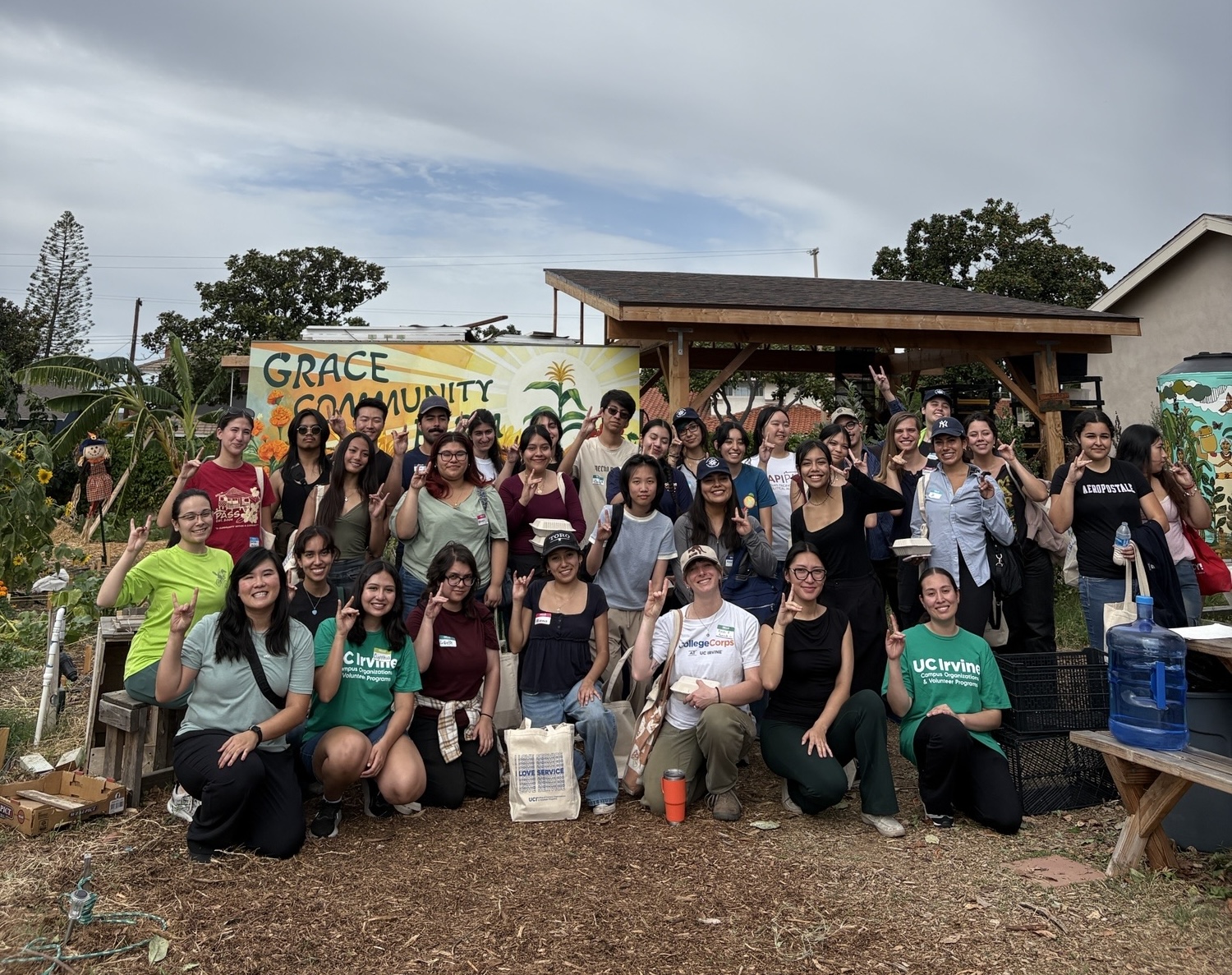


Members from multiple student organizations attended a service-learning project, Unity Through Service, on Oct. 17 in Orange. The event was hosted by Grace Community Farm in collaboration with CRECE Urban Farms, UCI’s Office of Campus Organizations and Volunteer Programs (COVP) and the Latinx Resource Center.
Student organizations Kababayan, Movimiento Estudiantil Chicanx de Aztlan (MEChA), Students Advocating For Immigrant Rights and Equity (SAFIRE), Pilipinx-Americans in Social Studies (PASS) and Society for Advancement of Chicanos/Hispanics & Native Americans in Science (SACNAS) were involved in planning the day’s agenda.
At the event, UCI students explored Filipino and Mexican American contributions in the farmworkers’ movement through community farm volunteering, student storytelling and discussions.
The day began with participants meeting at UCI’s flagpoles and completing a pre-event survey before boarding a bus to Grace Community Farm, an urban farm located in Orange, Calif. On-site introductions and a land acknowledgment preceded a tour of the grounds.
During the tour, students visited the nursery and learned about the farm’s plants and composting practices. There were fruit trees, marigolds and an area where worms helped produce nutrients for the soil.
At the farm, students worked on the grounds and learned about the communities behind the farmworkers’ movement. Participants rotated between farm service and a guided zine-making activity. Using sticks and twine, students supported the stems to keep the plants upright. Others distributed mulch, worked in the nursery and tended succulents.
Student leaders contributed to the agenda, presentation material and discussions. Fourth-year cognitive sciences student Cynthia Roxanne Ortiz helped facilitate the event as a volunteer activities coordinator with COVP. Preparing the presentation prompted her to learn more about her family’s connections to agricultural labor.
“I also learned that some of my family members were farm workers in the 1970s,” Ortiz said in an email to New University. “Hearing our student speakers share their families’ experiences with farm worker exploitation through the Bracero Program and on plantations in Hawaii inspired me to learn more about my Mexican American family history.”
Fourth-year history student and MEChA’s advocacy chair, Lizbeth Vargas, was a select student leader and presenter at the event. She emphasized the often overlooked contributions of Filipino farmworkers to the farmworkers’ movement.
“A lot of people, at least from the Latino side, only typically see the farmworkers’ organization as mainly Mexicans and Mexican Americans,” Vargas told New University. “But it was both Filipino and Mexican workers who worked in the fields.”
Vargas spoke about how many crucial members in the farmworkers’ movement may be overshadowed by more popular figures in history textbooks.
Larry Itliong, a Filipino American labor organizer, helped lead Filipino farmworkers in the 1965 strike against grape growers in Delano, Calif. He then persuaded the predominantly Mexican American National Farm Workers Association to join the strike.
“ Not a lot of people knew, at least from the Mexican side, did not know that Larry Itliong was a key founder of the movement,” Vargas said. “He was of Filipino descent. But it wasn’t just Larry Itliong — it was a lot of other Filipino farmworkers, like Philip Vera Cruz, Cornelia Delute and Lorraine Agtang.”
Vargas pointed to Dolores Huerta’s contributions as another part of the movement’s history that she wanted students to recognize. Co-founding the National Farm Workers Association with Cesar Chavez in 1962, Huerta organized boycotts and served as a lobbyist and lead contract negotiator for the union.
“ One of the students [at the event] talked about their experiences with their family being farmworkers,” Vargas said. “She told us how her mom and her dad were both farmworkers. Her mom is Filipino, and her dad is Mexican. So knowing that there’s that connection too is really awesome.”
Fourth-year urban studies and criminology, law and society student Charlotte Dunlap, PASS’s external vice president, connected the physical farm work to her family’s experience working on plantations in the Philippines.
“ While I don’t have connections specifically to the United Farm Workers movement, it does put you in their shoes, in a way,” Dunlap told New University.
During the other rotation, students assembled small booklets using historical information and images prepared by the committee. Scissors, glue sticks, washi tape, stickers, markers and colored pencils were available for decorating the zines.
The accompanying presentation covered the farmworkers’ movement’s origins, participants, outcomes and relevance today. Student leaders divided the presentation among themselves, and participants read material aloud as they worked.
Discussions addressed collective organizing and the contributions of people beyond the movement’s most widely recognized leaders. Dunlap said she wanted participants to recognize the role of communities working together across cultural differences.
“ There’s a lot of conversations around one or two specific leaders within the movement,” Dunlap said. “But organizing really is a joint effort, and it was not just one or two leaders; it was two whole communities coming together. I hope people come out of this really seeing how strong collective power can be … across cultural differences and backgrounds.”
The annual event’s October timing intentionally coincided with Filipino American History Month and Hispanic Heritage Month.
“ The idea of counter-storytelling drew me to this event,” Assistant Director of Campus Organizations and Volunteer Programs Kathy Dong told New University. “ I hope that students, some students will feel seen, of course. I also think students hopefully feel empowered by their histories … and to believe in resiliency and the power of people.”
Students ended the day of service with the Unity Clap and Isang Bagsak, a term coined by Larry Itliong that Mexican and Filipino farm workers would call out to one another to convey that they were still working together.
Isang Bagsak is part of the Unity Clap — students gathered in a circle and began by clapping slowly together, before gradually accelerating and growing louder. It ends with the call-and-response “Isang,” then “Bagsak.” Translated from Tagalog, the phrase “ Isang Bagsak” itself roughly means “when one falls, we all fall; when one rises, we all rise.”
“[The students] were really interconnected with each other,” Vargas said. “They wanted to work with each other, and they wanted to provide for the community as much as possible.”
UCI’s Campus Organizations and Volunteer Programs host service projects each quarter that highlight different forms of history.
“Farm workers around the world are still fighting for humane treatment and fair working conditions,” Ortiz said. “I would love to see collaborations like Unity Through Service continue in the future to raise awareness about the importance of cross-cultural solidarity in advancing human rights everywhere.”
Ashley Liau is a Features Intern for the fall 2026 quarter. She can be reached at liaua@uci.edu.
Edited by Avery Rosas and Geneses Navarro.

Interested in becoming an intern or a contributing writer for the City News section?
Contact us at citynews@newuniversity.org!