

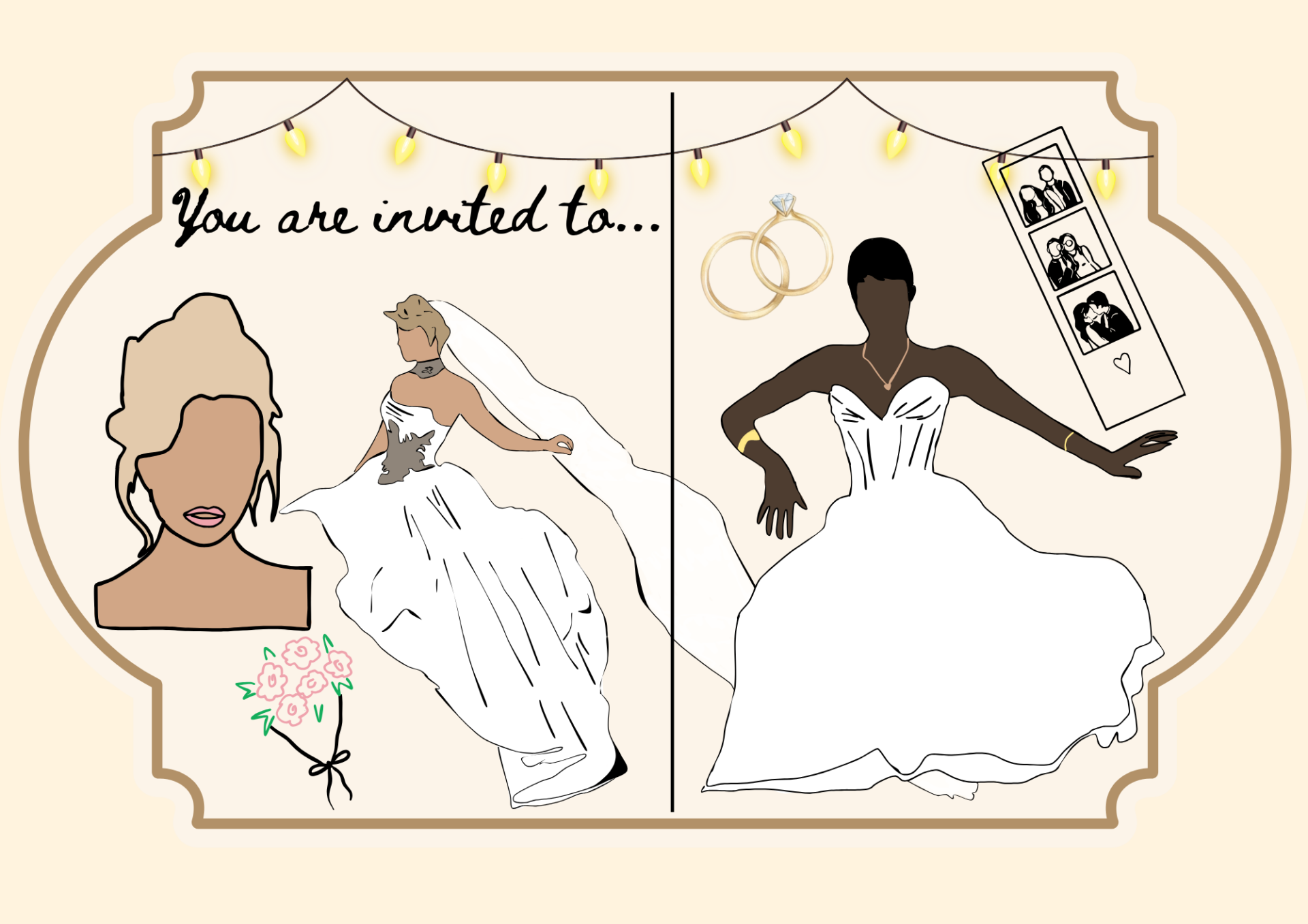


Wedding bells and ringtones have rung over the past week as influencers have tied the knot in very public ways. From Paige Lorenze and Tommy Paul to Shay Sullivan and Casey Johnson, recent weddings have been placed under the internet’s magnifying glass. Every detail is being dissected in pursuit of finding a deeper meaning than just champagne towers.
The scrutiny is not accidental. Weddings have become increasingly intertwined with social media, where celebrations can function as postable milestones, cultural statements and highly visible displays of consumption. A 2024 study examined the social visibility of wedding consumption during Chinese wedding ceremonies and found that increased social visibility was associated with greater conspicuous consumption. The growing pressure to make our experiences visible raises questions about how much of what we present online reflects genuine self-expression and how much is shaped by our desire to be seen, validated, and perceived a certain way.
Even the wedding photography industry has adapted: Vogue reported in 2025 on the growing popularity of wedding content creators hired specifically to produce social media-ready photographs and videos.
For influencers, the need to plan for their wedding to be post-worthy is even more pronounced. Their careers depend on making everyday life visible, desirable and constantly new. Yet when it comes to a wedding — an event traditionally associated with permanence — the most compelling celebrations seem to move in the opposite direction.
The best influencer weddings are not advertisements for a lifestyle or copies of whatever aesthetic is currently trending. They are opportunities to turn fashion into art and self-expression, using history to create something that feels personal enough to outlast the algorithm.
Sullivan’s wedding to former reality television star-turned-TikToker, Johnson offers one example. The couple married at Castello di Celsa in Sovicille, Italy, on July 15. Sullivan wore a strapless Kim Kassas ballgown, from the La Cocotte collection, complete with crystal embellishment, a corseted bodice, matching choker and cathedral-length veil.
The important part of the dress, however, is not simply that it is extravagant. Its inspiration pulls from the past. Kim Kassas described the La Cocotte collection as a vision of 1950s Paris, an era in which haute couture represented a renewed celebration of beauty following the austerity of World War II.
As Vogue’s Lilah Ramzi explains, Christian Dior’s “New Look” helped usher in an era of dramatic silhouettes and extravagance after years of wartime rationing, transforming bridal fashion into a celebration of romance and craftsmanship.
Sullivan’s gown, therefore, references more than a particular decade. It captures a moment in history when wedding gowns conveyed a message: beauty was something worth preserving after hardship.
That is precisely what makes the historical reference valuable. Sullivan works in an industry where trends can become irrelevant within weeks, while her wedding is supposed to mark something permanent. Evoking 1950s couture gives the celebration a visual language that exists outside the immediate trend cycle. History becomes a creative resource, allowing Sullivan to borrow from the romance and craftsmanship associated with mid-century couture without attempting to recreate the life of a 1950s woman.
Lorenze and Paul approach that desire for permanence differently.
Lorenze first gained notoriety through content creation on Instagram, YouTube and TikTok, she later launched her East Coast-inspired clothing brand, Dairy Boy. They married on July 17, at Old Westbury Gardens on Long Island, a setting steeped in American heritage and old-world romance.
Covered by Vogue, the ceremony evoked the polished Americana of 1990s Ralph Lauren and Calvin Klein campaigns, complete with the quintessential grain and muted color palettes of film photography. Lorenze’s Carolina Herrera gown similarly communicated restraint and elegance. When asked why she chose the designer, Lorenze told Vogue, “I think Carolina Herrera represents elegance and timelessness, and it’s an American designer (Wes Gordon), which is really important to me.”
Lorenze is not simply choosing an old-fashioned dress because old-fashioned dresses are currently fashionable. She is using fashion to communicate something about herself: her relationship to American identity, romance and belonging. Her wedding’s references to Victorian silhouettes, aristocratic estates, and 1990s Americana are not meant to reproduce any one historical period. For Lorenze, it seems as though history becomes a way of expressing what she wants her wedding to mean rather than what the algorithm tells her it should look like.
That distinction matters because social media has made weddings increasingly visible and increasingly commercial. Couples can now turn every dress fitting, venue reveal and ceremony detail into content. Influencers can receive brand partnerships, media attention and engagement from events that were once private celebrations. In 2026, wedding influencers are marketed as a distinct category with measurable impressions, engagement rates and monetary value for brands.
Yet, visibility and commercialization do not necessarily erase authenticity. Influencers can use these same tools to create something more personal: a wedding that is photographed, posted and monetized while still existing as an authentic and sincere representation of the couple.
Sullivan’s 1950s couture fantasy and Lorenze’s American romanticism demonstrate what that can look like. Both weddings use fashion to slow down an inherently fast-moving culture. Their clothes reference eras that have already survived their own trend cycles, allowing the brides to reconstruct identities that feel connected to something larger than the present.
For people whose careers depend on being constantly new, perhaps the ultimate luxury is permanence.
The most meaningful influencer weddings are not timeless because they belong to no era. They are timeless because they use the past to express something that still matters in the present: romance, belonging, beauty and identity. Fashion becomes more than just a decoration; it becomes a language for deciding what is worth carrying forward.
In a culture that always asks what comes next, maybe the most powerful statement an influencer can make is what they want to last.
Jordan Salter is an Arts & Entertainment Intern for the summer 2026 quarter. She can be reached at jasalter@uci.edu.
Edited by Avani Kumar, Ruby Goodwin and Zara Baker

Interested in becoming an intern or a contributing writer for the Opinion section?
Contact us at opinion@newuniversity.org!