

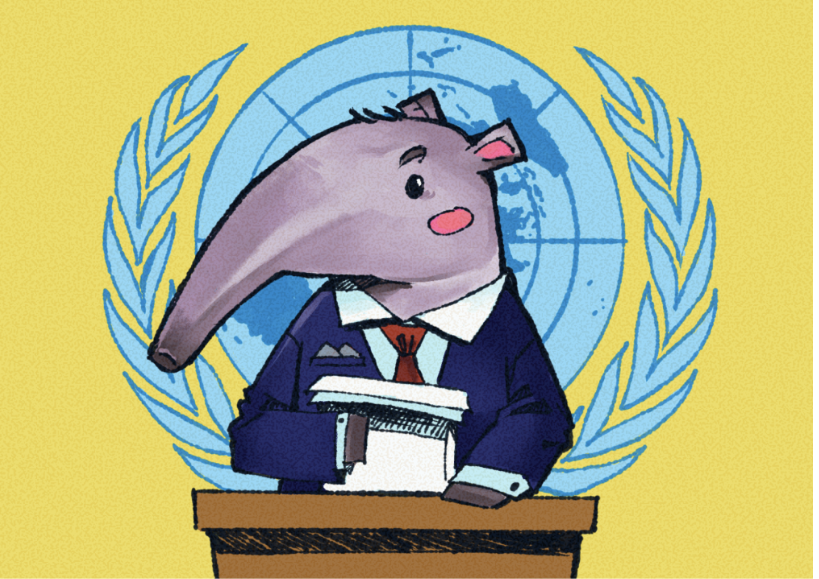


In the midst of the Second World War, the Allied Powers created the United Nations (UN) — a global peacekeeping organization dedicated to preventing world-wide conflict through international cooperation. When the war was over in 1945, the victors established themselves as the Permanent 5 (P5): the United States, the United Kingdom, the Soviet Union, France and China. This made up the UN Security Council, where they were given permanent membership and a special privilege: the veto power. This gave any member of the P5 the power to strike down international resolution or action with just one vote.
Over time, it has become blatantly apparent that the UN veto power has become a way for these nations to permit their abuses of power as a means to advance their personal agendas. And honestly, the UN and its reputation has become a really bad joke in international politics. The veto power must be abolished to strive for a more democratic process because it causes too much administrative gridlock, and it’s evolved to become the antithesis of the UN’s goals.
The veto power often creates a deadlock for critical action in immediate affairs. A tragic event that showcases this is the 1994 Rwandan Genocide. After generations of classist tensions originating from Belgian rule, the boiling pot exploded in a Hutu-driven ethnic cleansing of the Tutsi people. The United Nations refused to help the Tutsi people, reducing their stationed peacekeeping units — U.N. Assistance Mission to Rwanda (UNAMIR) — from 2,500 to only 270 personnel.
The United States and France threatened to use their veto powers with the “hidden veto” because they didn’t want to repeat the infamous 1993 U.S. intervention in Somalia, where 18 U.S. servicemen were killed in the Black Hawk Down Incident. They refused to label it a genocide in their UN resolutions, as that would obligate the UN member states to assist Rwanda according to the 1948 Genocide Convention, which was made after the Holocaust.
Numerous countries in the UN General Assembly pressured the UN Security Council to declare it a genocide, but to no avail. Close to 500,000 to 1 million Tutsis were murdered in 100 days. Because of the veto power, the rest of the United Nations that wanted to provide assistance couldn’t do so until it was too late. The P5 members held near-absolute power in the United Nations and were the determiners of an important decision like this. Thus, as showcased in 1994 Rwanda, even when there is a majority of countries that support an issue, one vote from the P5 can strike it all down.
Furthermore, the UN veto power defeats the purpose of the United Nations itself. The first article of the UN Charter reports that the UN’s mission is to maintain international peace and security. However, the P5’s special privilege to veto raises a rather interesting question: What if a P5 member engages in conflict? With this, the P5 member can strike down any action from the UN for its own international transgressions. There is no binding contingency plan for the UN General Assembly to fight back.
This is exactly what happened in 2022 with the Russian Federation’s invasion of Ukraine. The UN Security Council wanted to act fast and demanded an immediate ceasefire, but Russia’s veto single-handedly killed the resolution. By having this immense and absolute authority as a whole, these P5 states are shielded from international law and consequence. This makes it evident that these P5 countries shouldn’t have this much power.
A democratic process like checks and balances ensures that all countries are held accountable. In the United States, it works quite effectively with the balance of powers among the Executive, Judicial and Legislative branches. We can mirror those parallels to the UN, with the Executive being the UN Security Council and P5, the Judicial being the International Court of Justice and the Legislative being the UN General Assembly. This way, all members of the United Nations are held accountable and are allowed to achieve their founding purpose of international peace.
The framers of the UN believed that the founding members would leave if they weren’t given the veto power because then they would be pressured to take actions against their interests, just like with what happened with the League of Nations. However, this power has allowed these countries to commit atrocities without international pressure or consequence. It’s also enabled them to ignore real-world crises like what happened with Rwanda. It’s time to shed light on this poor system and work together to make it better.
The veto power should be abolished to stop this decision-making paralysis from the P5. The evidence is clear that there is too much gridlock in the UN’s administrative bureaucracy that makes immediate action impossible. The veto power has evolved from a way to keep the P5 members involved in world order to a way for the P5 to abuse their power. With the removal of the veto power for a more favorably democratic process, the UN’s status as a joke will cease and become a shining beacon of the free world.
Aarya Banerjee is an Opinion Intern for summer 2026 quarter. He can be reached at asbaner1@uci.edu.

Interested in becoming an intern or a contributing writer for the Opinion section?
Contact us at opinion@newuniversity.org!