

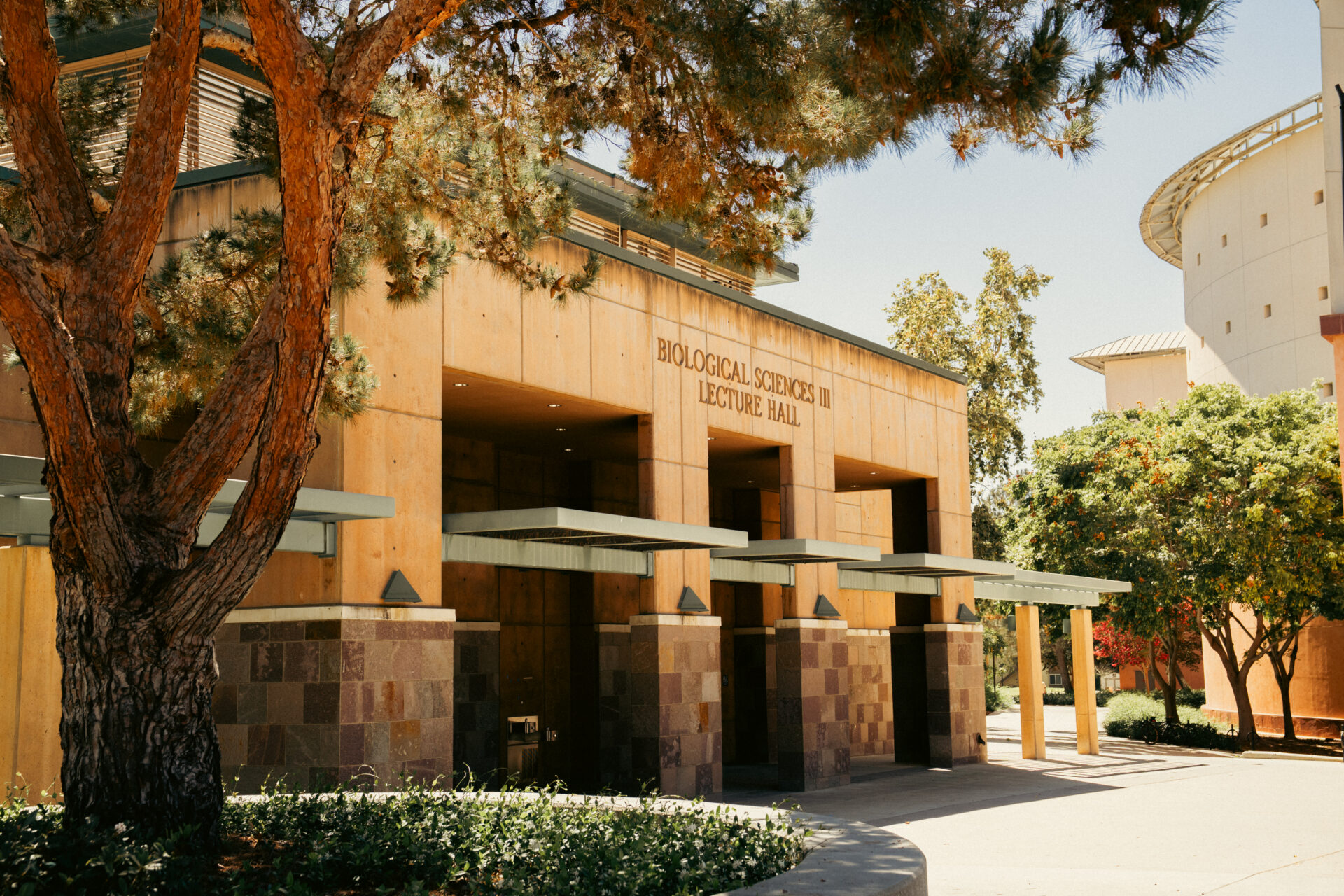

Advisors at UC Irvine’s Charlie Dunlop School of Biological Sciences continue to support students in summer. Similar to the academic year, advisors answer emails and live chats and meet with students about their concerns. Instead of meeting a large portion of their advisees at their on-campus office, summer meetings are primarily held on Zoom.
While much of the day-to-day advising for returning students remains the same, there is a fresh influx of summer advising sessions for newly admitted first-year students and transfer students preparing for the upcoming academic year.
“Everybody’s planning around in summer. Basically, what does our full year ahead look like?” the School of Biological Science’s Senior Advisor and Director of Program Development, Jenna Bague-Sampson, told New University.
After graduating from UCI with a degree in environmental analysis and design, a major that no longer exists in the School of Social Ecology, Bague-Sampson went on to gain about 25 years of experience in academic advising. Before advisory, she worked as a research associate in the Epidemiology Division just after her graduation in 1998. Then, she joined the School of Social Ecology as an academic advisor in 2001. In December 2005, she then became the advisor for the School of Biological Sciences.
Much of her summer preparation for the upcoming school year now takes place behind the scenes, including evaluating the curricula for incoming students. For example, advisors review transfer students’ previous coursework to determine which credits will transfer over to UCI and which degree requirements students still need to complete.
By the time advisors meet with newly admitted students during the Student Parent Orientation Program (SPOP), they can provide more accurate information about the courses students should take.
“We’re looking at, okay, before they come to SPOP, are they eligible to enroll in [chemistry (chem) classes]? Do they have credit for Chem 1A via [Advanced Placement classes]?” Bague-Sampson said.
After summer preparation for incoming students, advisors continue supporting students throughout the academic year.
In the School of Biological Sciences, that support includes helping students to get involved in research. Students can enroll in Biological Sciences (Bio Sci) 199, a course that allows students to earn units and grade credit by conducting research with faculty in the School of Medicine or at the UCI Medical Center. Enrollment in Bio Sci 199 takes place during the first two weeks of the quarter, making the advising office busy at that time.
For incoming students in the School of Biological Sciences, advisors can also help organize learning communities. Bague-Sampson said that first-year students take several courses together. These include two seminars, Bio Sci 2A and 2B, and a lab, Bio Sci 90L. Taking these courses together helps establish a community among first-year students. Transfer students also take a seminar course, Bio Sci 190.
Advising, however, extends beyond course planning and academic programs.
The advising office also organizes activities to help students manage stress and connect with the community. Advisors provide postcards and crafting materials for Valentine’s Day and bring therapy dogs to campus. Bague-Sampson said that the advising office tries to plan such activities once a quarter.
“Sometimes we’ll find, especially for newer students like first-year students, that sometimes there’s outside pressures about why they’re choosing to do pre-health or why they’re choosing to be bio [sci majors],” Bague-Sampson said. “Part of it is really just checking in to make sure that our students are really where they want to be and where they think they can thrive.”
That concern for student well-being also extends to academic advising.
Bague-Sampson said many students do not know that they can discuss academic struggles with their advisors.
“I always tell students, ‘Hey, after an exam, if you didn’t do as well as you hoped, if you can, go over it with your [teaching assistant] or your instructor to see if like you’re missing out on big concepts, or you were just feeling rushed and didn’t read things thoroughly, or made like mathematical mistakes,’” Bague-Sampson said.
She also encouraged students to maintain a life outside of school, despite the pressure of striving for good grades.
“Just remembering, like exercise, you know, [spending] time with your chosen community, whether it’s family or friends or whatever, but trying to just keep some balance,” Bague-Sampson said.
With many advisors in the office representing different personalities and age groups, students may find themselves more comfortable working with one advisor over another. Despite these differences, Bague-Sampson said the advisors share the same goal of supporting students based on their individual needs.
“If [students] are struggling, even if we don’t know the answer, hopefully we can direct them to the place that does if they don’t know where else to go,” Bague-Sampson said.
Chloe Mo is a Features Intern for the summer 2026 quarter. She can be reached at chloem7@uci.edu.
Edited by Aditya Biswas and Jaylynn Zi-Qing Tsui.

