


As the U.S. job market becomes increasingly competitive, internships have become an important part of preparing for a successful professional and academic career.
College students increasingly seek out these short-term, real-world work experiences to build their resume because companies often consider previous internship experience when hiring for full-time positions. Some universities, including UCI, offer or require internships as part of academic programs.
Additionally, internship programs can have hidden curriculums, where interns develop professional skills such as workplace communication and time management alongside the technical skills required for their jobs.
If academia and the corporate world are so closely connected, do universities adequately prepare students for the application process and professional expectations or does responsibility fall primarily on students?
Hailing from New Delhi, India, third-year applied and computational mathematics and statistics student Anjana Sinha is currently a business and data analyst intern for a Sunnyvale-based healthcare startup Trust.
As an international student, the main challenge Sinha faces when seeking job opportunities is finding companies that actively recruit international students.
Interns are sometimes hired with the possibility of returning for a full-time position after graduating, making a future employee’s legal status an important consideration.
International students on F-1 visas can work in the U.S. after graduation, but they are limited by narrow eligibility, strict processing times and rules around their employment directly relating to their field of study. Some employers may be hesitant to hire F-1 students for short-term roles, uncertain whether they will be authorized to stay long-term.
Additionally, internships require F-1 students to obtain Curricular Practical Training (CPT) from their school, which authorizes them to participate in off-campus employment in a field that is related to their academic curriculum.
On Aug. 12, 2026, U.S. Immigration and Customs Enforcement sent a broadcast message reinforcing CPT authorization requirements after noticing potential misuse. As a result, UCI has changed its policies and now approves CPT only if employment is a degree requirement for all students in that degree. As of Aug. 17, 2026, the International Center has paused applications for course credit CPT until further notice to comply with the broadcast message.
Sinha credits Handshake, the UCI-partnered job seeking platform, for its filtering system that allows F-1 and CPT-eligible international students to identify companies that accept their applications. However, Sinha mentions the number of internship positions she found on the platform was limited, so she also searched for jobs on LinkedIn and company websites.
Still, Sinha applied daily, adjusting her résumés and cover letters for each position to increase her chances of receiving a response. Sinha also used UCI’s International Center to plan her application cycle and stay updated on U.S. hiring laws and required documents.
Throughout her professional experience, from high school leadership positions to on-campus jobs, Sinha gradually developed hidden skills such as maintaining professional relationships and coordinating tasks primarily through on-the-job observation.
“You learn to live [and adapt] in different environments, and that really makes your learning process much more fruitful,” Sinha told New University. To prepare for client meetings during her internship, she watched YouTube videos, “but when you actually sit in on those client meetings, and you see how people work, you learn a lot.”
Vaibhav Prakash, a third-year mechanical engineering student, is currently interning at Hewlett Packard Enterprises (HPE) as a mechanical engineering intern on the structural analysis team.
As Prakash’s first internship, learning professional etiquette, jargon and behavior was something he also had to learn on the job. Corporate professionalism was a learning curve but became easier to pick up on the longer he held the role.
Prakash described his recruitment process as transparent and timely. He had an existing connection within HPE that helped bring attention to his application and secure him an interview. According to Prakash, his interviews seemed to be standard and were not “tailored towards any referrals.”
Because HPE started recruiting later than other engineering companies, networking did not affect his other internship applications. However, Prakash plans to utilize networking when applying for full-time positions.
“I think having a network is really valuable. It’s really important to kind of get a foot in the door … Anybody can use a strong network, so it’s really important to talk to people and get to know what they do and get your name out there,” Prakash said.
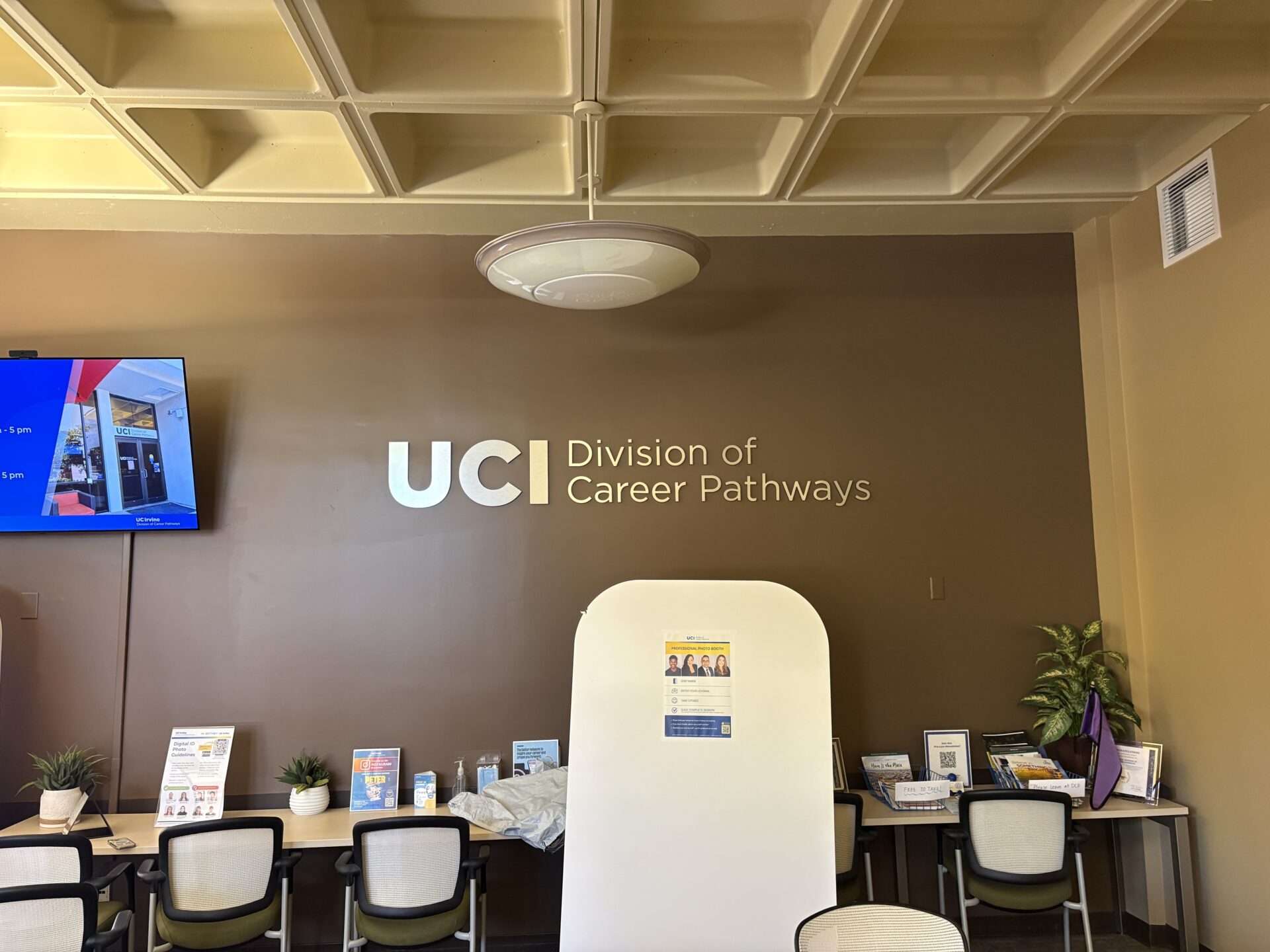
Allison Keller, Career Education Director at the Division of Career Pathways (DCP), believes networking, especially with UCI alumni, makes the application and internship process “a little more human.”
“It’s really great to utilize the networking aspect of being in an internship, so talking with as many people as possible … [Internships] can be a really good learning and growth experience,” Keller told New University. “[Internships] kind of test [drive] a career, so you want to just try to be a sponge and absorb a lot of that great information … out there.”
Although both Sinha and Prakash were aware of campus career resources, including the DCP and school-specific resources, they primarily used external resources during this application cycle.
Prakash attended DCP’s career fairs but said its timings and limited guidance from company representatives made the events feel less helpful and discouraged him from attending regularly.
He suggested hosting career fairs over two days to improve student turnout. With events spread across multiple days, more students can find time to visit, while single-day events may force students to choose between career fairs and other priorities.
“The timing of [career fairs] are … not great,” Prakash said. “It’ll be on a Thursday during class time, and I just have no way of getting to the career fair to even check it out.”
Prakash also criticized some company representatives at the fair, saying they did not always serve the interests of students who are trying to build a network.
“There should be a representative that is willing to take down names, or build some sort of connection with the people that are coming up to them to talk to them. And I think that that would help students that are applying for internships get their name out there,” he said.
In response to the criticism, Keller said the timing of career fairs depends on employers’ availability and scheduling conflicts with career fairs at nearby universities.
She adds that career fairs are a “starting point … educational point” to learn more about a company, while students can form stronger, direct connections with employers through DCP’s on-campus information sessions listed on Handshake.
Keller previewed two new DCP initiatives launching this school year: a workshop on universal professional communication covering topics from writing emails to conversing with recruiters, as well as a site visits program titled “Anteaters to Work,” where students can tour the campuses of nearby companies.
Overall, landing an internship and being a successful intern often requires a strong understanding of the job and industry, as well as professional skills practiced both inside and outside UCI.
Networking is one way students can increase their chances of finding internship opportunities as the job market becomes more competitive, but not necessarily a requirement. Students can also pursue internships through direct applications and by making full use of university resources.
Piyush Vaishnava is a Features Intern for the summer 2026 quarter. He can be reached at pvaishn1@uci.edu.
Edited by Aditya Biswas and Geneses Navarro.

