

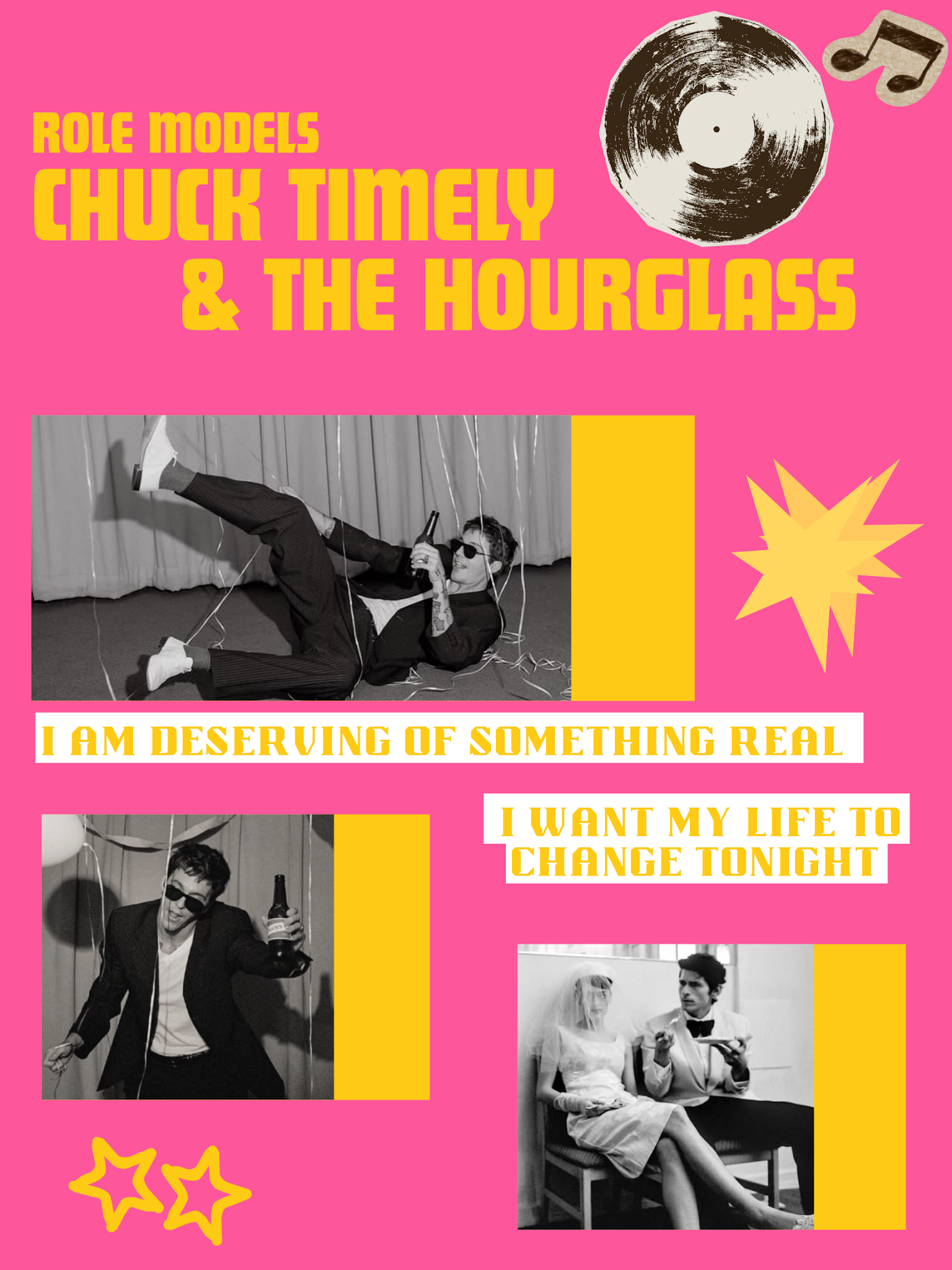


Role Model’s third studio album, “Chuck Timely & The Hourglass,” quietly dropped on Spotify Aug. 7 and deserves a chance to be heard at full volume at least once.
Born Tucker Pillsbury, the singer-songwriter built his audience off bedroom pop, a genre which makes the sound of heartbreak danceable and laughable. The self-deprecation embedded into his songs and public persona provides a needed humility to the music scene — a humility that has earned him loyal listeners of all ages.
His popularity skyrocketed after “Sally, When the Wine Runs Out” — a song about falling for a woman at a dive bar — premiered and quickly became a fan favorite on tour. Occasionally, Pillsbury brought out a celebrity to play the role of Sally and dance alongside him. Olivia Rodrigo, Hilary Duff, Natalie Portman and Charli XCX were just some of the Sallies chosen to help create an unforgettable concert experience for fans. Pillsbury took that Sally success and utilized it as a stepping stone to pivot his music from the sounds of bedroom pop to a style more folk and country adjacent.
This album fully introduces Role Model’s newest alter ego: Chuck Timely, a fictional time-traveling musician who Pillsbury described to People Magazine as “a little bit pathetic in a charming way.”
When asked about his inspiration behind this new album, Pillsbury spoke about feeling “a little bit stagnant” when it comes to dating and being single. He also cites watching his friends get married and leading different lives as another source of inspiration. His song “The Wedding” captures his change in perspective after attending a wedding for the first time as an adult. Despite having negative connotations towards the idea of a wedding for himself, physically seeing it sparked something emotional inside of him.
The album messes around with vintage sounds and stories while, ironically, honing in on a central theme: fleeting time. Loneliness, passing years and the fear of being left behind while everyone moves forward are the essential pillars holding this album up.
Essentially, “Chuck Timely” asks the question every young adult has asked while watching another Instagram engagement announcement: Am I behind?
Exploring the intricacies present in the concept of loneliness is the star theme of each song; you’re accompanying Chuck Timely on his journey moving from feelings of displacement to accepting that love might just look different for him. Yet his loneliness never feels unfamiliar, as it’s an experience seemingly everyone can understand.
The song “Honeydew” hits that note of loneliness just right, presenting less like a conversation and more like a confession. It is vulnerable but intensely relatable.
“You’re not lonely anymore / What you feel, I feel the same,” Pillsbury sings. “No more counting down the days / You’ll always have a place to stay.”
He intentionally frames loneliness as an accepted, communal fact of life with humility. He focuses on the paradox of being lonely while having a community of lonely people.
As for the album as a whole, it’s a collection of hits that will probably be loved most by longtime fans.
Pillsbury’s inspiration from other artists is especially present in the musical direction he took with this album. He cites Bruce Hornsby, best known for “The Way It Is,” and Don Henley, the mastermind behind songs like “The Boys of Summer” and a contributor to Stevie Nicks’ “Leather and Lace.” The blend between these artists and Pillsbury’s own sonic choices results in an album that sounds like it could’ve been made inside an emotionally intelligent honky-tonk.
“High Hopes 3000” immediately establishes this new energy. The song opens up with Chuck Timely admitting his day is ending the way it started: alone in Los Angeles and waiting for someone to change his life. What makes the song interesting is the contradiction between its upbeat sound and its lonely narrator. He’s optimistic because he has to be in order to move forward, even if moving forward is just finding acceptance in his own solitude. His titular “high hopes” become a coping mechanism.
This idea reaches its peak when he asks whether love comes around or if “one comes around to it.” It is one of the album’s more interesting questions, shifting love from something that happens to you into something you become ready for. For all the cowboy “woo!”’s, there is a surprising existential man underneath the hat.
That existentialism is what breathes life into “Chuck Timely.” It’s where you hear Pillsbury’s truth.
Then there is “Love I You,” which may be the album’s most obvious attempt at becoming a TikTok audio. The track features Pillsbury’s real-life lover, actress Dakota Johnson, in a spoken cameo that turns an already intimate song into something resembling a private conversation. It works, and it works well.
Rather than presenting romance as something polished or cinematic, Pillsbury makes it sound real and conversational. Johnson’s appearance embraces that realism while making you question whether Chuck Timely is actually an alter ego or simply a way for Pillsbury to express his honest thoughts without the baggage of being Tucker Pillsbury.
It’s catchy, embarrassing and incredibly easy to imagine being played over a montage of someone’s relationship on TikTok.
Pillsbury’s ability to construct a story is questionable at times but if you can follow along, it can be really fun. He is less focused on constructing linear narratives than he is at collecting specific moments in time: a bar, a missed connection, a wedding or a voicemail. These moments are reminiscent of the title and theme — temporary, whether or not you want it to be.
The variety showcased in this album keeps it from ending up solely on a T.J. Maxx worker’s aux. There are songs like “Service Receipt” that lean into Pillsbury’s humor, while “Harmony” closes the album with a more reflective perspective that shows his walls coming down.
All in all, “Chuck Timely & The Hourglass” is a fun listen and a pretty accurate representation of Role Model’s spirit. It is an album about loneliness that never lets loneliness become completely miserable. Chuck Timely may not know where he is going, but at least he has a good soundtrack for getting there.
Jordan Salter is an Arts & Entertainment Intern for the summer 2026 quarter. She can be reached at jasalter@uci.edu.
Edited by Travis Foley.

Interested in becoming an intern or a contributing writer for the Entertainment section?
Contact us at entertainment@newuniversity.org!