



For more than two decades, “One Piece” has been one of the most influential anime and manga franchises in the world. Created by Eiichirô Oda, the long-running pirate epic follows Monkey D. Luffy (Mayumi Tanaka) and his Straw Hat crew as they sail the Grand Line in search of the legendary treasure known as the One Piece.
Across more than 1,100 episodes and dozens of films and specials, the series has become renowned for its imaginative world-building and emotionally resonant storytelling. Now, some of the series’ most beloved women are taking center stage.
“One Piece: Heroines” was initially published as a light novel written by Jun Esaka and illustrated by Sayaka Suwa. From there, it was adapted into an anime and quietly debuted as a stand-alone special on Crunchyroll on July 6 before arriving on Netflix on July 11, opening a new chapter that explores the heroines who have helped define the Straw Hat’s adventures.
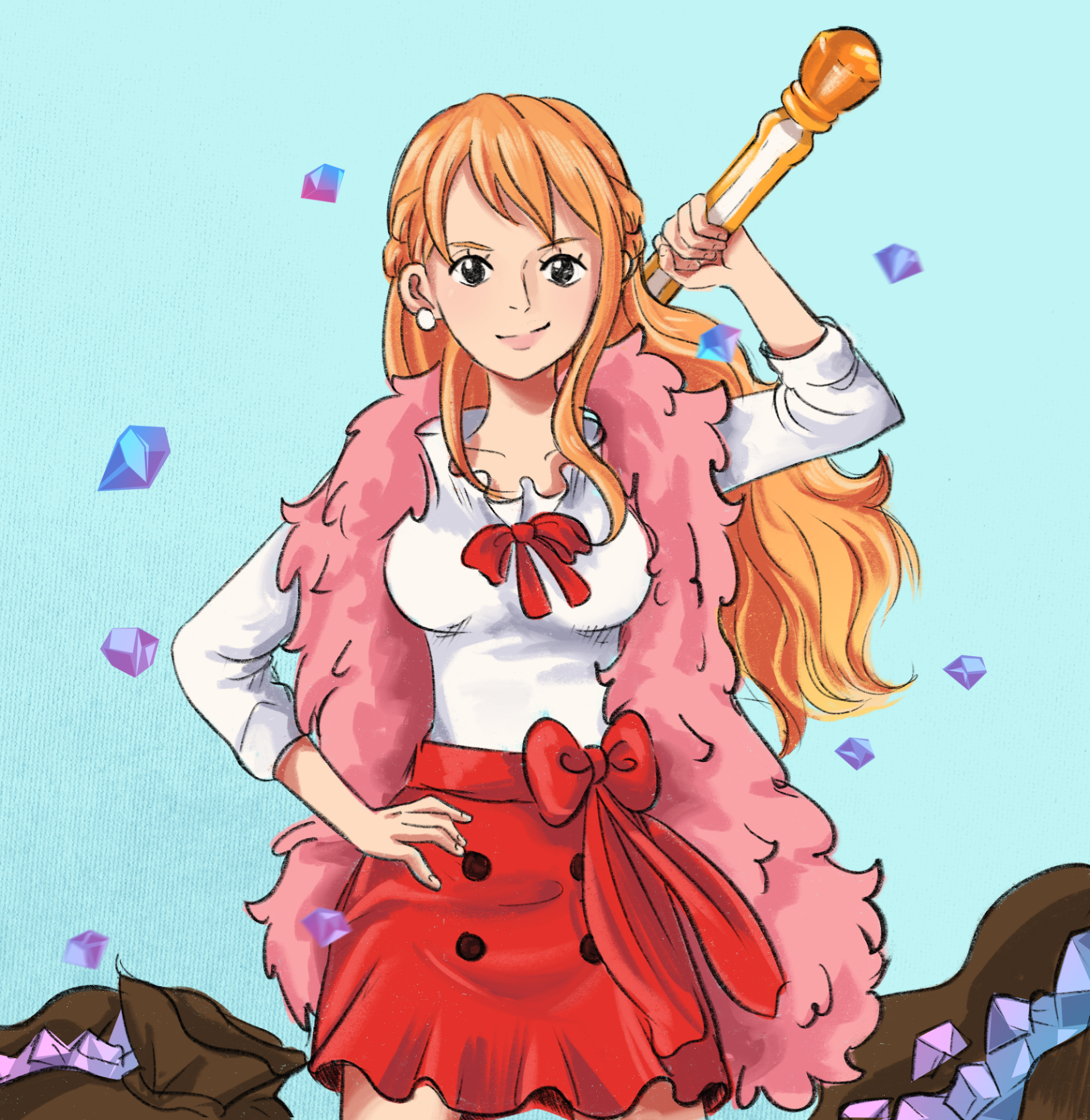
This twenty-two-minute special follows Nami (Akemi Okamura) — the Straw Hats’ navigator — after a pair of shoes advertised for pirate combat fails her during a battle with jewel thieves. Furious, she storms into the designer’s boutique and demands a refund, only to discover that the shop’s eccentric designer, Lebno Listchaque (Takehito Koyasu), refuses unless she agrees to walk in his latest runway show.
The premise is admittedly absurd, even by “One Piece” standards, but it allows the spin-off to explore territory the main series rarely examines.
Rather than simply shrinking the scale of the story, “One Piece: Heroines” reimagines the original series’s storytelling. Softer colors and a more grounded visual style replaces the exaggerated energy that defines “One Piece” without sacrificing its sense of adventure. The result is an aesthetic that emphasizes strength through grace, reflecting the femininity and multifaceted battles of the story’s three central women: Nami, the Straw Hats’ archeologist Robin (Yuriko Yamaguchi) and the shoemaker Miucha (Maaya Sakamoto).
The refreshed animation style, shortened action sequences and reduced number of combat shots creates room for detailed character-driven storytelling, a welcomed change from “One Piece.” Rather than relying on an abundance of medium, wide and close-up shots of flying fists, the episode builds tension through dialogue, music and lighting, which results in a more immersive and emotionally engaging experience.
The story embraces both girlhood and pirate fantasy, allowing the two to coexist with equal narrative and cultural weight. Jewelry, fashion and runway shows aren’t treated as frivolous distractions from the adventures but as meaningful passions that can both shape lives and be used to manipulate others for personal gain.
The result is not a “One Piece” made for women, but a special that recognizes how femininity and adventure have never been mutually exclusive.
The expansion of Nami’s characterization is this special’s greatest achievement. Her defining traits — intelligence, composure, greed and fierce loyalty — are not only reaffirmed but deepened through her interactions with Miucha and Listchaque.
During her initial conversation with Listchaque, Nami notices her stolen silver anklet dangling from his wrist, immediately exposing his role in a pirate smuggling operation. Instead of confronting him on the spot, she keeps her composure, choosing instead to calculate her get-back.
Her relationship with the shoemaker Miucha serves as the emotional centerpiece. Miucha’s deteriorating partnership with Listchaque — a once kind and trusted collaborator who becomes increasingly greedy and tyrannous — subtly reflects Nami’s own history with Arlong (Chris Rager), her notoriously abusive captor. Recognizing another woman trapped by someone exploiting her talent, Nami subtly pushes Miucha toward reclaiming her agency.
Nami’s request to wear the properly customized shoes created by Miucha, as opposed to the solely decorative pair Listchaque demands she wear on the runway, becomes more than a practical choice. It contributes to Nami’s influence on Miucha. It gives Miucha the state of mind to stand up to Listchaque. Nami has always disguised compassion as self-interest, and the special appears to understand and highlight that contradiction. All the while, Miucha is given the ability to choose herself within her tumultuous partnership with Listchaque.
The special also presents an interesting contrast between traditionally masculine and traditionally feminine approaches to conflict. At the start of the special, Nami relies on physical force against the jewel thieves because they dismiss her with the assumption that she’s “just a woman.” Their gendered expectations become an advantage she nearly exploits. Yet the episode’s emotional climax is not won through combat, but through persuasion, empathy and solidarity between women.
Nami’s understanding of gendered conflict resolution and her ability to wield them to her advantage mirrors the overarching theme of this episode: femininity isn’t a distraction or inconvenience but a source of strength. Rather than suggesting one approach is superior, “One Piece: Heroines” demonstrates that strength takes many forms, allowing conversation to become just as powerful as violence.
If there is one major stumbling block, it is the premise itself. Asking viewers to believe Nami — a veteran pirate who has fought barefoot and while gravely injured — suddenly cannot win because of an ill-fitting pair of shoes requires an enormous suspension of belief. It feels less like a natural obstacle and more like a piece of narrative machinery needed to launch the plot.
Fortunately, the special acknowledges its own silliness often enough that it becomes easier to accept. Without the faulty issues, after all, there would be no boutique, no fashion show and no opportunity for Nami and Miucha’s relationship to develop.
The special also quietly addresses one of “One Piece’s” longest running criticisms: its treatment of women. While the franchise’s female characters have always possessed compelling back stories and memorable personalities, later arcs have often prioritized exaggerated designs over meaningful development.
“One Piece: Heroines” does not abandon the series’ stylized aesthetic when it comes to the portions of a female body, but it does restore some semblance of balance between the attention to detail provided for their figures and the attention to detail provided for the character studies. The women drive the narrative through their choices rather than simply occupying it, and their relationships with one another receive as much attention as the action itself. It is a reminder that compelling female characters require more than elaborate costumes and dramatic entrances. They need to be multidimensional. However, Robin receiving little interaction or introspection was a let down.
As the first installment of what appears to be an anthology centered on different women across the “One Piece” universe, this special lays a promising foundation. If future installments continue to prioritize intimate character studies over spectacle while playing with storytelling approaches, “One Piece: Heroines” could become one of the franchises most creatively rewarding projects.
Although “One Piece” has built its legacy on exploring uncharted islands and facing notorious villains, sometimes all it takes to breathe new life into a familiar world is seeing it through a different pair of eyes — or in Nami’s case, a different pair of heels.
Jordan Salter is an Arts & Entertainment Intern for the summer 2026 quarter. She can be reached at jasalter@uci.edu.
Edited by Travis Foley and Tracy Sandoval.

Interested in becoming an intern or a contributing writer for the Entertainment section?
Contact us at entertainment@newuniversity.org!