

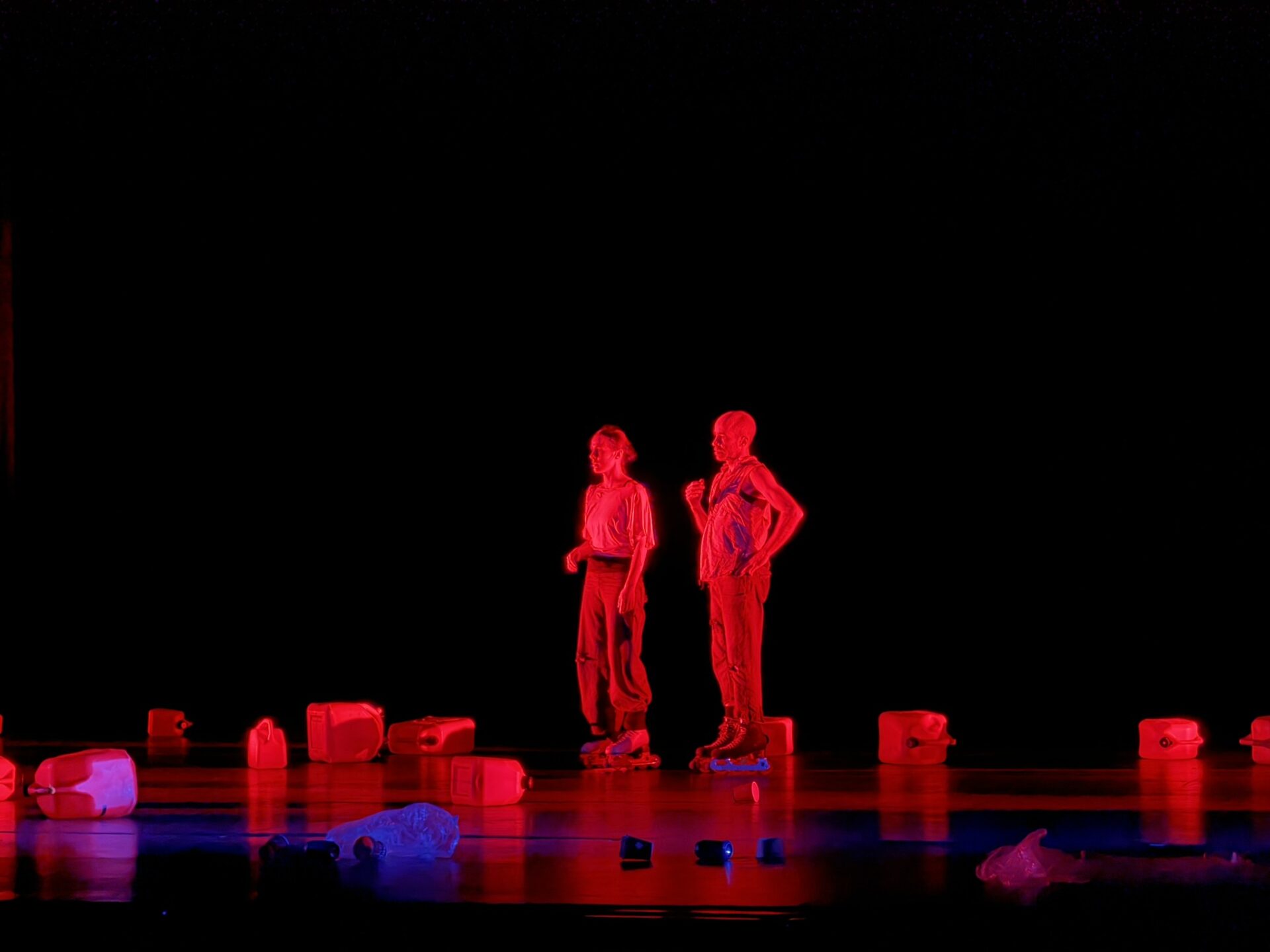

Le Patin Libre brought “Melt” to the Irvine Barclay Theater stage on Oct. 11, a skating performance using original choreography and orchestration to create an “intimacy and weirdness impossible on an ice rink.”
In the performance, a duet of skaters navigated a post-apocalyptic world that has lost both ice and music. Gliding across the stage in a 1990s prototype of roller skates, they told their story.
The program opened with percussive pulses, as the two skaters drew near each other before being forcibly drawn apart by a rope harness. Monochromatic lighting mirrored the tension, with spotlights haloed around each retreating figure.
A third character, the musician, loomed over the couple. In the absence of speaking lines from the skaters, his music was used as the primary narrator. As the environment tests the limits of friendship, rolling arpeggios and dissonant chords audibly signal their conflict to the audience.
Moving away from the traditional ice rink, “Melt” is performed on theater stages for the first time.
Alexandre Hamel is Le Patin Libre’s artistic director, as well as the choreographer and male skater in “Melt.” According to Hamel, they intentionally made this change to reinvent skating as a contemporary performing art and to bring the audience physically closer to the performance’s message.
“A stage surface is much smaller, but also the audience is much closer,” Hamel said. “It creates something more intimate. Performing in a theater makes things more perfect. We can have a blackout, the acoustics are good and every seat has a really good view of the stage.”
When asked about the most challenging sequence to create, Hamel reflected on the emotional side of his choreography for the two skating roles.
“There’s a moment between those two dancers — there’s a connection,” Hamel told New University. “Some see it as a friendship, some see it as love. We wanted to show the relationship that was positive, turn a bit sour, to see how the characters would survive and evolve from that back to their harmony, to their love.”
The duet of skaters relied on movement to convey their journey. Creating a blend of figure skating, contemporary dance and street performance, skaters Hamel and Maude Poulin provided the visual elements of their humor and love.
Beyond the Barclay, the rotating cast of “Melt” is a group of former competitive figure skaters who were used to traditional techniques often seen in the Olympics.
“We wanted to use the same skill to reappropriate that athleticism that we have and to make it something relevant on the art scene,” Hamel said. “It was seen as a little bit of a rebellion of a bunch of figure skaters who wanted out of the sparkles and medals and to do something that we think is cool now.”
The skaters used a 1990s prototype of roller skates, unique in the way they could replicate the feeling of ice skating with inline wheels.
“For the audience, it will be their first time seeing this kind of skating,” Hamel said. “We’re an oddity, and the only ones doing that kind of thing.”
Prior to the show, audience members were curious about what to expect.
“I’m actually curious about the music and the way they dance and mix the guitar,” third-year film and media studies student Yuyan Chen told New University. “Especially because music is a very important element in film.”
First-year sociology student Addison Daulo was brought to the Barclay to engage with the arts and be involved on campus, noting how “being a person as well as an academic” is important. After the show, Daulo shared her thoughts about the performance.
“The use of props really stood out to me,” Daulo told New University. “For example, the falling of confetti, the loud falling of the cartons and the kicking of the bottles all really surprised me, especially the noise that it made too.”
The use of lighting and orchestration allowed the audience to lean into the core themes.
“The show’s use of color with the type of movement they did really conveyed tension versus softness or love,” Daulo said. “I remember reading in the program something about how it’s a balance between humor and love, even though they’re in such dire circumstances. I think that’s very sweet.”
In one of the final scenes, the female skater plays the famous melody of the French love song “La Vie en Rose” on a music box. In a moment of tenderness, the two skaters continued to find their way back to each other.
“It’s human relations, it’s love and it’s friendship,” Hamel said. “It’s what I think can survive in such a world. The whole show dances on the challenges and the beauties and the opportunities of love, friendship, togetherness and intimacy.”
Ashley Liau is a Features Intern for the fall 2026 quarter. She can be reached at liaua@uci.edu.
Edited by Avery Rosas and Zara Baker

