



The Laguna Art Museum welcomed an exhibit that is best described as a whimsically macabre liminal space where humor and horror coexist on Aug. 1. The Tipping Point, created by artist brothers Einar and Jamex de la Torre, is visceral in all the most startling ways.
From grotesque human remains to glittering coins and an extravagant dinner table, the exhibit constantly teeters between beauty and disgust, celebration and decay, abundance and excess. In doing so, it lives up to its title: nearly every piece exists at a tipping point between two opposing ideas.
The Guadalajara-born brothers have built their artistic practice around the cultural collision of their Mexican heritage and American surroundings, drawing from pre-Columbian imagery and Catholic iconography to colonial history, border culture and modern consumerism.
Working primarily with blown glass, lenticular imagery and large-scale installation, they transform these familiar symbols into surreal, often excessive compositions that feel playful at first, yet reveal deeper themes surrounding the consequences of greed the longer you look.
The Tipping Point’s overarching theme, displayed in an exhibit statement directly outside the entrance, is humanity’s fixation on wealth and excess. The brothers state “the signs, obvious as they are, are never heeded.” This suggests that decadence and unchecked accumulation continue to precede societal collapse.
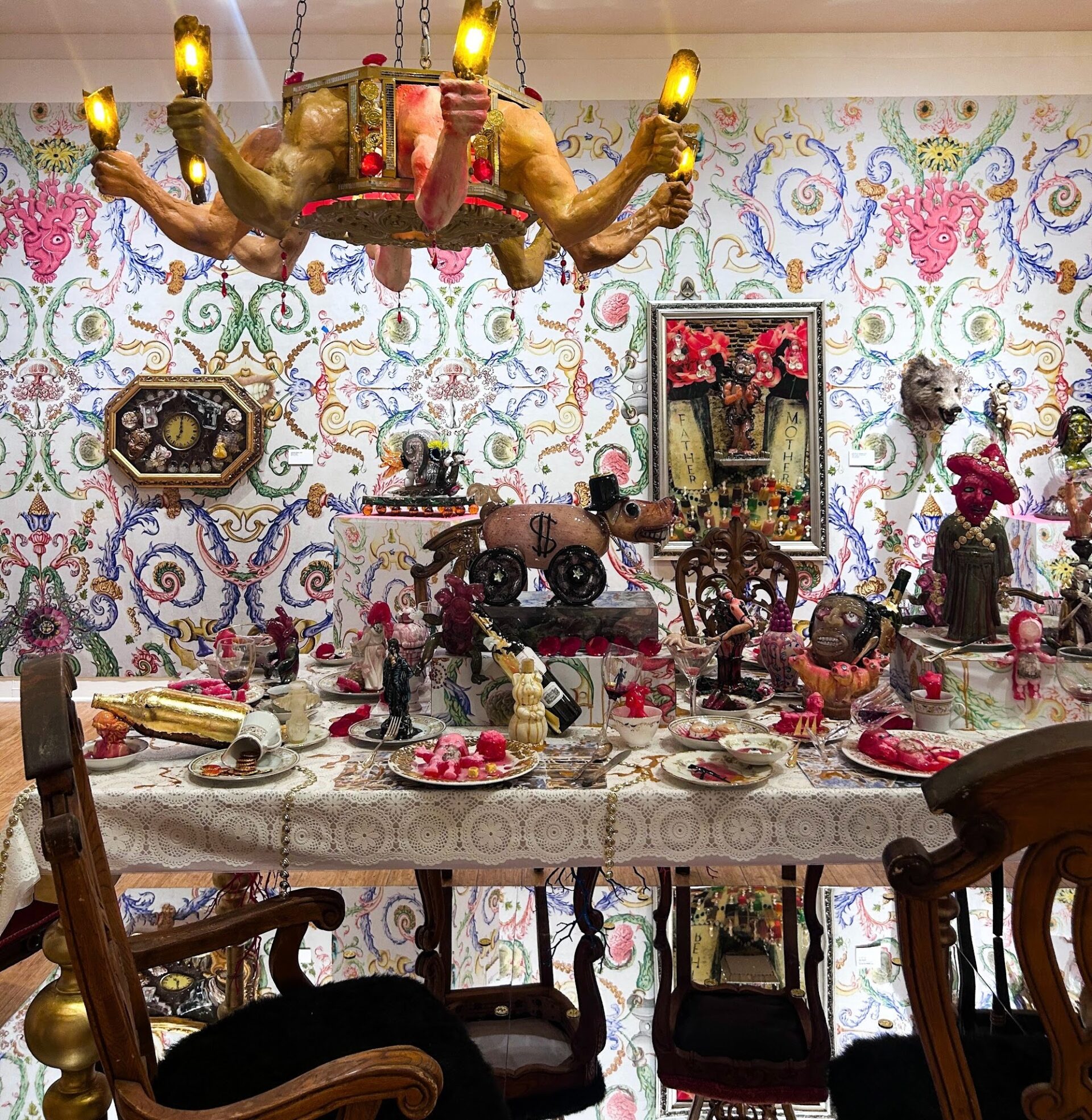
The tension is immediately apparent as you walk through the exhibit doors. An extravagant dinner display serves as both the backdrop and main event of the exhibit, beautifully representing familiarity, celebration and opulence. Yet the longer you look, the more unsettling the feast becomes; Toy-infested displays surround the table, whose colorful innocence and inability to decay contrast the rot that lies near.
A man’s severed head lies on a plate, partially decayed yet his eyes still wide open. Nearby, a gold-dusted female bust occupies another place setting. Above it all, a chandelier of disembodied arms hoisting blown-glass candles illuminates the elaborate scene.
It is difficult to determine whether the table is inviting you to sit down or warning you to stay away.
That uncertainty is part of the exhibit’s humor. The de la Torreses do not demand that viewers approach their work with solemnity. Instead, they lure you in with absurdity, color and visual excess.
Something might initially seem funny or ridiculous before revealing itself to be deeply grotesque. Viewers’ laughter becomes uncomfortable because the joke is often about something much more sinister: our tendency to consume, collect, preserve and assign value to things simply because we can.
The exhibit’s labyrinthine layout intensifies this experience. There is never quite one image to focus on. Glass, resin, toys, coins, taxidermy and religious references compete for attention, making the act of looking feel almost like wandering through someone’s bizarre subconscious. Every turn reveals another object that demands interpretation. The abundance itself becomes overwhelming, mirroring the excess the exhibit seems determined to critique.
Coins acting as either an accent or the backbone of nearly every piece suggest a connection to systems of greed that can impede our ability to find meaning outside of consumption.
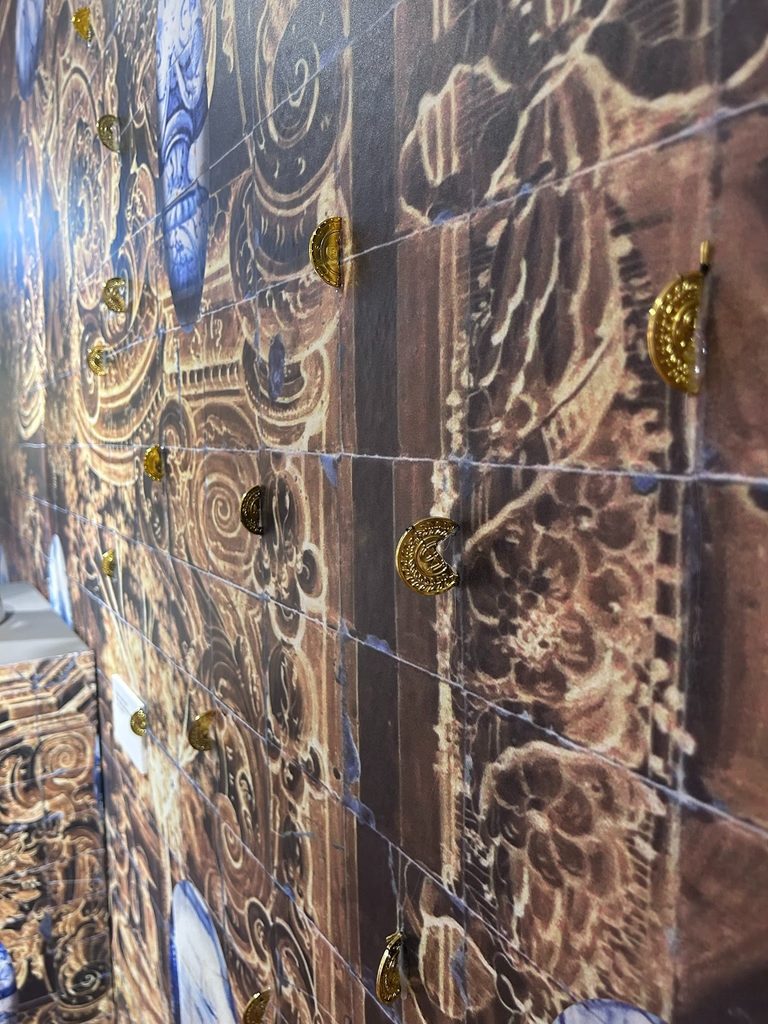
Photo by Jordan Salter / Staff
The taxidermy placed throughout the exhibit, each bearing dollar-sign necklaces, make that relationship even more apparent.
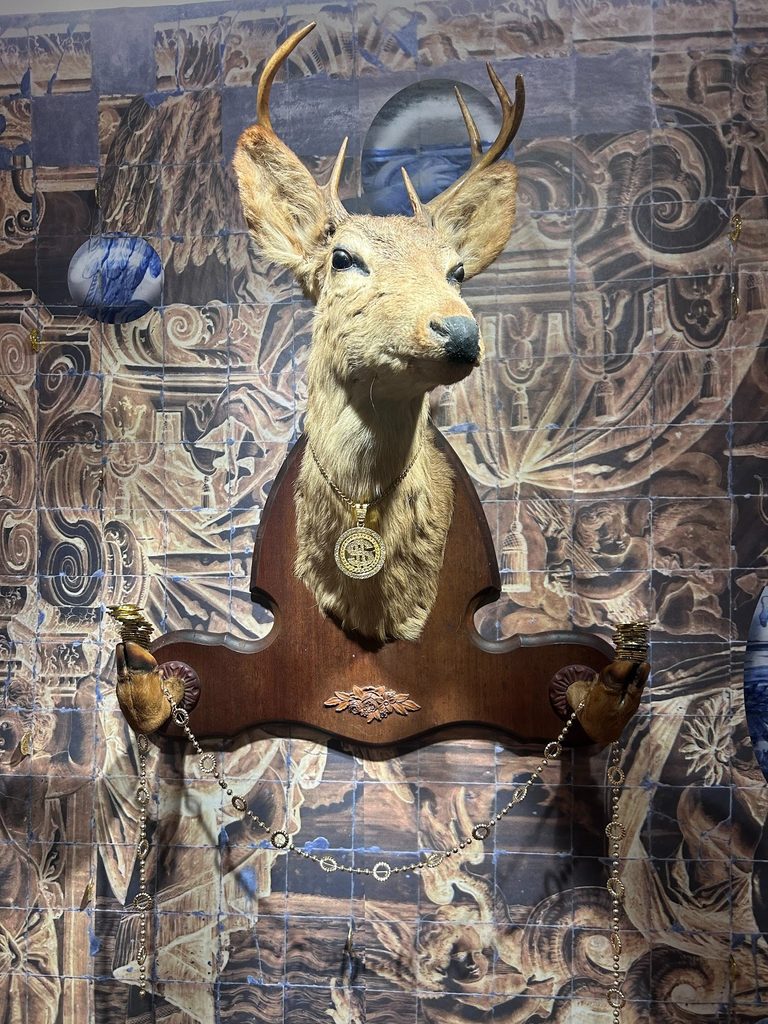
Photo by Jordan Salter / Staff
With these displays, nature is adorned with the very symbol that has come to represent human value. The result is striking: even the natural world seems unable to escape our economic systems.
Realistically decaying appendages, intestines and soup bowls of blood are contrasted with untouched, gold-encased human eyes and female body parts. The de la Torreses seem fascinated by the question of what humans choose to preserve — and what we allow to disappear.
That question extends beyond the objects themselves. Humans have always attempted to outlive their own morality through art, monuments, photographs, religion, money and stories. Pieces like Salvador Dali’s “The Persistence of Memory” and NASA’s “Golden Records” are examples of things that we create specifically so they can remain long after we are gone. The exhibit takes that instinct and makes it grisly. Gold preserves the body while decay reclaims it elsewhere. Taxidermy freezes animals in place. Resin transforms fragile objects into something capable of surviving generations.
Even the museum itself becomes part of this conversation: a space dedicated to preserving objects long after their creators are gone. In this way, The Tipping Point does not simply depict death. It examines humanity’s refusal to accept it.
The exhibit also asks what happens when our desire to preserve ourselves becomes indistinguishable from our desire to possess. Coins become more than symbols of wealth; they represent the human impulse to assign value, accumulate and leave something behind.
The de la Torres brothers’ exploration of dread born from greed, created by nature and therefore a part of nature, is extremely fascinating. By contrasting human invention with nature, they suggest that just as nature can destroy itself and others, so can our creations. This idea injects a sense of dread into you as you view each piece of their art. Our inventions can preserve us, but they can also overwhelm the very world we create them within, and their use of historical evidence makes that feeling even harder to escape.
This interplay feels particularly significant within the de La Torres’ Mexican-American artistic perspective. Their work does not treat culture as something fixed or nearly separated. Instead, pre-Columbian imagery such as rosaries and saints, that lay atop European aristocratic paintings representative of colonial history, collide within the same visual spaces.
The result is deliberately excessive because the cultures and histories being explored are themselves layered, complicated and impossible to separate.
Their surrealism becomes a way of representing that collusion — taking recognizable cultural symbols and pushing them so far that their contradictions become impossible to ignore.
Ultimately, The Tipping Point is less a collection of individual objects than an experience of constantly shifting perspectives. What initially appears beautiful becomes vile. What seems humorous becomes uncomfortable. What looks like abundance begins to resemble excess. What appears preserved becomes a reminder of mortality.
The exhibit continuously forces the viewer across these boundaries until it becomes difficult to determine where one ends and the other begins.
There is no doubt that the de la Torres’ work is open to individual interpretation, but the passion implicit in every facet of their creation is undeniable. The Tipping Point asks its audience to confront the strange systems humans have constructed around life, death, wealth, beauty and memory — and to recognize how easily those systems can tip into something darker.
Perhaps that is what makes the exhibit so mesmerizing. Beneath all the glass, gold, toys, coins and rotting bodies is a distinctly human fear: the knowledge that everything we create, no matter how extravagant or carefully preserved, exists in defiance of our inevitable decay. We build museums, monuments, art and wealth because we want to remain.
The Tipping Point simply has the audacity to place that desire on a dinner table with a fork, napkin, knife and request for you to take a bite.
Jordan Salter is an Arts & Entertainment Intern for the summer 2026 quarter. She can be reached at jasalter@uci.edu.
Edited by Corinna Chin and Zara Baker

Interested in becoming an intern or a contributing writer for the Entertainment section?
Contact us at entertainment@newuniversity.org!