



Paintings have always been frozen in time. Their subjects cannot move, speak or breathe. Yet every summer in Laguna Beach, some of the world’s most famous works of art come to life.
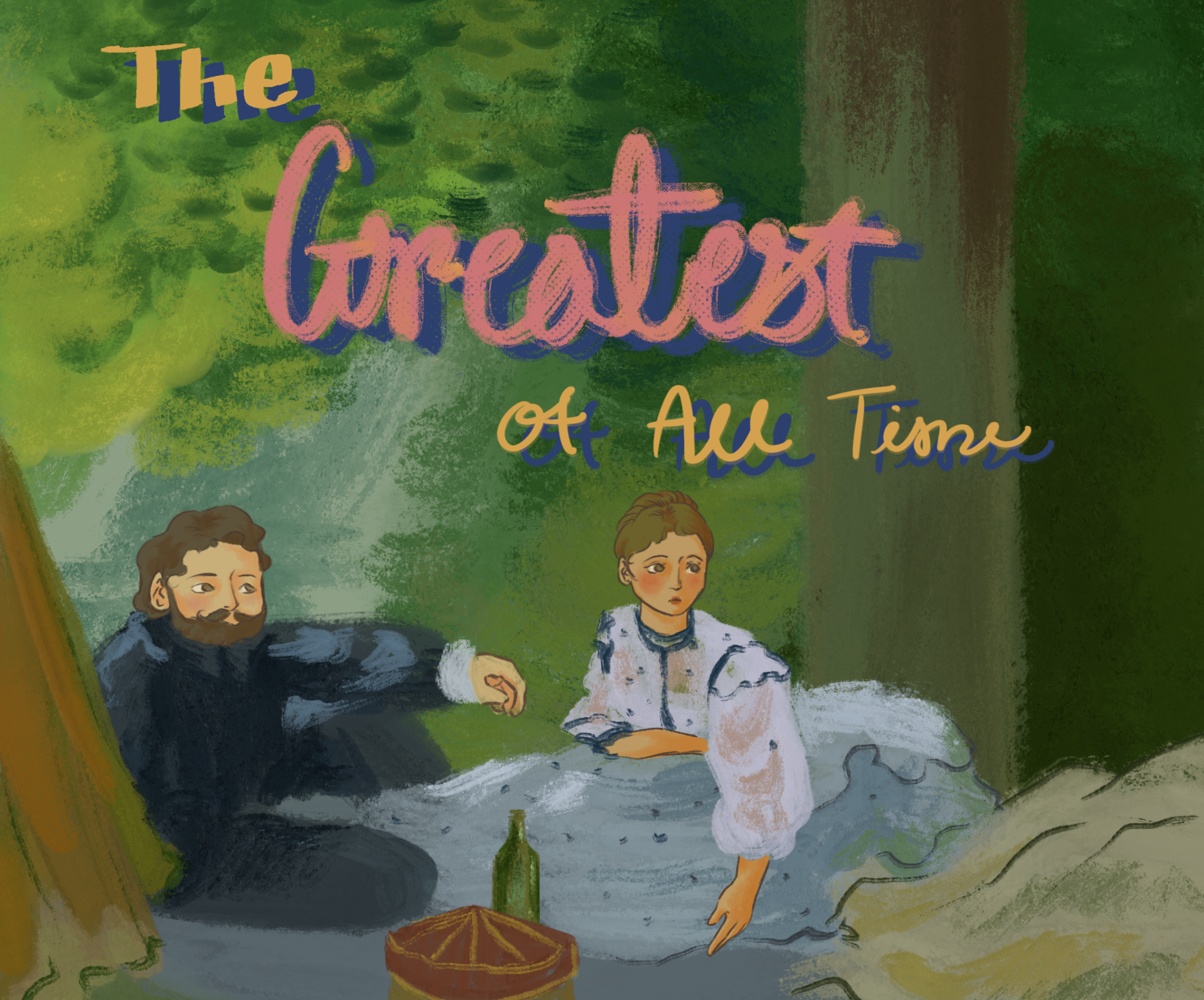
The annual Pageant of the Masters returned this summer with its newest theme, “The Greatest of All Time,” transforming the Festival of Arts’ outdoor stage into a living gallery. For more than an hour, spectators watched as some of history’s most recognizable paintings and sculptures were recreated through live actors, elaborate set pieces, intricate costumes and carefully positioned lighting.
The result is an experience that is almost impossible to describe: a performance unlike any other, in which the skill lies in the ability to remain perfectly still.
A beloved part of the Laguna Beach community, Pageant of the Masters has become one of Southern California’s most distinctive artistic traditions since its debut in 1933. Rather than placing a painting behind glass or a sculpture on a pedestal, the actors become the art itself, bringing these works to life onstage, in a way that feels tangible and humanizing. The Pageant provides a new perspective and life to these historical pieces.
Familiar works are reconstructed with actors positioned so precisely that, from a distance, the living subjects appear indistinguishable from the originals.
This year’s theme made that concept especially appealing. “The Greatest of All Time” celebrated artists whose work has endured across centuries, bringing together masterpieces from artists including Michelangelo, Leonardo da Vinci, Pablo Picasso, Claude Monet, Vincent van Gogh, Diego Velázquez, Norman Rockwell, Gian Lorenzo Bernini, Frida Kahlo and more.
The result was a journey through history with a touch of tasteful and oh-so-questionably campy performances.
Missed lip-syncing moments in between tableau displays, caricature-esque costuming of the famous artists themselves, cringey dialogue and abstract scenes brought some humor to the show, all delivered with a clear sense of self-awareness. The actors are local volunteers and the audience is there to appreciate the art more than the theater, which makes those lighter moments feel more intentional.
After some pretty emotionally intense history lessons, the campy performances offered a welcome bit of levity.
A short scene introducing some of the most famous artists being celebrated opened the show, and then Michelangelo’s “Pietá” was unveiled.
The iconic sculpture of Mary holding the body of Jesus has become one of the most recognizable images in Western art, making the recreation particularly powerful.
What is normally experienced through cold marble was instead felt through warm bodies. While the intricately painted actors were incapable of emoting in order to preserve the tableau, lighting and sound reanimated the scene as if it were never a statue but instead a live window into the past.
Bernini’s “Apollo and Daphne” was recreated with respect for his mastery of texture. The sculpture depicts the moment Daphne transforms into a laurel tree while fleeing Apollo. Bernini’s ability to make stone appear as soft as skin is a source of amazement, but seeing the sculpture recreated with human bodies makes the mastery of his texture even more remarkable. The humans themselves were almost identical to the sculpture Bernini created.
This sculpture posed a particular challenge to the actors embodying Apollo and Daphne as their pose is far from easy to hold. Yet the only sign of life visible was their diaphragms breathing in and out.
The music, perfectly chosen to complement each tableau and performed live from the pit, was essential in capturing the emotions we can imagine the original artists hoped to evoke through their visual art.
The narration between pieces, providing mini history lessons on each artist and the inspiration behind their work, made the show more than just a beautiful viewing experience; it became an opportunity to learn about the stories, intentions and historical context behind each masterpiece.
Perhaps the most visually overwhelming piece of the evening was Picasso’s “Guernica.” Unlike the serene beauty of the classical statues, “Guernica” is intentionally chaotic. Its fractured figures, distorted faces and violent imagery communicate the horror of war.
Translating Picasso’s two-dimensional cubist composition into a live version seemed nearly impossible. Instead, the Pageant chose to embrace the painting’s disjointed quality by having actors frantically carry around set pieces inspired by the painting. Intense orchestration from the live pit heightened the chaos, forcing the feeling of war right into your seat.
Kahlo’s “The Love Embrace of the Universe, the Earth (Mexico), Myself, Diego and Señor Xólotl” offered another particularly memorable moment. Kahlo’s deeply personal imagery already blurs the line between reality and symbolism. The Pageant’s recreation emphasized that dreamlike quality. Seeing the layers of the painting physically represented made its symbolism feel almost architectural, allowing the audience to take in details that might otherwise be overlooked within the original canvas. Kahlo was the only female artist featured by the show, which was unfortunate but her impact was significantly and beautifully showcased.
Of course, the Pageant would not be complete without da Vinci’s “The Last Supper” closing out the show. Few paintings are as deeply embedded in popular culture, which makes seeing it recreated onstage strangely surreal. Humorously, actors portraying Andy Warhol and Leonardo da Vinci conversed and argued over Warhol’s famous series of The Last Supper recreations, which were infused with his signature style. A painting from the series was shown just before unveiling “The Last Supper” itself.
Monet’s “Luncheon on the Grass” was chosen to be the only tableau constructed onstage, providing an opportunity for the audience to see how these recreations are done. The fascinating demonstration consisted of the performers and set pieces being arranged by the tech crew with immense expertise and within minutes to complete the illusion. Monet’s painting emerged right before the audience’s very eyes as lighting struck into place and sound rose from the pit. A reminder that beneath the magic, there is an extraordinary amount of work and precision.
That precision is ultimately what makes the Pageant of the Masters so impressive. The slightest misplaced hand, incorrect angle and poorly matched costume could disrupt the illusion.
It is ironic to call the Pageant of the Masters a performance when movement is practically forbidden. But the stillness makes it theatrical. The audience knows they are looking at people, but for a few moments the performers become brushstrokes, marble and pigment.
“The Greatest of All Time”, therefore, feels like more than a celebration of famous artists. It’s a testament to art’s ability to survive. The messages intended by each piece, despite being created centuries and decades ago, still resonate today. The Pageant simply gives these works a new body.
In an age dominated by constantly moving screens, rapidly changing images and endless visual stimulation, it is captivating to watch people hold completely still.
The paintings may be frozen, but they are far from lifeless. For one summer in Laguna Beach, the greatest artists from history returned to the stage, proving that the spectacle is not always in the movement but in the stillness.
Jordan Salter is an Arts & Entertainment Intern for the summer 2026 quarter. She can be reached at jasalter@uci.edu.
Edited by Avani Kumar and Zara Baker.

Interested in becoming an intern or a contributing writer for the Entertainment section?
Contact us at entertainment@newuniversity.org!