

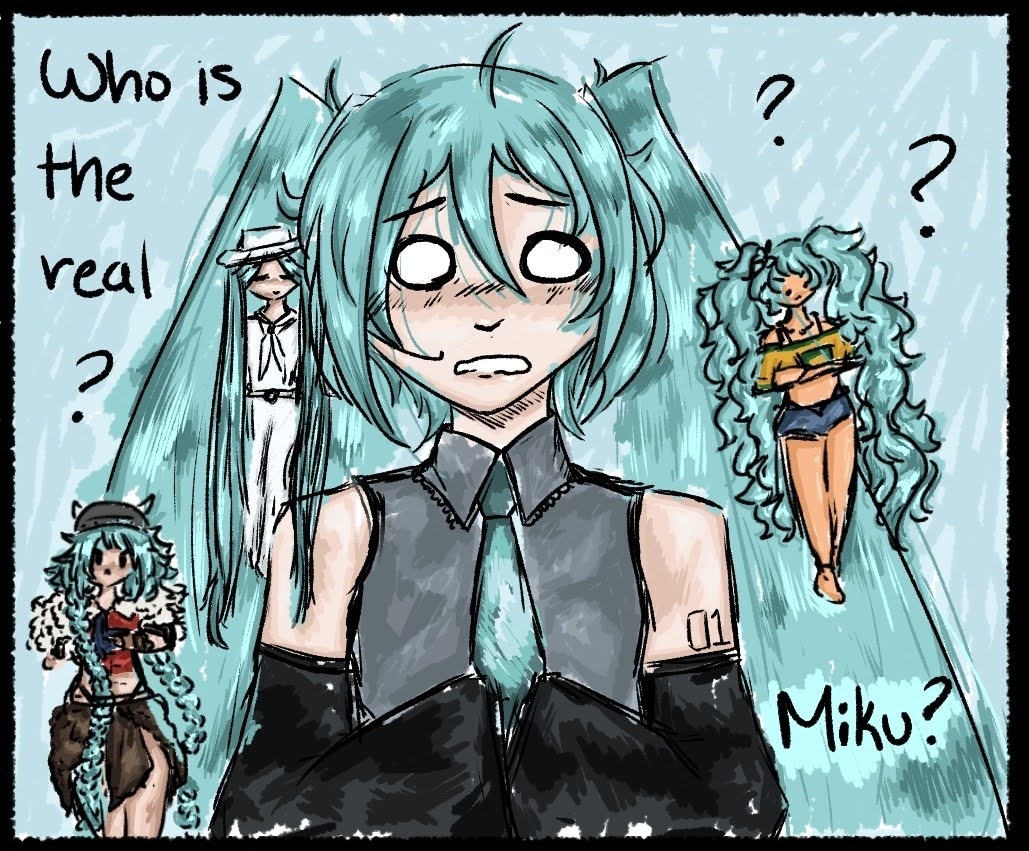


When most people think of the World Cup, a few famous names immediately come to mind: Lionel Messi, Cristiano Ronaldo, Erling Haaland and Kylian Mbappé. But this year, another “player” has unexpectedly entered the tournament conversation: a blue-haired, forever sixteen virtual pop star created by Crypton Future Media in 2007.
Yes, Hatsune Miku has somehow become one of the biggest stars of this year’s World Cup — without ever stepping onto the pitch. Miku was created by Crypton Future Media to serve as the company’s mascot and a tool for amateur and professional musicians. She has since grown far beyond her intended purpose, as the virtual pop star now possesses a massive global fan base and is considered by many to be a true idol. While her sudden rise may seem like nothing more than an internet joke, her presence at one of the world’s largest sporting events reflects a notable shift in how humanity interacts with digital creations.
In one of the internet’s most unexpected crossover events, thousands of users have jokingly replaced the FIFA World Cup Trophy with Miku herself. What began as a niche joke among Miku fans during Japan’s match against Brazil has since exploded far beyond anime circles, taking over X, TikTok, Reddit and countless other fan communities.
Fans quickly established one simple rule: whichever country defeated Japan would inherit Miku. So when Brazil beat Japan on June 29, the internet had collectively decided that Miku changed nationalities overnight.
After the match, X user @kijidere backed that sentiment, writing, “Miku is now oursヽ(・∀・)ノ 🇧🇷🇧🇷🇧🇷🇧🇷.”
Almost instantly, fan art flooded social media. Artists traded in Miku’s signature teal and gray outfit for Brazil’s iconic yellow and green jersey. Brazilian Miku quickly became a digital phenomenon and was depicted being clutched by fans in the stands, lifted by players and even brought to life by talented cosplayers — turning a devastating loss for Japan into a masterclass in collaborative internet storytelling.
Yet Brazil’s win over what some people are referring to as “Hatsune Miku’s custody battle” didn’t stop there; when Brazil ultimately lost to Norway, Miku’s “custody” went as well. Hours after the match, fans unofficially knighted Norway as her new home, sparking Viking illustrations of the Vocaloid voicebank.
X user @gacha_zone edited a photo of a mid-match Erling Haaland sporting a Hatsune Miku plush on his shoulder. The user’s tweet claiming “Hatsune Miku is officially Norwegian” has now been viewed by over 4 million people.
This once niche meme has now become mainstream media. Fast food chain KFC joined in on the fun as well with their Spanish X account posting a graphic of Miku at the World Cup with the message, “You all want to reach the final to win the World Cup…Me, to get custody of Miku. WE ARE NOT THE SAME, RETURN MIKU TO ME.”
Cosplayers have also quickly switched out those Brazil jerseys for Norway ones.
Part of what makes this trend so entertaining is how quickly thousands of strangers agreed to rules that never actually existed. No organization officially declared Hatsune Miku as the World Cup prize, yet fans around the world have happily accepted the fictional storyline and continue to expand it.
As different countries compete in the World Cup, fans eagerly wait to see which version of Miku will come next, and while the trend is undeniably absurd, it also represents something much larger happening online.
For years, anime and sports have existed in neighboring corners of internet culture. Series like Haikyuu!! transformed volleyball into one of anime’s most beloved genres, while Aoashi introduced audiences to the tactical side of soccer. Professional athletes regularly reference anime in score celebrations, sports organizations occasionally produce anime-inspired merchandise and anime creators have increasingly embraced sports culture.
Hatsune Miku’s World Cup journey pushes that crossover even further.
Unlike a traditional FIFA mascot, Miku belongs to the internet. Her existence has always depended on participation from fans. Since her debut as a Vocaloid voice bank, fans have written songs with her voice, animated her music videos, designed alternate costumes, created concerts using holograms and continuously reinvented her identity.
She is less of a fixed character and more of a collaborative canvas.
That flexibility makes her the perfect subject for an internet wide joke. Every country can imagine its own version of Miku because there isn’t one definitive version to begin with. The community has spent nearly two decades remixing her image, so temporarily transforming her into a Brazilian, Norwegian or whichever nationality comes next feels completely natural.
Hatsune Miku’s World Cup journey demonstrates how fans can transform a digital creation into a figure that feels so uniquely human. Despite existing only virtually, she has been assigned identity, nationality and cultural significance, adapting to whichever community claims her.
She becomes whatever the internet needs her to be.
Yet Miku’s shocking World Cup entrance raises a question that extends beyond fandom. This trend embeds a virtual creation within moments where human livelihood and achievement feels most celebrated. Exposing a deeper question about humanity’s evolving relationship with technology. Is Hatsune Miku’s sudden existence in the World Cup a hilarious internet joke or a glimpse into a future where artificially intelligent entities become cultural companions disguised as memes?
While stories surrounding technological advancement are often framed through a techno-dystopian lens, Miku represents a different possibility. Rather than replacing human connection, she exists because of it. Her identity is not created by humans alone but by millions of human interactions, interpretations and creative contributions.
Perhaps that’s why the joke has resonated so widely; modern sports fandoms are no longer confined to the ninety minutes on the pitch. Social media has transformed tournaments into nonstop entertainment, where memes, fan edits, reaction videos and inside jokes often spread just as quickly as the final score. Fans help shape the cultural narrative surrounding sports, including ones that blur the line between digital and human.
Miku has become one of the tournament’s biggest recurring characters, despite technically having nothing to do with soccer. That may be the internet at its best, taking two completely unrelated communities and convincing everyone they were always meant to overlap.
July 11th’s shocking match between England and Norway, gave way and with that Miku’s passport has gained yet another stamp.
User @AnimetrendsLA on X may have said it best, “THE ENGLISH HAVE JUST COLONIZED HATSUNE MIKU.”
With England ending up victorious, Miku subsequently entered her British era. Artists swapped out her fur coat and horned helmet for a classic British “chav” black puffer jacket and a brand-new catchphrase…
In a shocking turn of events, England’s semi-final loss to Argentina on Wednesday, July 15th, officially brought Miku’s British era to an end.
You have to admit, Messi and Miku has a nice ring to it. If Miku’s World Cup journey has proven anything, it’s that fans are quick to embrace Miku’s new nationalities, however they’re also quick to take notice of more than just attire.
An eerie pattern amongst this innocent trend has been discovered, every time the nation currently “holding custody” of Miku takes the field, that team has lost 2-1 to its opponent, passing Miku on to the next country. Some call it a coincidence, others have dubbed it “Miku’s curse”.
All eyes are on Argentina’s match against Spain this Sunday. Will the curse strike again, sending Hatsune Miku into her Spanish era? Or will Argentina finally break the pattern and keep Miku in Messi’s hands?
Jordan Salter is an Arts & Entertainment Intern for the summer 2026 quarter. She can be reached at jasalter@uci.edu.
Edited by Corinna Chin and Zara Baker

Interested in becoming an intern or a contributing writer for the Entertainment section?
Contact us at entertainment@newuniversity.org!