



The United States officially turned 250 years old on July 4, 2026. For many, this is a milestone worth celebrating. Others may consider how America possibly made it this far, and question how much longer it can continue to prosper.
To the British historian Sir John Glubb, America’s continuance may not be for long. His 1977 essay “The Fate of Empires and Search for Survival” argues that many of history’s most powerful empires lasted roughly 250 years before entering a period of decline. Glubb identified a recurring pattern consisting of six stages. While Glubb’s theory is far from being accepted, the United States’s current state falls into the theory’s categorization of the final state: decadence. Unless Americans find a way to rebuild their sense of internal unity, America may be the next addition to the 11 empires mentioned in Glubb’s essay.
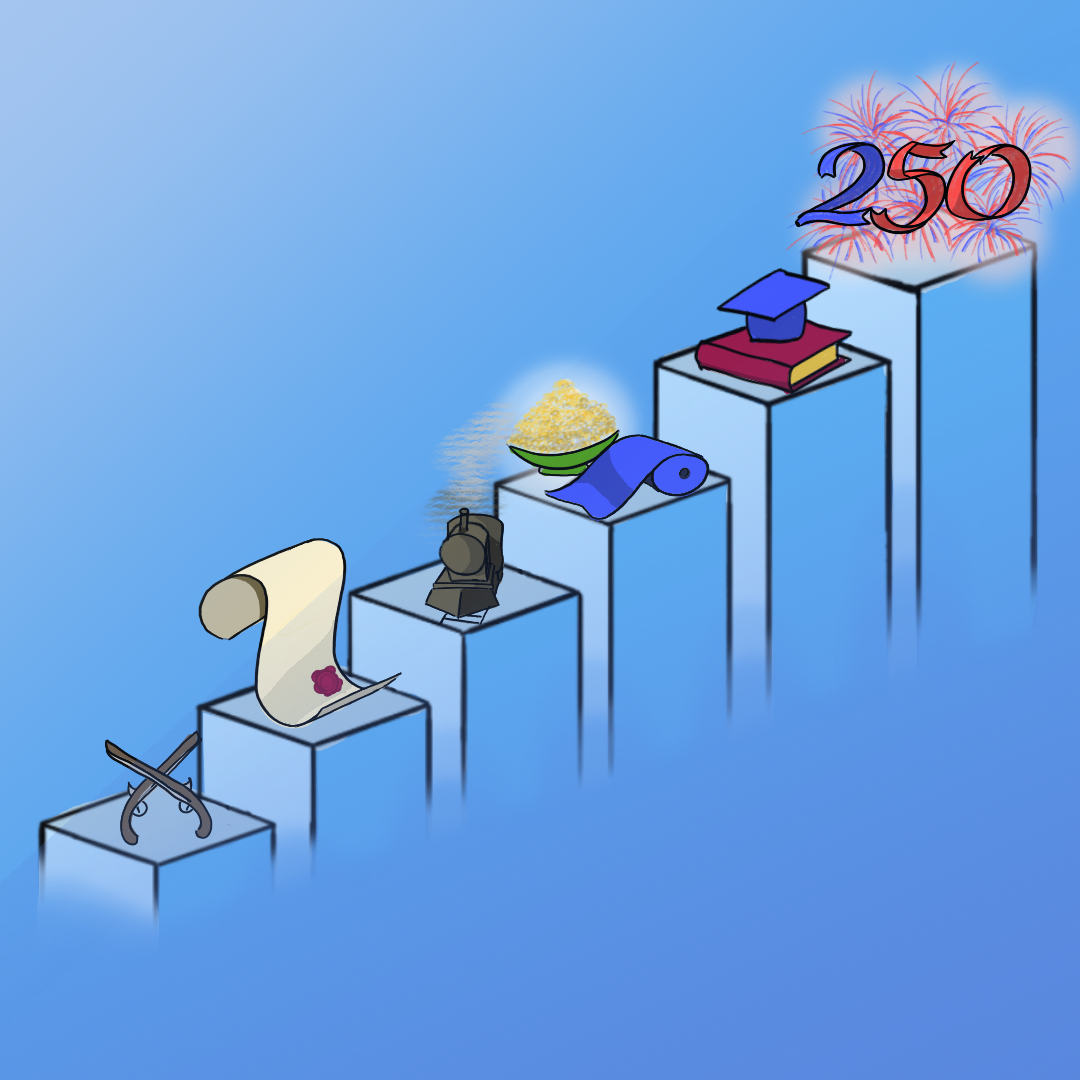
Glubb argued that successful civilizations typically progressed through six stages. Nations begin with a small, ambitious group willing to sacrifice and leave elsewhere to expand their territory. After optimistically expanding, the nation enters a period of economic expansion and eventually, builds up the nation’s international standing. The country’s living standards rise and a small majority’s wealth begins to accumulate. Towards the end, while education from universities and innovative ideas have begun to arise — a period that may seem like their peak — they reach their state of decline, or decadence.
Sound familiar?
The theory might align with the brief history of the U.S. After breaking away from the British Empire, the 13 colonies, in time, established the United States and quickly began to expand their territory through Manifest Destiny, the Louisiana Purchase, and later, the acquisition of California. Along the way, the events of America’s Gilded Age and the Industrial Revolution opened up the nation’s economy, and the GI Bill expanded educational opportunities while suburbs spread across the country and consumer goods flooded the market. Eventually, universities in the United States began publishing earth-shattering research, the nation was ahead in the space race and companies such as Apple, Microsoft, Google and OpenAI transformed global technology forever. Today, the citizens of the nation have become more entrenched in the decadence stage.
This final period is represented by what Glubb terms as the Age of Decadence, or a period wherein the nation is in a gradual decline in civic spirit. This includes: citizens of a nation becoming more focused on material overconsumption, a decline in religion, great disparities between the rich and poor and more, all of which lead to a disappearing shared sense of purpose.
Whether you agree with Glubb or not, many of these patterns appear increasingly visible in the United States today.
Material acquisition and overconsumption practices have become embedded into U.S. culture. If you scroll through TikTok for a few minutes, you’ll likely encounter a “Get Ready With Me” routine with a creator insisting that a product will “change your life” or some form of shopping haul. If you go to buy something a bit more expensive online, Buy Now, Pay Later services such as Klarna are normalized as an available method to finance everyday purchases even if you cannot readily afford them now. The Consumer Financial Protection Bureau has found rapid growth in the use of these services, particularly among younger consumers.
The decline in religion is another clear example of the decadent patterns. In 2007, 78% of American adults identified as Christian. By the 2023–24 Religious Landscape Study, that figure had fallen to 62%, while the share of Americans with no religious affiliation had risen from 16% to 29%, as found by a recent Pew Research poll. Though not an inherent signal of civic decline, religious spaces have historically served as places where Americans have built their communities and volunteered for the public good. Thus, its diminishing role represents a decrease in unity amongst people in the United States.
Lastly, the widening gaps between the rich and poor is economic inequality, which weakens the social cohesion amongst citizens that nations should strive for. In the United States, this pattern is evident in the growing disparity between executive and worker pay. According to the AFL-CIO, the average CEO of an S&P 500 company earned 268 times more than the median worker in 2023. This far-outpaced wage growth for ordinary workers versus those at the top divides people by a very vast, uneven distribution of wealth. This wide, unequal wage gap disconnects citizens from one another and weakens the sense of shared purpose that Glubb argued is essential to sustaining a cohesive society.
All in all, Americans are less prideful about their nation compared to previous generations, and for good reason. A Pew Research study found that about 41% of people in the U.S. claim the American dream was once possible for people to achieve, but may no longer be achieved. If this nation’s citizens no longer believe in the very ideal that may have first attracted them to the nation, how can they be expected to have a civic duty to the country? When citizens no longer believe the nation delivers on its promises, the social contract that binds individuals to the state and holds their civic duty begins to fray.
However, this does not mean the United States is destined to follow the fate of past empires. Glubb’s 250-year timeline is not exact, even for the countries he pointed out.
The fate of the U.S. — whether it lasts for another few years, decades or centuries — depends upon whether Americans can restore the civic trust and common identity that historically allowed the country to thrive. If they can, Glubb’s theory will remain an interesting coincidence. If they cannot, the six stages may prove their validity.
Julia Kremenetsky is an Opinion Assistant Editor. She can be reached at jkremene@uci.edu.
Edited by Ruby Goodwin

Julia Kremenetsky is in her final year majoring in Political Science! She is an Assistant Opinions Editor for the 2026-27 year. Since joining in April of 2025, she has written stories ranging political issues, social media and trends, current events, and more. Outside of the New U, Julia loves spending time with her dogs, spending time in nature, and watching YouTube video essays about obscure topics.