

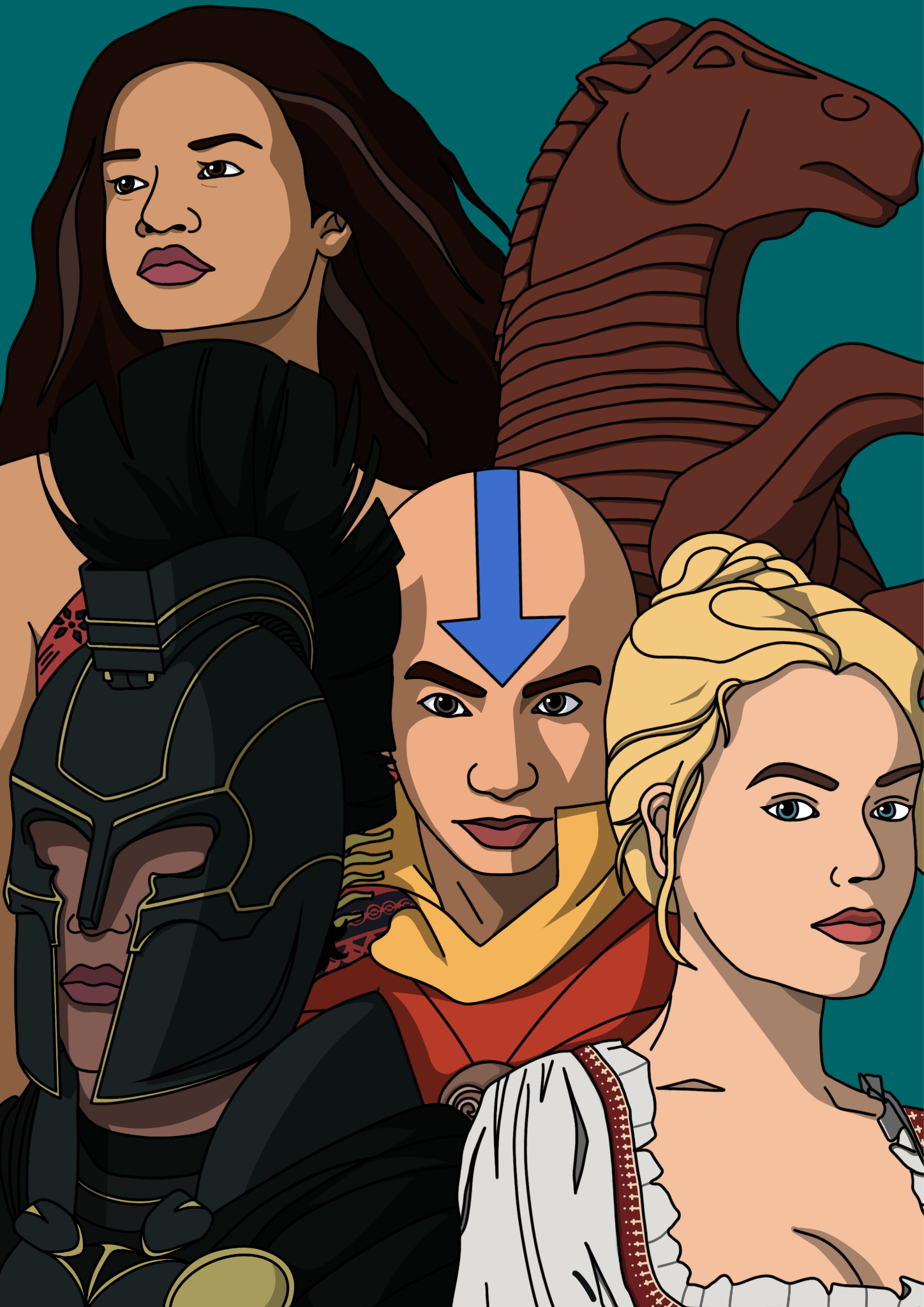


Ask 10 moviegoers what a good adaptation looks like, and you’ll get 10 different answers. That disagreement might explain why Hollywood keeps facing criticism from the audience no matter which one it picks — risky or faithful.
Netflix released the second season of its live-action “Avatar: The Last Airbender” in June 2026. Disney rolled out live-action “Moana” barely two years after the billion-dollar animated sequel. Emerald Fennell’s “Wuthering Heights,” released Feb. 13, still garnered op-eds in the spring. Christopher Nolan’s “The Odyssey” had just barely hit theaters before it started facing backlash over casting and modernized dialogue.
Almost none of these projects have escaped criticism. Not the faithful ones. Not the risky ones. Not even the box office hits.
That’s not a coincidence.
Audiences no longer agree on how loyal an adaptation should be, so every choice a studio makes is guaranteed to betray someone. Faithful adaptations get called lifeless. Risky ones get called disrespectful. There’s no third option, because the standard people are measuring against is never really the movie in front of them — it is memory.
Take season two of “Avatar: The Last Airbender.” Showrunners said they were retelling the story, not recreating it. But it rebuilt Ba Sing Se brick by brick, matching the original’s scenery almost shot for shot. It didn’t matter. The season debuted with 8.7 million views in its first four days, a 59% drop from season one’s 21.2 million, according to Variety.
What the show could not recreate was the animation’s spontaneity, something live action structurally struggles with. To fit a shorter season, producers cut whole storylines, forcing the writers to invent new plot points to fill the gaps. That’s where it fell apart: Chasing visual accuracy left the writing sloppy.
And in the end, even that accuracy was not enough to keep fans satisfied.
Casting faced its own backlash recently, with actress Thalia Tran, who plays Mai, getting harassed online for not looking like her animated counterpart. Faithfulness elsewhere did not save the show from casting scrutiny — stipulations on casting without an appreciation for original scenery shows that audiences do not know whether they want a retelling or not. But what they do seem to want is the original show they already knew.
“Wuthering Heights” took the opposite bet. Fennell even put the title in scare quotes — a warning that this was her version, not Emily Brontë’s. She amped up the sexuality, modernized the soundtrack with Charli XCX, and cast Jacob Elordi, a white Australian actor, as Heathcliff — a character Brontë explicitly describes as dark-skinned.
The reviews split almost down the middle: 57% positive on Rotten Tomatoes and a 55 on Metacritic. Critics argued the film flattened a story about class and racial exclusion into glossy, decontextualized romance. Yet “Wuthering Heights” made $241.7 million worldwide against an $80 million budget. Creative risk didn’t work with the critics, but the discourse fed the box office.
Put both side by side and the pattern becomes clear.
Faithfulness and riskiness were never the real tests. What’s being measured is whether an adaptation matches the version each viewer has carried privately for years: a childhood memory, a favorite scene, one detail that mattered the first time. No writer’s room can adapt nostalgia. Audiences aren’t asking for the original story back. They are asking for a feeling.
That gamble is also, conveniently, excellent business. Recycling a title with a built-in fan base means the marketing is a nostalgia that already exists. It is a cheaper pitch than an original one, which is why studios like Disney keep making it despite the numbers.
Live-action “Snow White” lost an estimated $115 million after backlash over Rachel Zegler’s casting, much of it about her not looking the part. Live-action “Moana,” which opened this month, debuted domestically to just $43 million against a $250 million budget. Nostalgia isn’t a guaranteed return. It is a gamble studios keep making anyway, because it is cheaper than building something original — and when it works, the audience is already there waiting.
And nowhere does that gamble get more scrutiny than in casting, and it’s never applied evenly.
Lupita Nyong’o’s casting as Helen of Troy in “The Odyssey” already drew accusations of historical inaccuracy, including from Elon Musk, despite Nyong’o’s reminder that it is a mythological story. Similarly, before Disney’s live-action “Tangled” had cast anyone, a fan suggestion that Indian American actress Avantika Vandanapu could play Rapunzel triggered racist backlash, per NBC News.
Compare that to Heathcliff, an explicitly non-white character. Elordi’s casting barely drew a fraction of the backlash aimed at Nyong’o or Vandanapu, even though accuracy is supposed to be the standard everyone’s applying. It gets loud when a character of color is cast, and goes quiet the moment one is written out.
So is a good adaptation, in the eyes of the audience, actually impossible? Not exactly.
“The Odyssey” makes the case.
Nolan didn’t lean on nostalgia. He used a modern translation; wrote dialogue meant to feel real, not accurate; and spent three hours and $250 million treating a 2,700-year-old poem like it still had something to say. It worked. The film holds a 94% on Rotten Tomatoes, tying with Nolan’s best-reviewed movies. It opened to $124 million domestically, his biggest debut in years. Empire described the reason as a trade-off: “What [the film] loses in faithfulness, it gains in visual and structural poetry.”
That’s the real difference. A cash grab cuts corners everywhere else. That’s how you get “Avatar: The Last Airbender’s” rushed plot or “Moana’s” box office flop. A film made with intent can change the story and still hold together, because the craft carries it. When a film is good, it is good.
Yet, good is still not enough. Even after the reviews and box office numbers came in, the complaints didn’t stop.
A week after its release, there were articles dissecting the historical inaccuracies in the costume, props and dialogue. Social media still had people insisting the film was somehow a failure. Criticism about Nyong’o’s Helen, transgender actor Elliot Page playing Sinon, Telemachus calling Odysseus “Dad” — none of it went away because the movie was good.
Audiences want faithfulness, then reject it. They want boldness, then punish that too. The reaction changes depending on which title, which actor and which fandom is doing the reacting. Casting is where that contradiction always ends up, because it’s the one choice a studio can’t hide behind visual effects or a shorter runtime.
Hollywood can’t win with adaptations because winning was never actually on the table. Not because every adaptation is doomed to fail, but because there is no single audience left to satisfy. Just a thousand private versions of the same story, each person certain theirs is the right one.
Meghna Srikumar is an Arts & Entertainment Staff Writer. She can be reached at msrikuma@uci.edu.
Edited by Corinna Chin.