



There’s something about watching a student film that a blockbuster can never replicate.
You are not just watching a story. You are watching someone figure out who they are, one frame at a time. Crystal Cove Auditorium became that kind of place — where you sit down a stranger and leave feeling like you witnessed something real — on May 22.
For the Film Arts Drama Alliance (FADA), the 27th annual Zotfest delivered exactly that: 13 short films, one intermission, a room full of people rooting for each other and a reminder that some of the most honest storytelling happening right now is coming from students with a camera and something to say.
Fourth-year international studies student Yuktha Chowdary Yalamanchili, Zotfest’s festival director, has a phrase she keeps coming back to: “delusional dreamers.”
“If you want to believe in something that does not exist yet, you have to be a little delusional,” Yalamanchili told New University.
It is a phrase that sums up not just her philosophy, but the ethos of everything FADA has built over nearly three decades.
FADA was founded 27 years ago by a group of college students. Among them was Asian-American documentary filmmaker Janet Chen Ma, who wanted to build something that did not yet exist: a space at UCI where filmmakers from different backgrounds could find each other. This diversity was not incidental; it was the point.
Today, Yalamanchili carries that forward.
Planning for Zotfest begins at the start of fall quarter with budgets, fundraisers, intern hiring and marketing. This year, the team also launched Stamp the World, a segment interviewing international students about their favorite films and an introduction to the festival’s larger spirit.
This year’s theme, World Cinema, was voted on by international students, transfers and first-generation Americans.
“As immigrants, as international students, as individuals who step into America, we are often taught to conform,” Yalamanchili said. “But art — filmmaking, dancing, singing, acting — these are so inbuilt in who you are as a person. If we can keep that alive here, at a campus as big and diverse as UCI, I think that is one of the best places to do that.”
The festival embodied the theme in every sense with students dressed in saris, salwars and batiks, each outfit a quiet declaration of where they came from. During the intermission, Circle of Fifths, UCI’s inclusive tenor-bass acappella group, performed a pop medley that had the auditorium clapping along.
The 13 short films reflected the same spirit — spanning horror, comedy, romance, experimental, documentary and political thriller. Some directors were veterans of the UCI film community, and others stepped in front of, or behind, a camera for the first time.
“One of the first things we wanted people to know is that you do not have to be part of the film community,” Yalamanchili said. “You can come from any background and still enjoy the film festival.”
While her message of belonging was simple, the road to make Zotfest happen was challenging. FADA runs on fundraisers, student passion and sheer will, coordinating nearly a dozen events this year alone.
“Even if we do not have official funding, we have the passion and the dedication to make this happen,” Yalamanchili said. “And I think that is one of the reasons we have been able to exist for so long.”
Despite the lack of official funding, the films did the rest. And one of them made the entire room hold its breath.
Directed by third-year film and media studies student Caden Kim, “Dreamboy” is an experimental horror film about a young man trapped in a dream-like loop.
Credited only as Angel, he is haunted by a ghostly entity — the haunting angel — that turns out to be his own repressed self. The film opens in a lush green field, the color grading already making everything feel slightly unreal. Angel turns to his friend, Joseph, and asks: “How do you know when you are in a dream?” What follows is a beautifully constructed meditation on self-acceptance, told through horror.
“I wanted to approach horror with the question of ‘what is this sense of dread,’” Kim told New University. “The tension and fear of not accepting yourself is the driving horror within the film.”
The film was born in an Art 81A Digifilm class; Kim had carried the idea for a year before finally having the push to make it. It was his first solo directorial debut and edited entirely by himself. Zotfest was the first time a real audience watched it on a big screen.
The haunting angel — designed by costume designer Nayely Muratalla-Morales and makeup artist Teresita Cienfuegos, two fourth-year film and media studies students — is veiled, pale and somewhere between a ghost and a bride. She is the part of Angel he cannot face. In a tunnel sequence, Angel finally confronts everything: “What do you want from me?” The answer: “You are running away from yourself.”
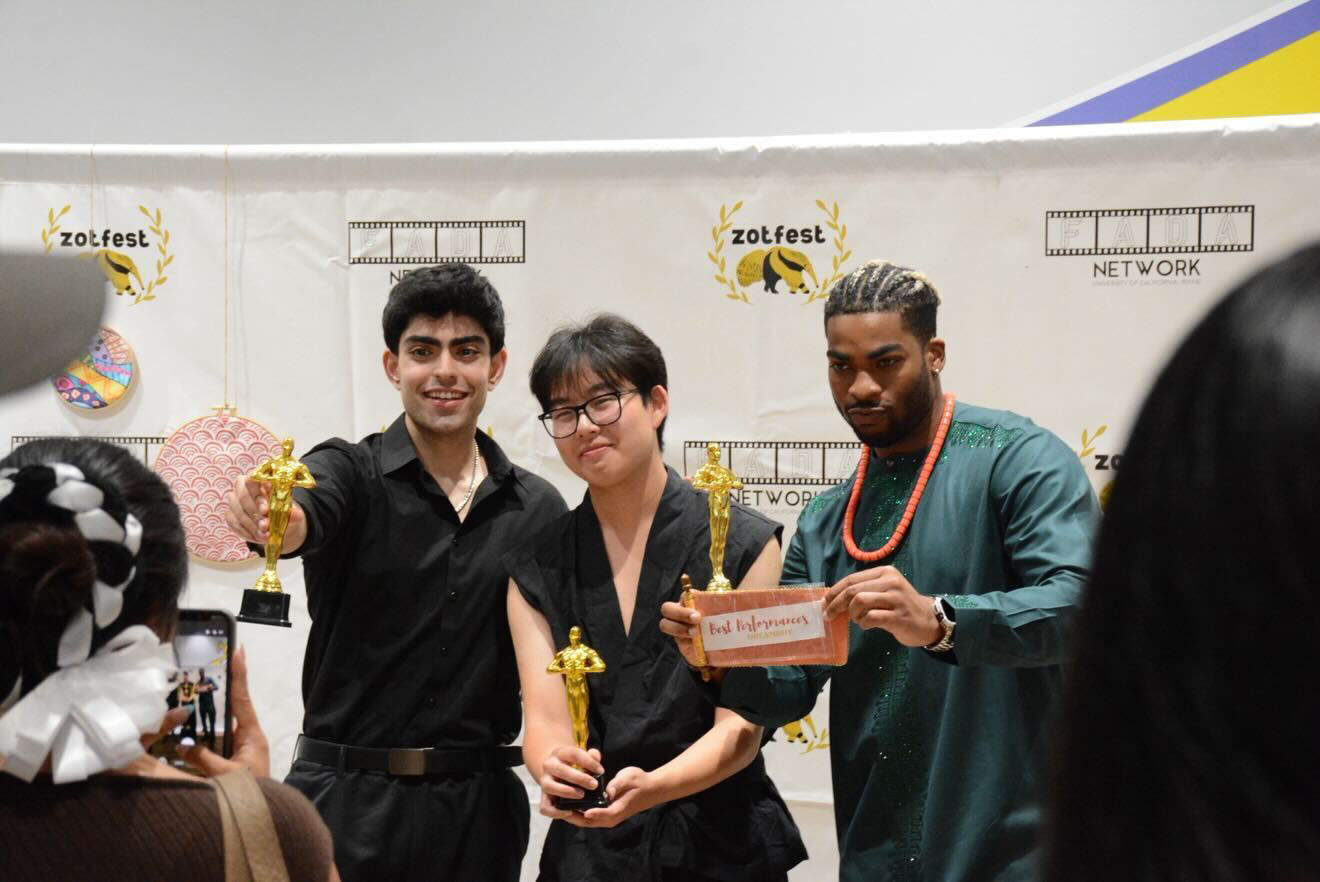
Lead actor and Cal State Fullerton student Ishan Panjabi brought a raw, quiet vulnerability to Angel. Fourth-year urban studies student Daniel Edu was a grounding presence as Joseph, and professional actress Alice Vo played the haunting entity entirely through movement — a shift, given her background in voice acting.
But that background did not go to waste. Sound designer and fourth-year business administration student Lucas Shin worked with Kim to transform her voice into something echoey and reverberant, a sound that fills a tunnel sequence with the kind of dread that had the audience gripping their seats.
According to Kim, funding was a challenge on set too. However, limitation became its own kind of creative fuel. The team went thrifting for costumes, used their own props and rented equipment.
“Having limited resources makes your creativity larger,” Kim said.
“Dreamboy” won Best Picture: the Golden Anteater Award. When Kim accepted, he kept it simple: “Accept yourself and be who you are.”
The Q&A that followed was one of the night’s best surprises. With the emcee ensuring every group felt the room’s attention, questions ranged from technical to deeply personal. Actors revealed their process, cinematographers explained lighting choices and costume designers unpacked symbolism. These students had spent months — some, an entire year — carefully building every detail of their film. This was their moment to be seen for their hard work.
“Cinema is one such field where you are asked to be courageous twice,” Yalamanchili said. “The first act of courage is when you think of an idea and start working towards it. The second is when you put that idea out there for the whole world to see and judge.”
The students in that auditorium had done both.
With Zotfest empowering student filmmakers for 27 years, Yalamanchili’s hope is simple.
“We hope to see it continue for another 27 years,” Yalamanchili said.
Alumni return every year. Families drive in from out of town. And somewhere in the audience, a future filmmaker is probably watching — not knowing yet it would one day be their turn.
Meghna Srikumar is an Arts & Entertainment Intern for the spring 2026 quarter. She can be reached at msrikuma@uci.edu.
Edited by Elizabeth Gregg.