



Editor’s note: The article was originally published on January 20, 2026. An editor’s note was added July 10, 2026. An author title was added to this article on June 29, 2026.
Former Sen. Mitt Romney (R-Utah) encapsulates what many consider to be the old Republican Party, representing a version of the Grand Old Party (GOP) that feels increasingly extinct. He has been explicit in his rejection of the modern far-right takeover of his party and continues to distance himself from the populist politics that are associated with the current Republican Party.
Romney has, once again, taken a stance on fiscal politics that many members of today’s GOP would not dare to make in his New York Times op-ed titled “Tax the Rich, Like Me.” This striking title is not something you expect to hear from a Republican politician.
But upon reading between the lines, Romney is simply reminding Americans what U.S. politics should be about. He advocates for politicians acting on what is best for the country as a whole, rather than getting caught up in partisan quarreling. He also wants to see a return to what the political system looked like before the divisive partisan shift. More politicians should take an example from Romney’s move and advocate for policy solutions that are in the best interest of the American people, even if they do not directly align with their political party.
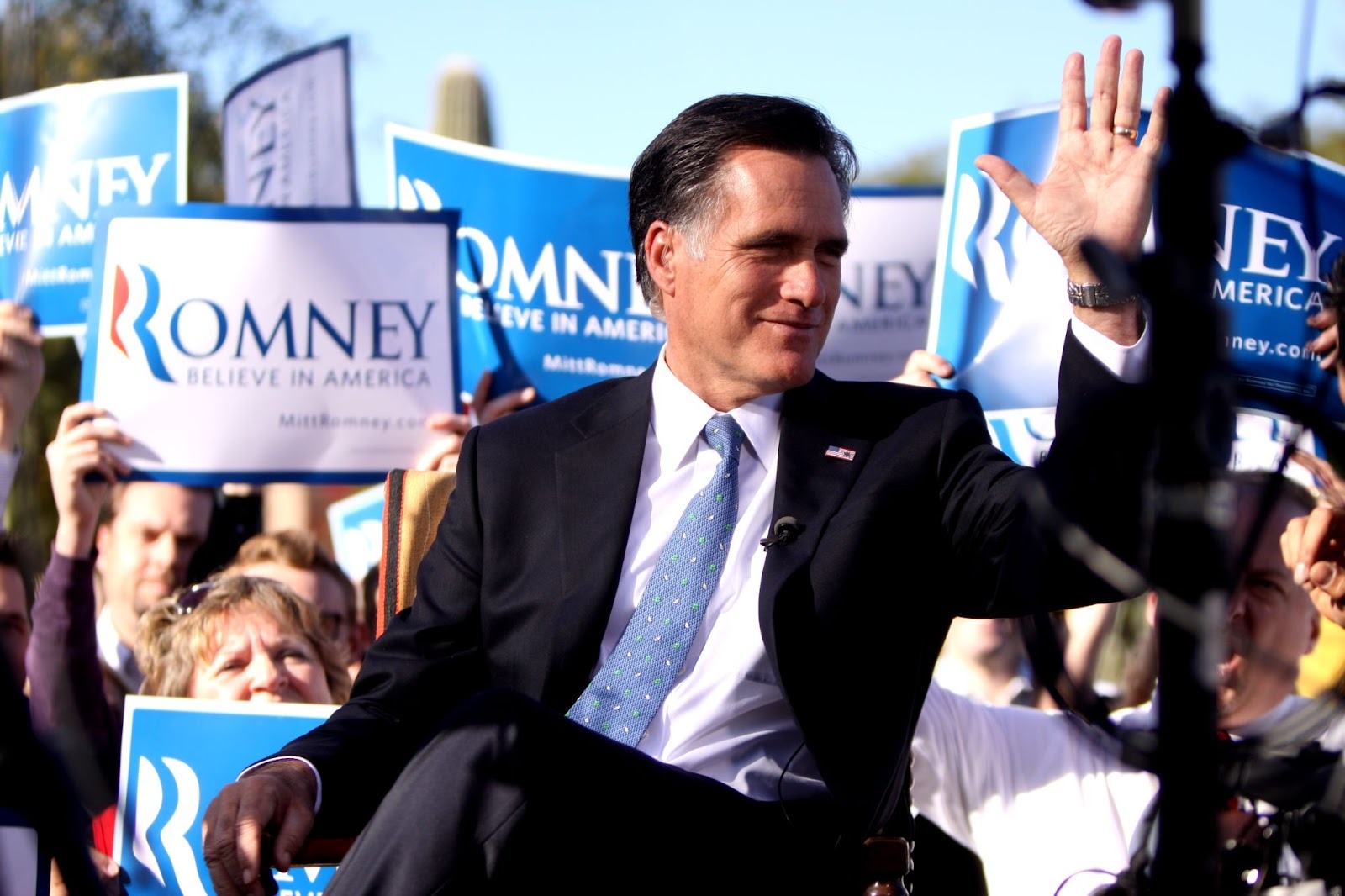
Just a decade earlier, the 2012 presidential race between Romney and President Barack Obama was one of the last elections that centered on political disagreements about what would best serve the country. Now, presidential races have each political tribe endlessly defending their party’s candidate, no matter the stance.
Though during that same election, in a privately recorded fundraiser, Romney suggested that nearly half of Americans, or 47%, were dependent on the government and therefore unlikely to support his campaign. Yet even then, Romney was mainly just focused on fiscal policy concerns. He didn’t care as much about winning as he did to “put[ting] people before politics.”
He now argues openly that wealthy Americans, including himself, must contribute more if the nation hopes to preserve programs such as Social Security and to avoid economic instability. In doing so, he supersedes his past beliefs. “There was a time in this country where we didn’t celebrate attacking people based on their success,” Romney claimed back in 2011. Today, he sees this taxation as an appeal for fairness and as a way to realistically address the national debt.
The Republican orthodoxy has usually emphasized tax cuts and taking personal responsibility, sometimes failing to acknowledge the structural realities many Americans face. These are not usual comments being made by conservatives, but Romney has proven that he does not have blind loyalty to the party.
“Today all of us, including our grandmas, truly are headed for a cliff: If, as projected, the Social Security Trust Fund runs out in the 2034 fiscal year, benefits will be cut by about 23 percent. The government will need trillions of dollars to make up the shortfall,” Romney writes in his op-ed.
To avoid this outcome, he argues the nation will require trillions of dollars in new revenue in addition to a serious spending restraint. But, endlessly borrowing money will only risk higher interest rates and inflation; therefore, it is not a viable option. As Romney claims, the Social Security Trust Fund itself cannot sustain the programs past 2034, calling for increased taxation with simultaneous spending restraints in other areas.
Romney now warns that failing to raise the revenue necessary to cover the programs will harm everyone — especially the seniors who depend on Social Security to survive. For Romney, it is no longer just about conservatism.
“Typically, Democrats insist on higher taxes, and Republicans insist on lower spending. But given the magnitude of our national debt as well as the proximity of the cliff, both are necessary. DOGE took a slash-and-burn approach to budget cutting and failed spectacularly,” he says.
It has gotten to the point where neither tax cuts nor spending cuts by themselves can fix a problem this big, so both parties have to meet halfway.
Romney’s willingness to endorse higher taxes on the wealthy is commendable and gives his argument credibility that few politicians possess. In doing so, Romney proves that to be fiscally responsible means to sometimes stray away from one’s party to pursue what one truly believes will help America, given the scenario at hand.
Now, in jarring contrast with today’s Republican Party, these calls for higher taxes on the rich are seen as a betrayal to his own party, even though it is his — and many others’ — solution to the looming fiscal crisis.
At the same time, Romney is not aligning himself with anti-capitalist rhetoric, but is more focused on achieving long-term stability and preservation of the economy to prevent a collapse. This call to “Tax the Rich, Like Me” is simply a recalibration of Romney’s conservative priorities and a return to the old, respectable conservatism he was a part of — one that prioritized telling voters the truth even when it cost him politically.
Julia Kremenetsky is an Opinion Staff Writer. She can be reached at jkremene@uci.edu.
Edited by Isabella Ehring and Kailee Kim

Julia Kremenetsky is in her final year majoring in Political Science! She is an Assistant Opinions Editor for the 2026-27 year. Since joining in April of 2025, she has written stories ranging political issues, social media and trends, current events, and more. Outside of the New U, Julia loves spending time with her dogs, spending time in nature, and watching YouTube video essays about obscure topics.