

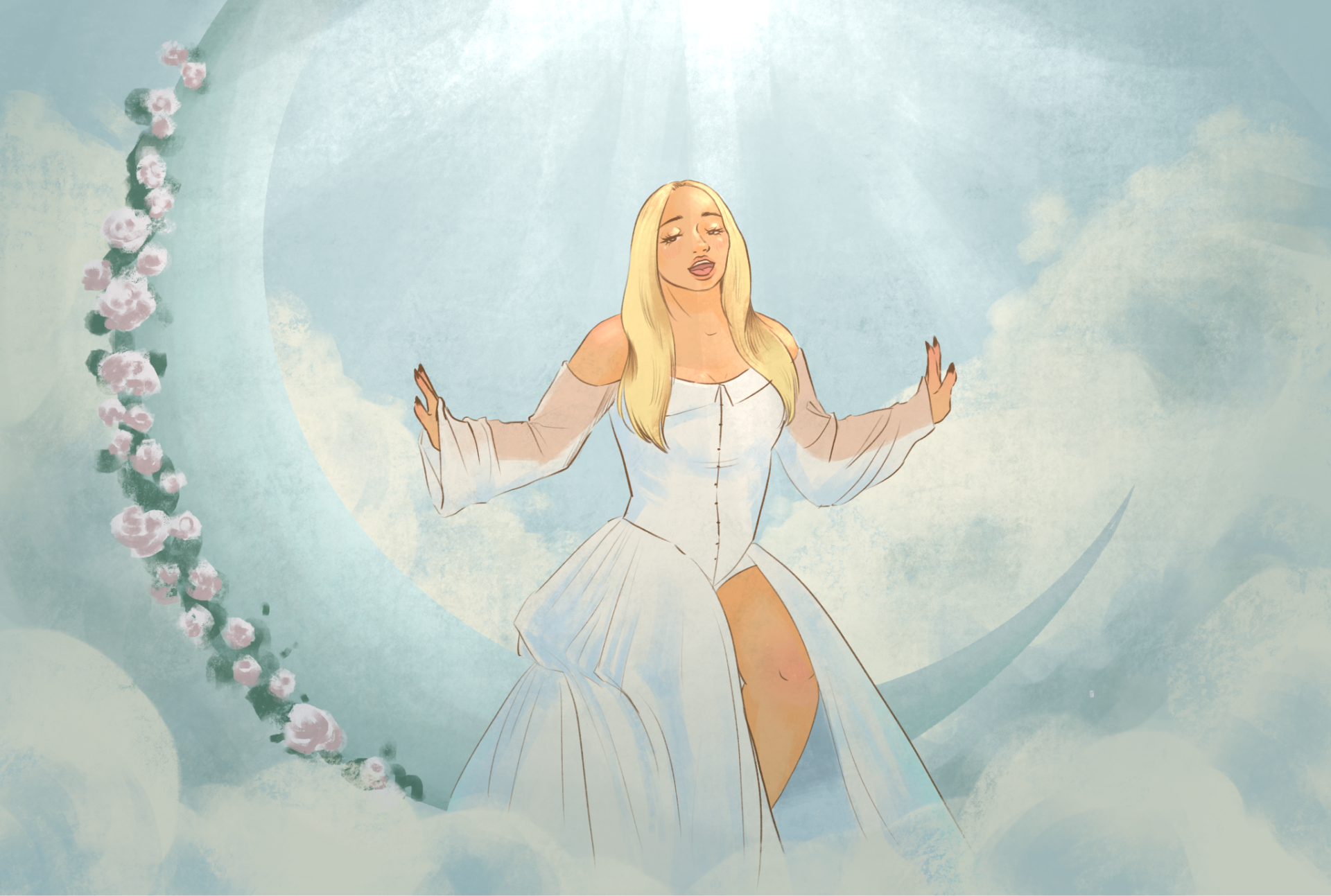


Trisha Paytas, an American influencer known for her long-standing online presence, released her newest single “사랑해 Saranghae (I Love You)” on May 18, which was written and performed solely in Korean. While K-pop is far from new to U.S. audiences, the release still riled up fans, as Paytas has shown minimal prior interest in the genre.
Given Paytas’ extensive online presence, it’s no secret that she has faced controversy for engaging with cultures outside her own, often in ways critics have described as insensitive or appropriative. In a now-deleted YouTube video, Paytas can be seen wearing Japanese gyaru-inspired makeup and defending herself against accusations of racism by claiming she “isn’t racist” because she enjoys Asian-associated items like rice and Hello Kitty. Although this incident occurred years ago, it represents just one of many moments in which Paytas has engaged with cultures outside her own. This recurring pattern has shaped how audiences interpret her creative choices, particularly when involving cultural aesthetics or languages she does not personally identify with.
“Saranghae” is a brief, two-minute single that finishes shortly after the first chorus, giving the song a short-lived impact. Critics have argued the song falls short in its rapping and English usage, noting that many K-pop songs incorporate more English lyrics than Paytas chose to include. Paytas has also received praise for working with collaborators, including Alex Wright and Korean writers Danbi Kim and Amy L. Stillwell. She has also been commended for learning Korean with the help of a language producer, demonstrating a level of preparation that critics have noted. These behind-the-scenes contributions suggest that, despite the song’s brevity and mixed reception, Paytas approached the song with a level of preparation and cultural research that goes beyond surface-level imitation.
The music video mirrors the style of many mainstream K-pop productions, featuring trendy fashion, synchronized backup dancers and a backdrop inspired by downtown Seoul. The visuals cycle through several familiar K-pop aesthetics — from cityscape backdrops to a dreamy cloud where Paytas sings on a swing. Another scene places her at the center of dancers in vibrant tops and shorts before transitioning into a nod to Korean mukbang culture, showing Paytas eating large portions of Korean food against a black background. Taken together, these elements make the music video read as an imitation of K-pop conventions.
The single’s release arrives at a particularly busy moment for Paytas, who is currently on a global tour, has recently collaborated with Benihana — a Japanese teppanyaki chain restaurant — and has announced plans to run for Congress in California. This kind of eclectic activity is typical for Paytas, who has previously released a Bridgerton-themed music video about the McGriddle from McDonald’s and even a devotional pop song about her love for Jesus. These wildly varied pursuits reinforce Paytas’ reputation for embracing whatever aesthetic, trend or storyline captures her attention.
While the single and its accompanying music video draw heavily from K-pop conventions, the song’s reception reflects the complicated history that shapes how audiences interpret her creative expression — marked by both earnest effort and repeated missteps in engaging with cultures outside her own. Whether viewed as an homage, imitation or another chapter in her ever-shifting online narrative, “Saranghae” underscores the unpredictability that has defined Paytas’ career and continues to fuel the public’s fascination with her next move.
Kathryn Lehman is an Arts & Entertainment Staff Writer for the Spring 2026 quarter. She can be reached at kalehman@uci.edu.
Edited by Avani Kumar and Joshua Gonzales

Kathryn Lehman is a first-year psychology major planning to double major in political science. Bay Area born and raised, she is an Arts & Entertainment Staff Writer for the 2025-2026 school year. She joined New University as an Arts & Entertainment Intern in fall 2025. Outside of school, she enjoys writing about pop culture, reading young adult fiction, listening to music and spending time at the beach.