



Editor’s note: The article was originally published on February 15, 2026. An editor’s note was added on July 10, 2026. An author title was added to this article on June 29, 2026.
Have you ever caught yourself, or your friends, after just returning from a Europe trip saying you felt like you lost weight? Maybe feeling lighter or healthier, in spite of the excessive pasta and gelato consumption?
A common explanation for this phenomenon may be the fact that, while on vacation, people walk more, experience increased overall relaxation and consume food items made from fresh wholefoods. But what is it about these factors that leads to an overall lack of sluggishness in Europe that can’t seem to be shaken off in the United States?
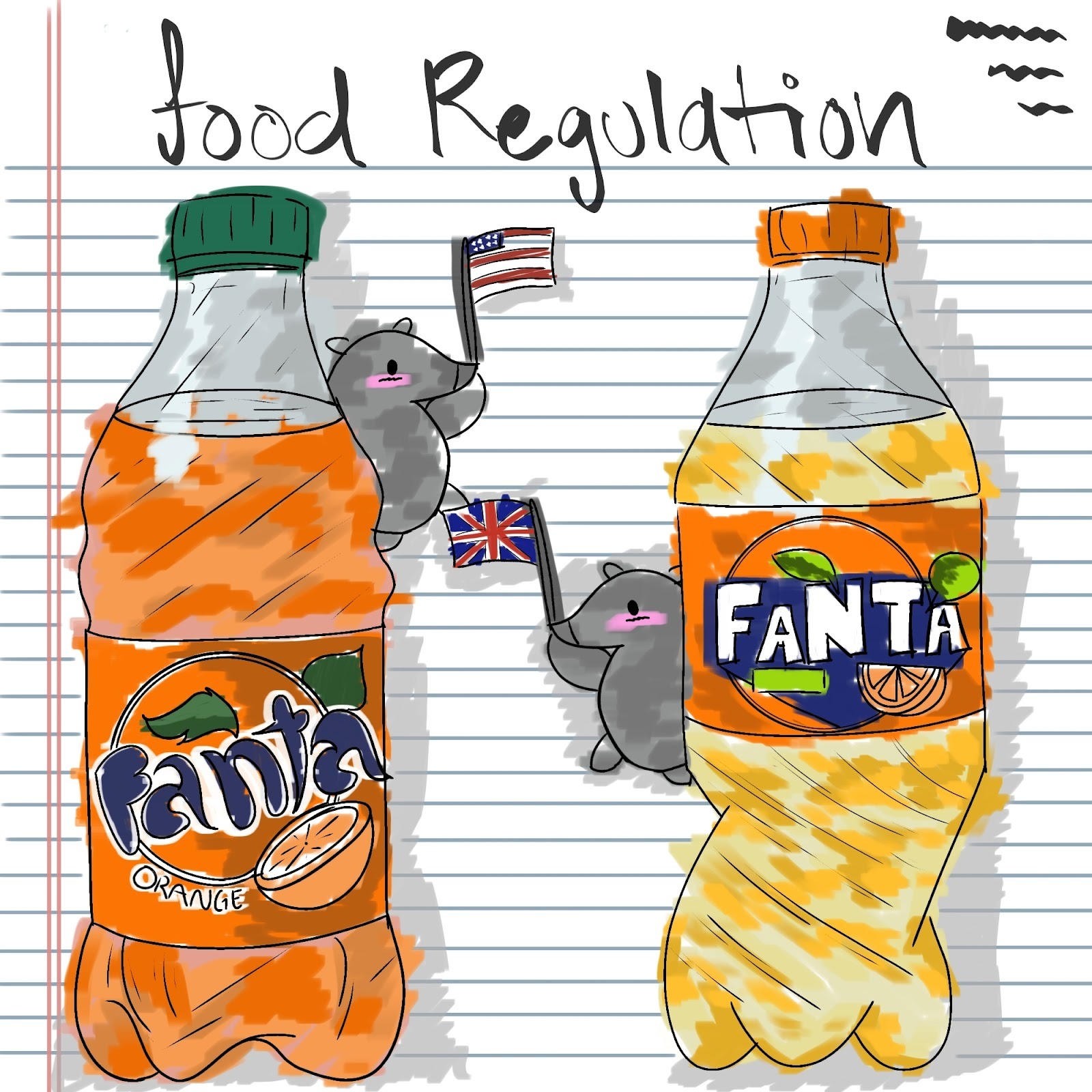
The phenomenon reveals something uncomfortable about how food regulation is approached in the U.S. Take an ordinary, popular product like Fanta. In the U.S., the bright orange soda contains high fructose corn syrup, as well as Yellow 6 and Red 40, which are artificial dyes created from petroleum. In Europe, the Coca-Cola company manufactures the same Fanta product with real orange juice, sugar and natural colorings from carrots and pumpkins. This is why the European version looks paler in color and almost watered down when compared to the U.S. version. Coca-Cola can make the product without these additives in the U.S.; they just choose not to because artificial food dyes are significantly cheaper to produce and possess a much more stable shelf-life than natural alternatives.
When a company proves a product can be made and sold without harmful additives, their choice to use cheaper, more controversial ingredients in the U.S. isn’t about what’s possible. It’s about what’s profitable.
This pattern of products being healthier in Europe is ubiquitous. Skittles in Europe are reformulated without titanium dioxide, a whitening agent the EU banned, after research suggested it accumulates in the body and causes DNA damage. Skittles produced in America still contain it. Even azodicarbonamide, a chemical used in bread baking which is also found in yoga mats, is currently banned in Europe while still permitted in the U.S.
These differences stem from fundamentally different regulatory philosophies. At the heart of this sits a question about capitalism: Whose job is it really to prove something’s safety?
While both the U.S. and European Union (EU) member states are fundamentally capitalist, their answer to this question differs. The EU operates on a precautionary principle: If there’s scientific uncertainty about an ingredient’s safety, it gets restricted until independent scientific authorities like the European Food Safety Authority (EFSA) determine its safety. Whereas, in the U.S., the FDA uses a “Generally Recognized as Safe” system that allows food companies to determine for themselves — often using their own hired experts — whether ingredients are safe. With less regulations, harmful additives and cheaper ingredients are effective cost-cutters for corporations within the U.S.
Currently, the U.S. approves roughly 10,000 additives, while the EU only approves around 2,000. This isn’t because the U.S. requires more variety in food colorings. It’s simply because both of these systems are asking different questions and striving for different goals. Europe asks if the product is proven to be safe, whereas the U.S. asks if the product is proven to be dangerous. By the time the second question is answered, it is often too late. American companies have already profited for decades on generations exposed to unsafe goods.
This is why the “eat less, exercise more” advice fails many people. People can’t moderate or diet their way out of ingredients that fundamentally alter the body’s functions. Research shows that high-fructose corn syrup — abundantly used in the U.S. as a substitute for sugar — is actually metabolized differently by the liver, and is linked to both insulin resistance and increased inflammation in the body. Studies on artificial dyes, like Red 40, show that they can cause DNA damage and colon cancer in animals. When these ingredients are removed from the diet, even temporarily on a European vacation, inflammation in the body decreases, resulting in better sleep, clearer skin and improved digestion.
But this regulatory difference extends beyond food. In September 2025, Europe banned TPO, a key ingredient in gel nail polish, after classifying it as potentially toxic to reproduction. Meanwhile, the chemical remains permitted in the U.S.
Another uncomfortable fact that should not be ignored is the implication of class differences. Typically, only wealthy Americans can afford to buy organic, unprocessed foods. Therefore, the people most affected by these lax food regulations are the ones who oftentimes can’t escape them financially.
The EU system of proving safety before selling, rather than asking sick people to prove harm after buying, prioritizes health over profit.
Sara Khan is an Opinion Staff Writer. She can be reached at skhan7@uci.edu.
Edited by Isabella Ehring and Joshua Gonzales

Sara Khan is an Opinion Staff Writer. She is a second year Computer Science major at UCI. Her writing focuses on psychology, social behavior and the cultural impact of emerging technologies.