

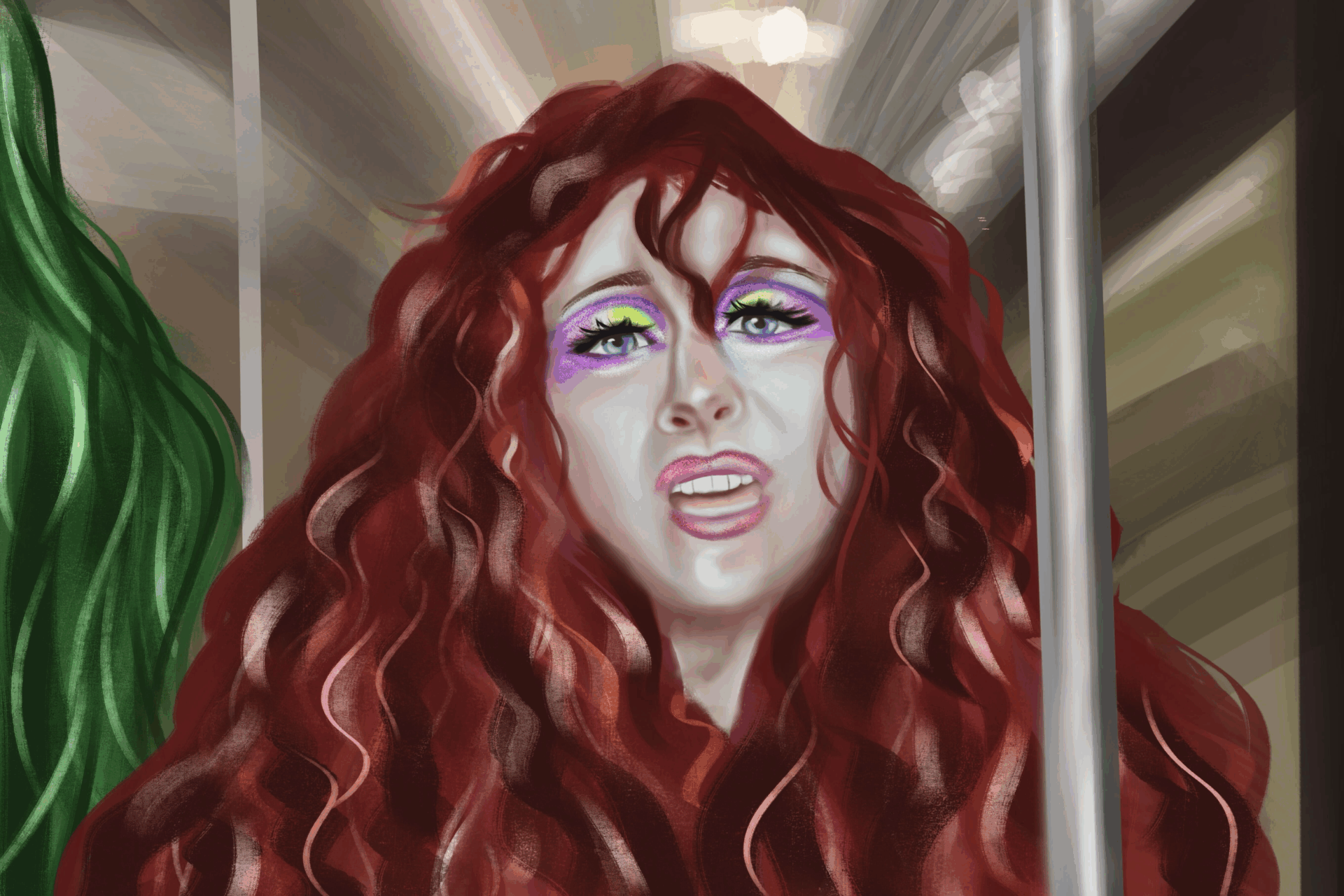


After several live performances of her song “The Subway” at music festivals like Coachella and Outside Lands in the past year, Chappell Roan officially released the single on Aug. 1. Accompanying it was a music video centered around a hair motif nodding to the fairytale “Rapunzel” in front of a New York backdrop.
Because live performances of “The Subway” captivated audiences prior to its studio version for almost a year now, fans’ reactions predominantly focused on the music video’s visuals and drama.
Roan’s costume changes included a variety of hairstyles and outfits: Long flowing locks drowning her entire body, her traditional cut which allowed viewers to see her face and shorn hair. Roan, immediately recognized by her red mane, took on the New York subway system to chase down her beloved — a mass of green hair without a visible face determinedly running away from her.
To contrast the first depiction of Roan nearly drowning in a sea of her red curls, the music video cut to shots of her laying supine in a public fountain with smudged eye makeup and soaked tresses trailing down her body.
With new braided locks pouring down from a balcony and trailing behind her in another shot, the “Rapunzel” reference is clear. A tower of green hair that Roan climbs signals to how Rapunzel’s prince loyally climbed her hair to meet her.
Underneath the allusions, Roan’s decision to use hair as a vehicle for painfully vivid memories of this faceless girl became obvious when the music video cuts to the singer now sporting a blunt-cut bob in a whirlwind of New York litter. Similar to the phrase “carrying baggage,” hair in this music video represents past trauma that prevents the bearer from moving forward. In the video, Roan is physically unable to exit a taxi when her hair caught on the car door and she’s dragged across the road.
Also important to consider is that red and green are complementary colors – but as Roan says in the song, she tries to let go of the notion that she and the girl represented by green hair were still soulmates.
Studying the lyrics, the first verse opens with relatable sentiments of missing someone complemented with resulting visceral reactions. Roan writes of her longing by invoking senses of sight and smell to describe the absent girl: “I saw your green hair, beauty mark next to your mouth” and “somebody wore your perfume.” Faced with these reminders, Roan confesses “I nearly had a breakdown” and “It almost killed me, I had to leave the room.”
Unraveling the paradox of missing someone who no longer fills in her life, the chorus explains “It’s just another day and it’s not over / ‘Til it’s over, it’s never over.” Life goes on post-breakup, as does the pain. That pain may lessen every day, leading the narrator to believe that it will completely pass at some point. However, it becomes clearer that the pain will only minimize over time without ever fully disappearing.
This indefinite process of “still counting down all of the days / ‘Til” she’s “just another girl on the subway” manifests into bitter lines like “Made you the villain, evil for just moving on.” Between resenting this girl and realizing she can never fully escape her memory, Roan eventually swears, “if in four months, this feeling ain’t gone / Well, f**k this city, I’m moving to Saskatchewan.”
The outro switches between two lines that only differ in one word: “She’s got a way, she’s got a way / And she got, she got away.” Through the usage of alternating words, Roan emphasizes that the girl who effortlessly enchants people is the same one who ups and leaves them immediately after.
Age-old fairytales like “Rapunzel” end with happily ever after; Rapunzel gets her prince even though he passes in and out of her life before the tale’s resolution. However, the video’s penultimate shot shows Roan stuck in her climb up this tower of green hair — as though Roan stoutly attempted to access this woman’s heart but has just realized how infinite and fruitless that journey is.
In the past few years, Roan has embarked on a journey of relating to broken or healing hearts, and incorporating fairytale allegory into her work is just one of Roan’s many elements of drama.
Carmen Lin is an Arts & Entertainment Intern for the summer 2025 quarter. She can be reached at carmnml@uci.edu.
Edited by June Min and Annabelle Aguirre

Interested in becoming an intern or a contributing writer for the Entertainment section?
Contact us at entertainment@newuniversity.org!