

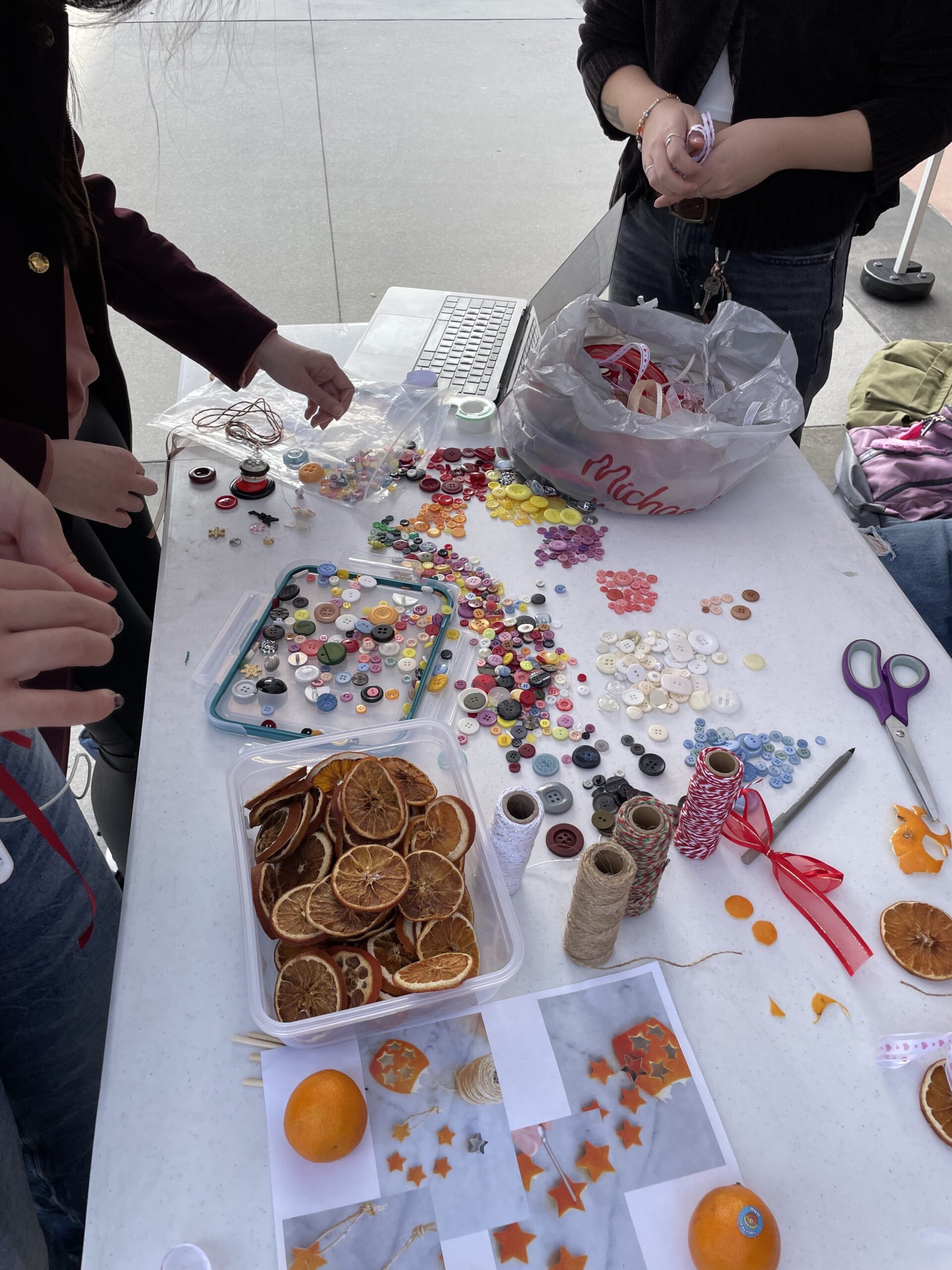

The Associated Students of the University of California in Irvine (ASUCI) Sustainability Project Commission filled a table with colorful buttons, festive ribbons, twine and slices of dried oranges for their second annual Greening the Holidays event. Most items at the event came from a secondhand source. Students stopped by at the event to make DIY Christmas decorations on Dec. 3 from 12 p.m. to 2 p.m.
Students hung dried orange slices on twine to make garlands, make christmas tree ornaments out of buttons and make bows out of eclectic ribbons.
When gathering the material, co-commissioner and fourth-year social ecology student Lizzie Braver tried not to contribute to mass production and to support small businesses instead.
She went to Savers, tried to locate Etsy sellers trying to get rid of extra material, went on a hunt for secondhand craft supply stores in Irvine, cut up the oranges and baked them herself and asked her grandma if she had extra sewing material she could use. She ordered vintage music paper which could have been used to make origami stars, but lost those in the mail. She also bought buttons from JOANN — a retail store — which she said wasn’t “as sustainable” as she was hoping.
“I tried to thrift as much as I could, but it’s still not as simple as you would like,” Braver told New University.
The activity is a way to show students that they can use material they already have to decorate this season and to deliver the message that holiday sustainability is fun and affordable.
“A lot of times sustainability [has a notion of] buying normally is more convenient and [that] kind of you have to go out of your way to be more sustainable and it’s a little bit more of a burden but like, I feel like kind of making your own decorations can also be really fun and make you feel more festive. I felt like it made me feel more festive,” Braver said.
According to the U.S. Environmental Protection Agency (EPA), December is considered the most wasteful month of the year, with the average amount of household waste being around 25% higher than it is all year. Overconsumption is a major aspect of American Christmas, with people buying decorations, gifts, wrapping paper and food in excess.
Holiday and everyday waste contribute to greenhouse gas emissions — and consequently to climate change. Whether waste is decomposing in landfills or incinerated, greenhouse gases are released.
The manufacturing of gifted items consumes energy produced by burning fossil fuels, which contributes to greenhouse gas emissions. Recycling is one way to prevent this process because recycled material requires less energy when it is used to manufacture products as opposed to newly manufactured material.
Being mindful of the amount of products we consume during the holidays is another way to reduce greenhouse gas emissions — it is a collective effort that will help lower the demand for production.
“Sometimes I feel [with] students and like younger people, it’s kind of hard to get involved in sustainability because it feels like, oh, I can’t do something. What I’m doing is not enough, I’m just one person,” third-year English and history student, Haley Towns, told New University. “But when you bring it down to a daily level and things that we use on an everyday basis, it kind of shows, well, oh, even taking this little step, I can help towards a more sustainable future.”
Other ways to incorporate sustainability this season includes making handmade gifts, using newspaper pages or recyclable grocery bags to pack them, gifting experiences instead of items and composting.
“It’s important to remember that you don’t have to buy all this stuff every year and you don’t have to change it up every year. These things are meant to last, you can save them or you can make new ones,” Towns said.
Mariam Farag is a Features Intern for the fall 2024 quarter. She can be reached at msfarag@uci.edu.
Edited by Kaelyn Kwon and Annabelle Aguirre

