

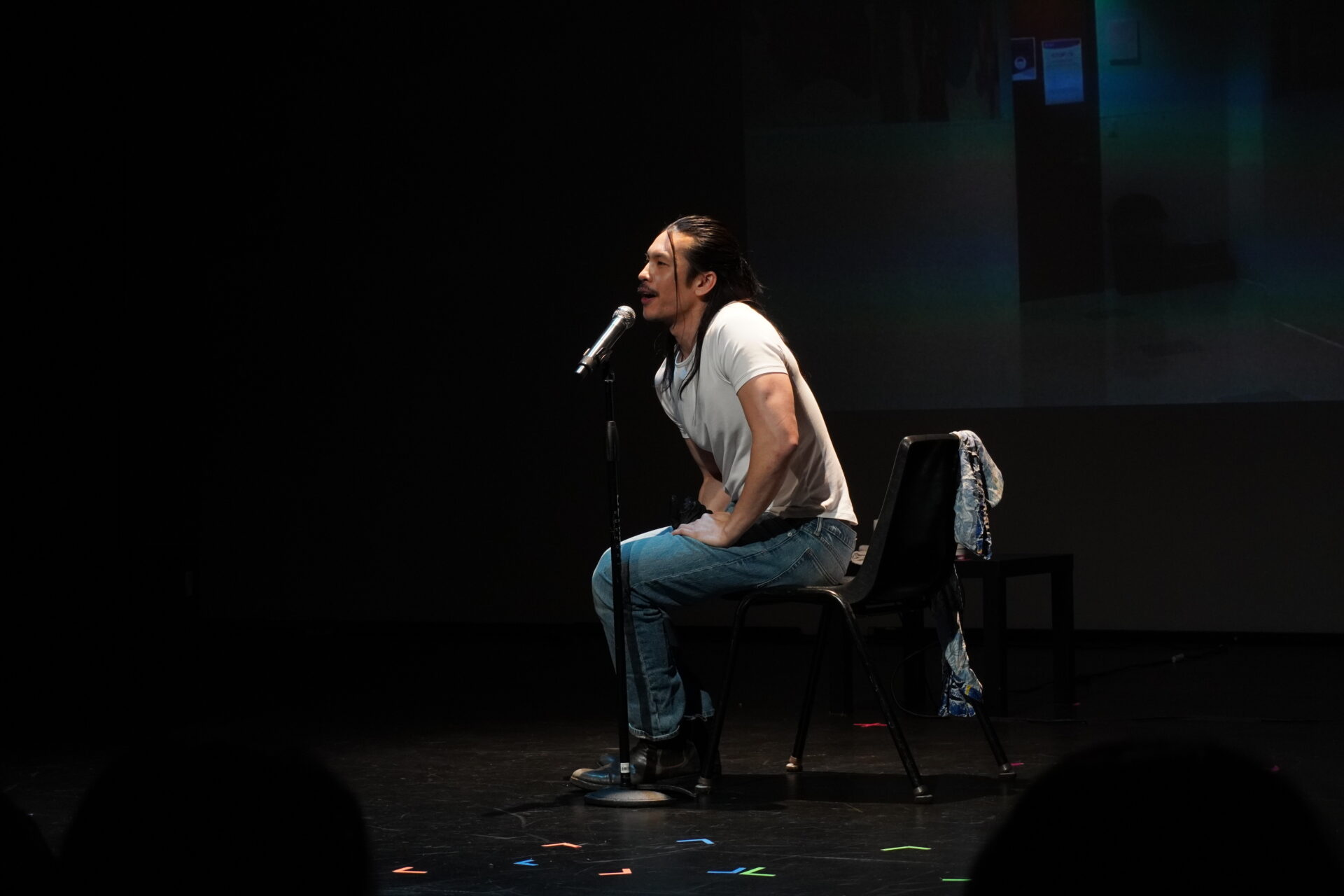

M.F.A ’27 Kurt Kanazawa currently works in the drama department of UCI, but his repertoire stretches across all fields of the arts. Kanazawa is an actor, playwright and opera singer; his accolades go far beyond the official titles that label his past experience.
New University had the pleasure of interviewing Kanazawa and discussing his recent work, such as his solo show “L’OPERA!” A work detailing the events of Kanazawa’s own life, “L’OPERA!” reveals that during his time as an opera singer, Kanazawa was diagnosed with vocal dystonia and was told he would never be able to sing again.
This prominent event in Kanazawa’s life was obviously a hindrance to his career as an opera singer. However, he views this incident in complement with a different takeaway of his experience. Branching outside of opera singing, Kanazawa extended his expertise to pursue opportunities in acting and writing his own plays, among other live theater-based work. During his time branching out into live theater, specifically playwork, Kanazawa discovered a truth in the interactive nature that comes with this line of work.
“This is the power of art and live theater, is this kind of conversation,” Kanazawa said.
The type of conversation Kanazawa refers to is one with differing voices, which he says can only happen during live theater. More specifically, he emphasizes that speaking in front of people is the true power of the art, creating “intertwined” conversation between audiences and actors of different backgrounds through interactions in a live theater setting.
“When you’re being a full embodied human being in front of other people, a different kind of empathy is built because this is, in theory, the kind of person you would confront in just normal life,” Kanazawa said.
The confrontation between performer and live audience, he describes, immerses participants and becomes associated with their real life beyond the medium of entertainment. It is this connection that moves people and builds an empathy that Kanazawa argues can only be bred through the nature of live theater. And it is this understanding of live theater’s impact that complements the progressive motivations behind Kanazawa’s work.
“The only way to really radically change people is by doing plays,” Kanazawa said.
While plays are his primary focus, even beyond “L’Opera” Kanazawa uses his position in the arts to amplify and progress Asian voices. As a Japanese man himself, he expressed his dedication to welcoming not only Asian people into the arts, but also to giving space for all minorities to feel welcomed in the field. He cites his background in teaching as an example of this.
“I’m trying to encourage freedom,” Kanazawa said. “And I think by doing that, I think it unlocks something, especially in the Asian American kids and as a result, that unlocks something in all the other kids.”
Kanazawa forefronts his teaching approach by unlocking potential and encouraging freedom of expression within his students. By inspiring one student or a group of students, he finds that this feeling spreads inevitably to them all.
“They explore freedom and find full expression of their humanity because they have a teacher who can maybe model it for them,” Kanazawa said. “And that’s infectious… when one student becomes free, everybody starts to become free.”
Kanazawa recognizes that his mindset — and his demonstration of human expression as a teacher — instills growth and freedom of expression among his students. His “crazy” persona when teaching is what creates that model for his students as a teacher from a minority population unafraid of unfiltered expression and freely exhibiting raw emotion.
Kanazawa’s drive as a role model is also reflected in his work beyond UCI.
For example, Kanazawa said that his success in obtaining roles helps expand opportunities for other aspiring Asian actors in the field.
“The ripple effect of that is they now have to find an understudy, for me,” Kanazawa said. “But that means a door has now opened, for an Asian-American male, an Asian male, to be invited into the room.”
By pursuing his passions and making big steps for his own career, doors for others within his community naturally open along the way. Kanazawa emphasizes that his indirect push through the need for an understudy empowers Asian actors to not only start, but keep entering the spaces he pushes himself into.
Kanazawa doesn’t limit himself to relying on ripples when it comes to promoting inclusion in the arts. As a leading figure behind UCI’s first student-run Asian theater group, Underground Asian Players, Kanazawa doesn’t shy from innovation when it comes to using his influence to inspire change and amplify minority voices.
In helping run the theater group, Kanazawa is responsible for putting on events such as Future Fest, which pushes cross-collaboration between varying minority groups in the arts to work on plays and varying attractions for the event. Once again, Kanazawa opens doors for all kinds of minorities to enter in collaboration with one another.
It’s no easy feat to say the nature of your work is embedded in progressiveness for not only your own community, but also the people outside of it. However, Kanazawa can.
Kanazawa’s story not only teaches audiences resilience but the importance of community and the political drive behind what it means to be an influential figure within the arts.
Audrey Phoukong is an Arts & Entertainment Intern for the winter 2026 quarter. She can be reached at aphoukon@uci.edu.
Edited by Joshua Gonzales

