




English singer-songwriter FKA twigs, born Tahliah Debrett Barnett, released the new single “Don’t Judge Me,” along with producer Fred again.. and rapper Headie One on Jan. 26. The track was originally an interlude on a mixtape titled “GANG,” a collaboration between Fred again.. and Headie One that was released last year. The short interlude from “GANG,” ironically titled “Judge Me,” was expanded into a full length track, now crediting FKA twigs as a primary artist.
“Don’t Judge Me” is twigs’ first song release since her 2019 studio album “Magdalene” under British independent record label Young Turks — whose roster includes prominent musicians such as Sampha, Kamasi Washington and Jamie xx.
“Magdalene” proved to be a haunting masterpiece upon its release. Almost every track is powerfully operatic yet dangerously delicate — excluding “holy terrain,” in which her pugnacious, sensual vocals overlay a trap beat filled with echoing ad-libs from rapper Future. Especially apparent in tracks such as “cellophane” and “home with you,” twigs’ high-frequency falsetto and pleasant piano melodies paired strikingly well, spliced with glitch sounds and heavy, repetitive bass.
The R&B futurist and electronic artist is known for the multimedia immersive experiences that she creates. She has directed many of her own music videos, including the one put out along with her release of “Don’t Judge Me.”
The music video addresses the ever-present systemic racism in America and Europe and features distinguished Black British professionals and creatives.
The music video spotlights an all Black cast, and twigs is styled in exclusively Black designer wear — a long sleeved Martine ROSE t-shirt and camouflage straight leg trousers — made possible through FARFETCH. A breakdown of twigs’ Black designer edit can be found on the FARFETCH website.
A large-scale sculpture by American artist Kara Walker titled “Fons Americanus” is a central element in the video. The four-tiered fountain contains multiple symbolic facets narrating the origins and impact of the African diaspora.
The oppression of Black bodies and livelihood is also made viscerally apparent through the video’s choreography and Headie One’s lyrics.
“Officer, am I allowed to breathe here?” Headie One raps.
The origins of FKA twigs’ love for choreography began before her prolific music career. The artist moved to South London at the age of 17 and started out her creative career as a backup dancer for other musicians, such as Jessie J. Twigs’ professional experience in dance is apparent in all of her videos and performances. Her performance of her songs off of album “M3LL155X” at the 2015 MOBO Awards convey a sense of twigs’ passion for choreography aesthetics.
The “Don’t Judge Me” music video was directed by twigs and Emmanuel Adjei, an acclaimed visual artist known for his work with Beyoncé on her visual album “Black Is King.” The music video is no exception to the stunning choreography centralized in twigs’ filmography. In “Don’t Judge Me,” performers express the dichotomy between the fluid beauty and forced rigidity of human movement, which is symbolic of survival under Black oppression in the media and everyday life.
In fact, the “Don’t Judge Me” music video is more stripped down compared to her other films since it focuses primarily on bodies rather than ornate costumes, special effects or set design.
The music video opens with a plain, unassuming room where Twigs sits, casually dressed. She lifts her head and looks directly forward, clearly longing for whatever is capturing her gaze. The object of her desire is a door, from which she rarely breaks her fixed concentration.
Throughout the music video, the scene of twigs tirelessly dancing toward the front of the room in a sisyphean fashion is continually returned to. At times when she is self-assured and determined, she makes her way closer and closer to her destination; however, she’s only to be abruptly pulled back into her chair by an invisible gravitational force, suspended mid-air like a puppet.
It is incredibly frustrating. Twigs tirelessly fights to move forward, similar to that recurring dream one gets — using all their strength to sprint away from the monster chasing them, only to look down at their legs moving slow as molasses or not at all.
Twigs pleads in a crooning voice, “Don’t judge me, take care of me / Don’t judge me, take care of my heart / Don’t judge me, be there for me / Don’t judge me, just hold me in your arms.”
This scene is intercut with another scene of a dark concrete room, with flickering fluorescent lights. Walker’s fountain “Fons Americanus” sits in the center of this almost pitch-black space, surrounded by limp bodies that slowly come to life to the beat of the song.
The dancers jerk and contort. Similar to twigs’ rigid movements as she is wrenched back to her seat, the animation of these dancers is forced and their expressions are filled with pain.
Culturally prominent Black individuals either sit or stand still around the fountain, simply staring into the camera in parts of the video. The appearances include poet Benjamin Zephaniah, radio personality Clara Amfo and journalist Reni Eddo-Lodge.
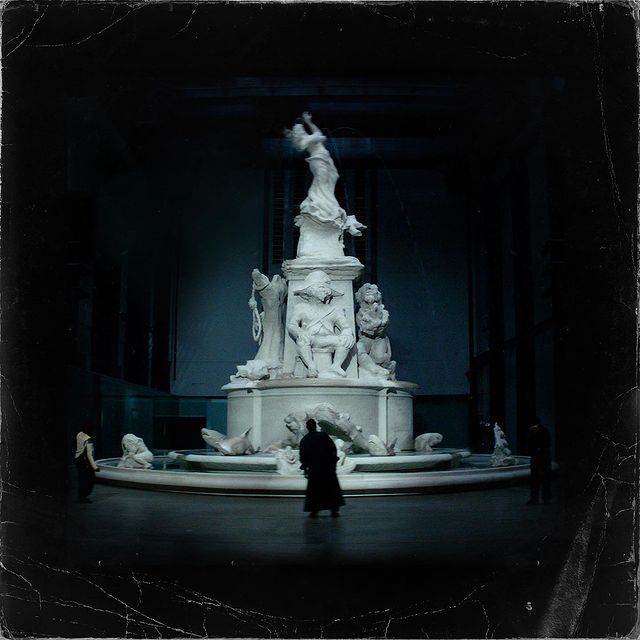
“Fons Americanus” was inspired by the Victoria Memorial, which is located in front of Buckingham Palace in London.
“The ‘Fons Americanus’ is an allegory of the Black Atlantic, and really all global waters which disastrously connect Africa to America, Europe, and economic prosperity,” Walker explained.
The term refers to the violent migration of Africans across the Atlantic Ocean, which shaped the development of Black identity and culture throughout Europe and America. One portion of the fountain includes “Shell Grotto:” a weeping boy with his head barely above the ocean’s surface, water running from his eyes. Water, a dangerous “source of power,” is a significant component in the piece, as it is what allowed for the transportation of Africans across the Atlantic.
The minimalism in the “Don’t Judge Me” music video made its message profoundly poignant; it did not attempt to dazzle. Instead, it presented dancers in their vulnerable states of struggle, Walker’s monument to traumatic histories and exceptional Black creatives and professionals simply being.
These are the powerful individuals that shape modern American and British culture and dictate the future; yet, systemic racism continues to apply pressure. It is exasperating to thrive, as seen by twigs’ solo performance in which she seeks truth — whether it’s liberation or self-understanding — through that enigmatic door.
Jacqueline Lee is an Entertainment Intern for the winter 2021 quarter. She can be reached at jacqusl4@uci.edu.

Interested in becoming an intern or a contributing writer for the Entertainment section?
Contact us at entertainment@newuniversity.org!