


Editor’s note: The article was originally published on May 20, 2026. An editor’s note was added on July 10, 2026. An author title was added to this article on June 29, 2026.
Every time you refresh Canvas or check how many connections you have on LinkedIn, you are participating in a system that shapes how you behave. It feels personal — thus, it’s tempting to chalk it up to something anxiety or ambition — but much of it stems from something more structural.
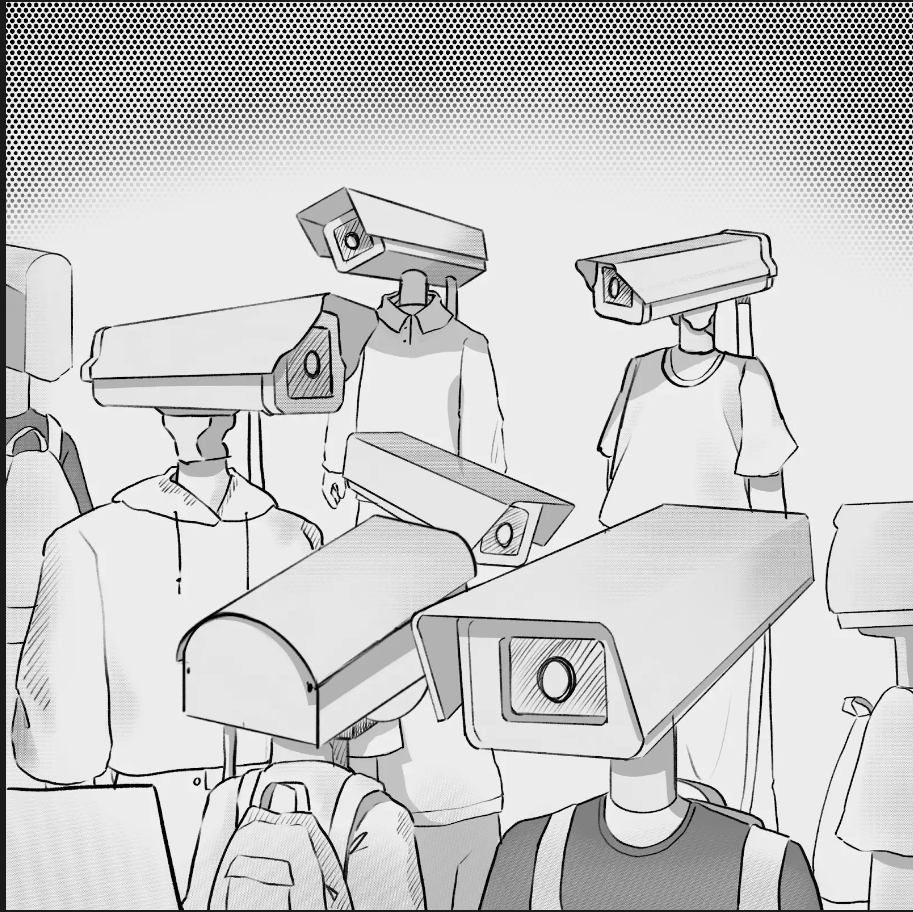
The modern college experience evaluates students to a sharper degree than before, while simultaneously encouraging them to evaluate themselves. This dynamic matters because students begin to anticipate judgment and adjust their behavior accordingly, turning evaluation into a constant, self-directed process. In this way, the pressures of college life become embedded in how students think, act and present themselves. This dynamic closely resembles the kind of power French philosopher Michel Foucault describes as being internalized and woven into everyday life.
In his book “Discipline and Punish,” Foucault explains that modern power works through disciplinary mechanisms that generate norms and sustain constant visibility. His metaphor of the panopticon shows how the possibility of observation leads individuals to monitor their own behavior as well. The panopticon refers to a circular prison design, where a central watchtower is used to observe inmates, who reciprocally understand they may be watched at any moment. This condition intensifies visibility since the uncertainty created by it encourages inmates to assume they are always being observed. As a result, they begin regulating their own behavior.
When applied to our society, it can be said that individuals are both constantly under the influence of power while simultaneously exercising it. Power functions through this network of relations rather than through a single, identifiable source and participation in these systems becomes part of how it operates.
College campuses — and importantly, their digital extensions like Canvas — mirror this structure. When students do something as typical as tracking their grades, the pattern of ongoing self-assessment is reinforced. Social media also reinforces this dynamic by making the optics of a person’s identity even more crucial to manage for the sake of accruing social capital and maintaining a carefully fabricated appearance. These practices function through what Foucault calls a net-like organization of power, where individuals move between roles as observers and observed to ensure a favorable position in society’s strata.
This system gains a great deal of its strength through internalization. Students often anticipate evaluation before it occurs, adjusting behavior in advance. For example, they may select activities based on how valuable they would appear on a resume..
Based on Foucault’s assessment, power relations are both intentional and non-subjective, meaning that while individuals act deliberately, the broader structures guiding those actions extend beyond any single person’s control. The pressure to perform emerges from this interplay and takes root in the organization of academic and digital life.
The consequences of this system of internalized evaluation are difficult to ignore. When attention becomes a form of capital, performance can overshadow legitimate engagement. Learning risks are reframed as a display of competence, while intellectual curiosity yields to a strategic form of participation.
Some might argue that these systems serve important purposes: evaluations are meant to maintain standards, and social media can foster connection. Foucault himself emphasizes that power is productive as it both creates ways of understanding and shapes how ideas are communicated. The challenge lies in the extent to which these mechanisms permeate student life. When nearly every action is subject to measurement, distinguishing between engagement and performance becomes increasingly difficult.
Foucault’s framework also highlights the presence of resistance within power relations. Because power operates through networks rather than a single center, it never fully closes off alternative ways of acting. Though there is a possibility of resistance, students retain the ability to navigate these systems and, at times, to push against them. Reclaiming a sense of autonomy begins with awareness. We can examine the metrics that shape our behavior by asking why certain achievements carry weight and whether particular goals align with our own interests.
College ultimately involves more than acquiring knowledge; it entails learning how to exist within systems that influence thought and action. Foucault’s theory sheds light on how performance pressures emerge from these systems rather than from isolated individual concerns. Greater awareness does not necessarily dissolve these structures, yet it enables a more intentional relationship to them. In a setting where attention is constantly evaluated, directing that attention deliberately becomes a meaningful way to assert agency.
Jacqueline Lee is an Opinion Intern for the winter 2026 quarter. She can be reached at jacquhl3@uci.edu.
Edited by Casey Mendoza and Riley Schnittger

