



Editors Note: Article was updated to reflect the first-place winners of the Stella Zhang New Venture Competition, announced on May 21.
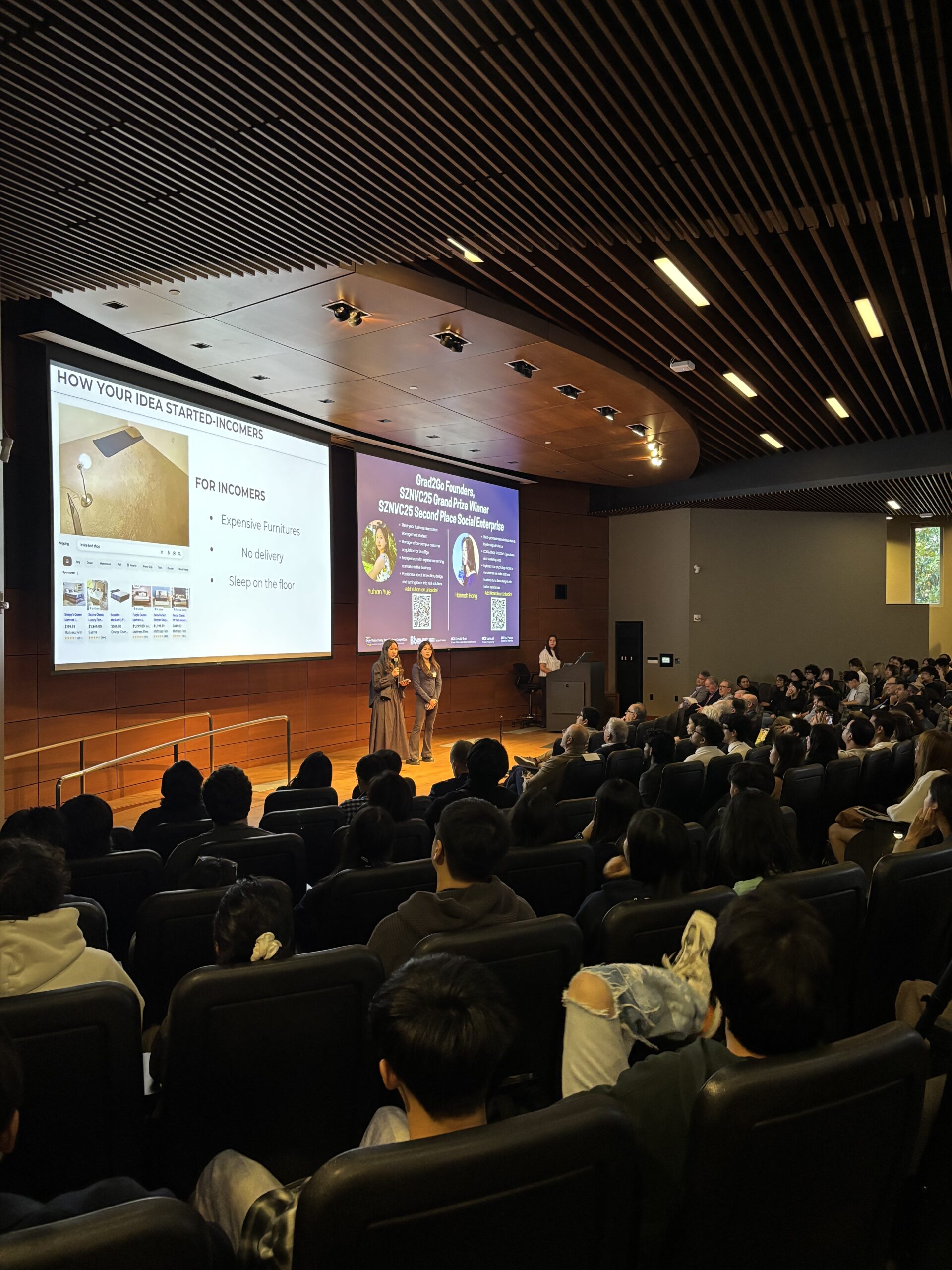
On May 21, the university’s annual Stella Zhang New Venture Competition will take place at the Paul Merage School of Business Auditorium. Ten student teams competing for a share of $100,000 in prize money will take the stage at UC Irvine to pitch their startup ideas to a panel of judges and business professionals. The competition, which began 22 years ago, functions much like the real-life “Shark Tank” for student entrepreneurs.
Open to students, researchers, faculty and staff, the competition is run through UCI’s Beall Center for Innovation and Entrepreneurship and is structured around five industry tracks: business products and services, consumer products, consumer services, life sciences and social enterprise.
Each industry track awards a first-place prize of $10,000 and a second-place prize of $5,000. Track winners then compete for a grand prize of $20,000 and a runner-up prize of $5,000.
The prize money is made possible through the support of 2005 UCI Master of Business Administration graduate Stella Zhang, whose 2022 gift transformed the longtime competition into what it is today. Additional donors help fund workshop expenses throughout the seven-month program.
Beall Center Program Manager Jenn Huynh said the competition is designed to walk participants through the full arc of building a business, from identifying a problem worth solving to figuring out whether a company can actually survive.
“The main part is how big is the problem that you’re solving,” Huynh told New University. “Is there something that you know like everyone is, and by everyone, you know like a majority of people, are facing that kind of problem and would love to see some kind of solution for that, or are you trying to have a solid, very niche problem for a particular aspect of a subset of people?”
That framework is put to the test over seven months of workshops and coaching sessions. Participants produce a final concept paper and pitch before the top 10 teams advance to the grand finale.
One of those teams is NeuroStrat, who created a mobile memory game designed to screen for early signs of Alzheimer’s disease in as little as 10 minutes.
Doctorate student in neuroscience and co-creator of NeuroStrat Casey Vanderlip said the idea came directly from his work in a neuroscience lab, where he has spent years researching Alzheimer’s disease.
“I work in a lab and we’ve been designing memory tasks to really better probe the disease and initiate memory changes,” Vanderlip told New University. “From that it kind of transformed into ‘Oh, how can I actually apply this to help patients that we’re researching?’”
The game works by showing patients detailed pictures and testing their ability to recall specific details, targeting the hippocampus — the area of the brain most affected by early onset Alzheimer’s.
Vanderlip said he almost didn’t enter the competition. When he first received an email about it, he thought it looked too business-heavy for a research-based team.
“The more I thought about it, the more our team thought about how to actually implement this opportunity and really ask: How can we actually make this a product that can really help people?” Vanderlip said.
Vanderlip and the team hope that NeuroStrat can eventually be incorporated into clinical trials and research practices.
The hardest part of the process was making sure the company was viable.
“How do we bring this to market? What is our go to market player? Who is our first buyer? That stuff, I think, was a little more of a process to learn,” Vanderlip said.
In the finale, the NeuroStrat team will present a three-minute pitch to an audience, judges, business professionals and their coach in the hopes of securing the grand prize.
The NeuroStrat team is one example of a team that wouldn’t traditionally consider themselves entrepreneurs but with the opportunity, now considers their idea a real startup.
This ideological shift is something that Huynh said she is seeing more and more among students.
“Right now, students, especially Gen Z’s, see [entrepreneurship] as a path,” Huynh said. “It doesn’t have to be a start-up even though, as you know the New Venture competition focuses on startups, but entrepreneurship is pretty much in a lot of spaces both in person and online that students see, so like influencers.”
Huynh explained how the competition is also an opportunity for students in the audience to network with people in the industry.
“It’s a great way for them to get to know the founders that are their peers [and] get to know them, and we will be inviting their coaches and judges that helped them along the way,” Huynh said.
“And there are business professionals, so it’s a great way for students to get to know, and expand, their network with people in the area.”
This year’s grand finale was held in the Merage School Auditorium on Thursday, May 21, from 5 to 9 p.m.
Fourth-year business administration student student and CEO Tyler Maher, third-year informatics student and CTO Cem Yilidiz and second-year political science student Jacob Douglas Speciale won the Business to Consumer Track with their product Pipeline, intended to help community college students transfer to university.
They were later announced as the winner of the $30,000 grand prize.
For students who were unable to attend or who are not yet ready to compete, the competition kicks off again every October.
Mya Romero is a Features Staff Writer for the spring 2026 quarter. She can be reached at myajr@uci.edu.
Edited by Avery Rosas and Sasha Alikhanov

Interested in becoming an intern or a contributing writer for the City News section?
Contact us at citynews@newuniversity.org!