


On June 30, the Supreme Court ruled 6-3 that President Trump’s executive order seeking to end automatic birthright citizenship was unlawful.
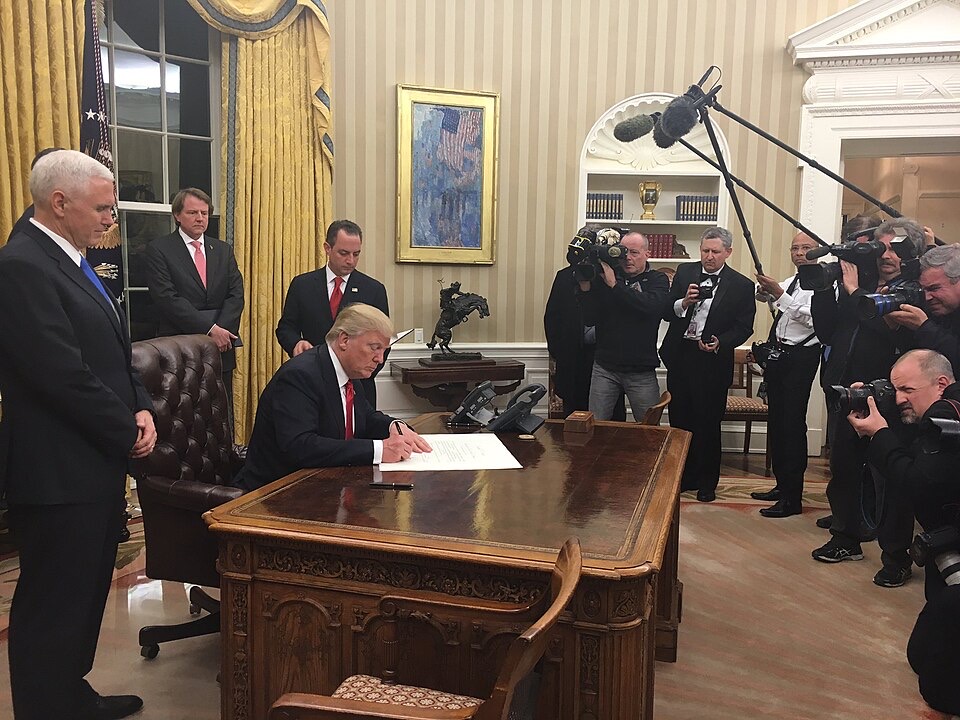
Trump v. Barbara challenged Executive Order 14160, “Protecting the Meaning and Value of American Citizenship,” which Trump signed on his first day in office, on Jan. 20, 2025. The order sought to prevent children born to undocumented immigrants and temporary foreign residents from automatically becoming U.S. citizens.
A five-justice majority held that the order violated Section 1 of the Fourteenth Amendment in an opinion written by Chief Justice John Roberts. They ruled that the Citizenship Clause, or Section 1, means that children born in the United States to parents who are unlawfully or temporarily present are citizens at birth. Roberts was joined by Justices Sonia Sotomayor, Elana Kagan, Amy Coney Barrett and Ketanji Brown Jackson. He traced the Citizenship Clause through English common law and the Reconstruction-era ratification of the Fourteenth Amendment, concluding that a child born on U.S. soil and subject to U.S. law is a U.S. citizen, regardless of the parents’ immigration status.
The Fourteenth Amendment was adopted in 1868 in part to overturn the Supreme Court’s 1857 ruling in Dred Scott v. Sandford, which held that Black people in America, who had descended from enslaved individuals, could not be U.S. citizens. Roberts also rejected the administration’s argument that citizenship should depend on a child’s “primary allegiance” to the United States, which the government argued was determined by a parent’s domicile rather than birthplace alone.
Susan Bibler Coutin, a professor in UCI’s Department of Criminology, Law and Society whose research examines how immigration law shapes legal status and belonging, said the ruling carries particular significance for a campus as diverse as UCI.
“I want UCI students to understand that this case definitively reaffirms that birthright citizenship is the law of the land and those who are born in this country do belong here,” Coutin said in an email to New University.
Coutin said that she was not surprised the Trump administration mounted the challenge, pointing to a broader history of nativist groups seeking to depict U.S.-born children of undocumented immigrants as foreigners rather than Americans.
Still, she said it was disappointing that the Court’s reaffirmation of its 1898 precedent in United States v. Wong Kim Ark came by a narrower 5-4 majority on the constitutional question. Birthright citizenship has long been considered settled law, Coutin said, and the broader public may not realize how far-reaching the consequences would have been had that settlement been overturned.
According to Robert S. Chang, executive director of UC Irvine Law’s Fred T. Korematsu Center for Law and Equality, who filed an amicus brief in the case urging the Court to strike down the executive order, the narrowness is the exact problem going forward. Speaking at the UCI Law’s 16th Annual Supreme Court Term in Review, Chang said the constitutional ruling is more fragile than its outcome suggests.
“Five-four is not well settled, because all it takes is for one of the five to be replaced by a justice who believes otherwise,” Chang said, pointing to the Court’s history of later declaring past precedent “wrong on the very day it was decided” — the same language the justices in Brown v. Board of Education used to overturn Plessy v. Ferguson.
Justice Clarence Thomas, joined by Justice Neil Gorsuch, dissented from the majority’s reasoning. “In doing so,” Thomas said, “the Court adds to the sad history of the Fourteenth Amendment, which was designed and understood to secure equal rights for the freed blacks but has instead been repurposed for political projects that the Reconstruction Congress did not support.”
More than a quarter of a million babies born in the US each year would have been affected by the executive order, according to research by the Migration Policy Institute and Pennsylvania State University’s Population Research Institute.
Birthright citizenship is also standard across much of the Western Hemisphere. Unconditional birthright citizenship, known as “jus soli,” is law in Canada, Mexico, nearly all of Latin America and the Caribbean. According to the New York Times, about 30 of the world’s roughly 200 countries automatically grant citizenship based on birthplace alone. Most nations in Europe, Asia, the Middle East and Africa instead rely on “jus sanguinis”, under which citizenship passes from parent to child.
Aadya Mishra is a News Intern for the summer 2026 quarter. She can be reached at aadyam2@uci.edu.
Edited by Anika Denny and Geneses Navarro.

