

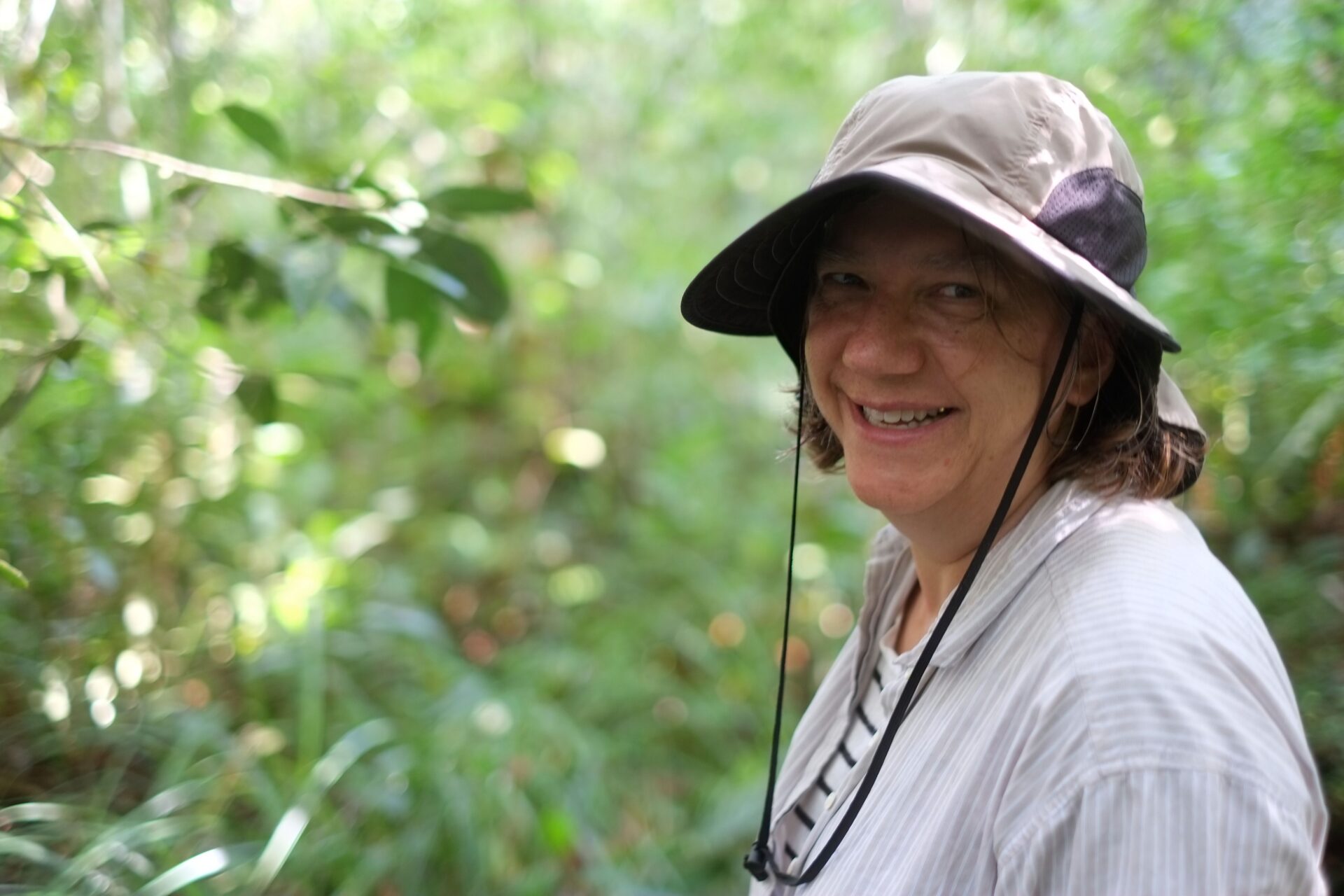


Susan Trumbore, a professor of earth system science at the University of California, Irvine, who simultaneously teaches Ph.D students in Germany, studies the carbon cycle and how forests and soils respond and contribute to climate change. Her research takes her to field sites around the world, where collecting data can sometimes be dangerous.
On a day of fieldwork in the Amazon rainforest, Trumbore and her colleagues were on their way to collect soil samples when a large snake suddenly emerged from beneath a fallen tree and aggressively charged at them.
“Usually, you look at a snake, it looks at you, and it goes away,” Trumbore told New University. “This one was like, ‘No, I’m coming for you.’”
While the encounter was frightening, it is not entirely unusual for Trumbore, whose research often takes her far from campus and civilization. Trumbore has spent decades conducting fieldwork in remote forests around the world — from the Amazon to the boreal forests in Canada.
These environments are central to her work studying the global carbon cycle.
“During my Ph.D, we debated whether we could prove CO₂ was warming the climate. That’s no longer a question,” Trumbore said.
In tropical forests like the Amazon, trees store much of the world’s carbon. As temperatures rise and droughts become more frequent, Trumbore said, these forests may begin to lose biomass and release stored carbon into the atmosphere.
Trumbore contributes to long-term research at sites such as the Amazon Tall Tower Observatory (ATTO), where measurements from a 325 meter tall-tower track how carbon and other gases move between the forest and atmosphere.
“The fate of the forest is the fate of carbon,” Trumbore said, explaining that when tropical forests degrade and lose trees, they release stored carbon into the atmosphere and are unable to absorb as much carbon dioxide, accelerating climate change.
Although forest ecosystems serve as a natural buffer against climate change, Trumbore’s research asks whether that buffer will continue to hold amid increased deforestation and carbon emissions.
At UCI, Trumbore studies these questions using radiocarbon at the W.M. Keck Carbon Cycle Accelerator Mass Spectrometry Facility (KCCAMS), one of the most advanced laboratories of its kind.
By measuring tiny amounts of carbon-14, a naturally occurring radioactive isotope of carbon, in trees and soils, Trumbore determines how long carbon remains stored and how quickly it moves through ecosystems under stress from drought, fire and deforestation.
“Much of what we understand about the carbon cycle comes from atmospheric nuclear weapons testing in the 1960s, which created fallout isotopes like radiocarbon. We essentially doubled atmospheric C-14, and now we can track where it goes and how long it stays,” said Trumbore.
The KCCAMS at UCI allows researchers to explore areas that have never been studied before, from soils to tree rings, measuring small samples faster and with greater precision than any other facility in the world.
Trumbore’s research also examines how different trees manage carbon, which can determine their survival during droughts.
Some trees have adapted to stop growing to store carbon during droughts. Others cycle carbon quickly, growing fast but dying young when drought hits.
In tropical forests with many species, these differences matter. If droughts become more frequent, fast-growing trees may dominate forests and reduce biodiversity.
“Certain days we have very high temperatures and hot droughts, which are forecast to be more frequent in the future,” said Trumbore on her work in the Amazon. “By studying what happens on those days now, we get a window into future climate conditions and how trees might adapt or die.”
Most carbon in boreal forests — cold, northern forests filled with coniferous trees — on the other hand, isn’t stored in the trees but in the soil, where cold temperatures slow decomposition. With global warming causing these soils to reach higher temperatures,questions arise about whether the carbon stored there will decompose faster.
While warmer temperatures could allow trees to grow larger, they could also trigger large releases of carbon from soils. This feedback loop is the main reason scientists like Trumbore worry that forests may become less effective at slowing global warming.
When comparing her international field sites to California, Trumbore noted that the state’s ecosystems face very different conditions.
“California is much drier and has a long dry season, so fire is a much bigger story here,” Trumbore said.
California forests face additional pressures, such as long-term drought and invasive insects. Some sites that were previously part of Trumbore’s research in the Sierra National Forest, have burned recently.
“Fire is natural — it should happen — but not these massive conflagrations,” Trumbore said.
In her UCI course The Future of Forests, Trumbore brings real data and stories from the field to help students understand climate change as a process unfolding in real places, not just in models or graphs.
“Fieldwork lets you see things directly. With AI and satellite imagery, people make assumptions that don’t always hold up on the ground,” Trumbore said. “I worry we’re in the last era of well-funded basic field research. I hope we don’t lose it — it’s rewarding, fun and leads to better science.”
For Trumbore, the work is as personal as it is scientific.
“I love nature, plants and trees. This field lets me satisfy my curiosity, work with isotopes — which I love — and do something societally relevant,” said Trumbore.
Trumbore continues to pursue her curiosity about how forests and soils store carbon, study how ecosystems respond to climate change and translate that knowledge into climate solutions.
Mya Romero is a Features Intern for the winter 2026 quarter. She can be reached at myajr@uci.edu.
Edited by Aditya Biswas, Annabelle Aguirre

Interested in becoming an intern or a contributing writer for the City News section?
Contact us at citynews@newuniversity.org!