

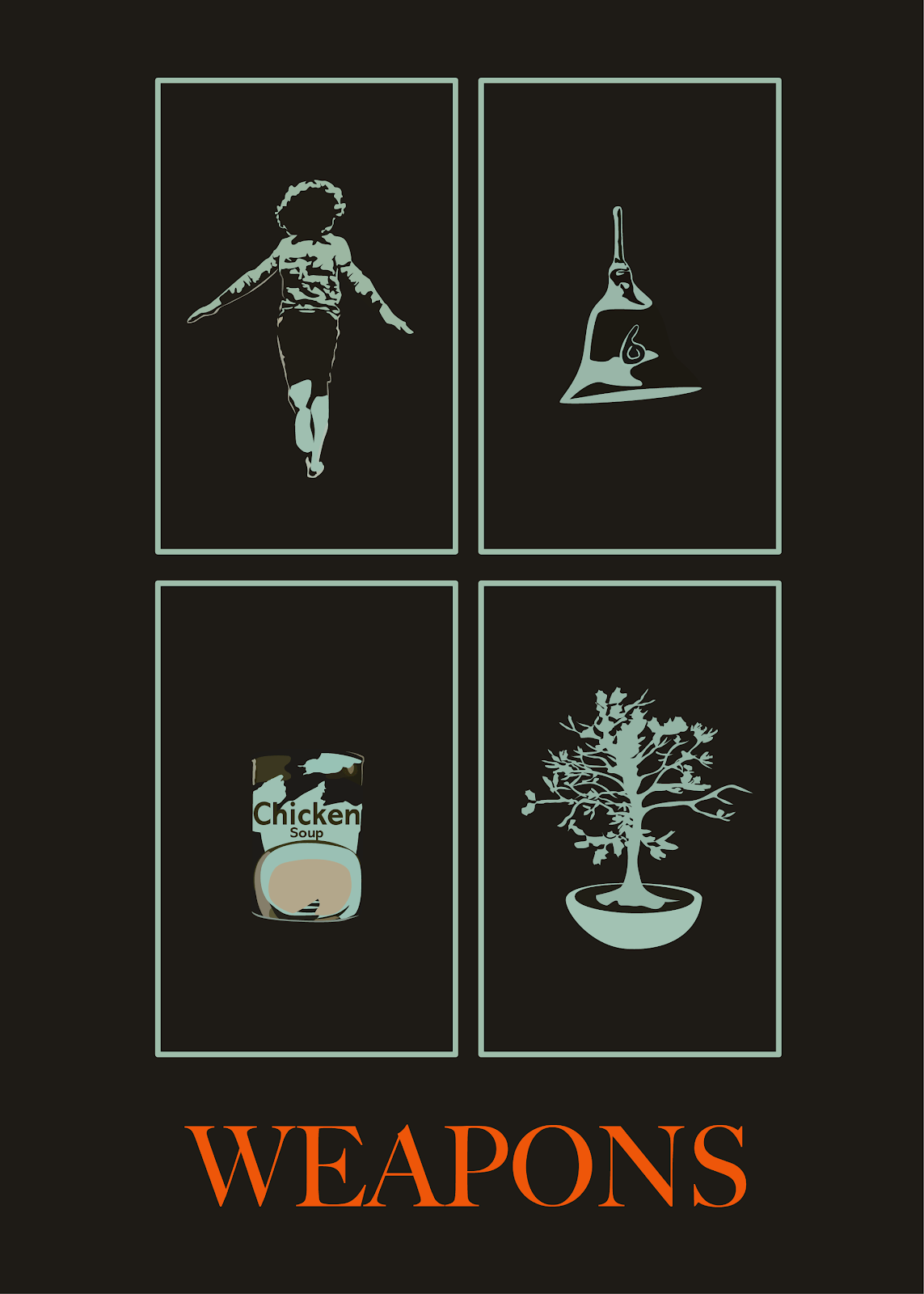

Third-grade teacher Justine Gandy (Julia Garner) steps into her classroom to find all but one desk empty. The lone student, Alex (Cary Christopher), sits silently wide-eyed. By morning’s end, she learns the rest of her 17 children rose from their beds at exactly 2:17 a.m. and ran wordlessly into the night with their arms stiffly outstretched, as captured on home surveillance cameras. This chilling enigma lies at the heart of Zach Cregger’s “Weapons” released on Aug. 8, setting the tone for a story that only grows stranger.
“Weapons” unfolds its dark, original concept through a tapestry of six interwoven perspectives. This builds an atmosphere of dread that gnaws at you as you try to piece this eerie puzzle together.
It begins with Justine’s perspective, where the public immediately suspects she knows where the children are. Spiraling into doubt and frustration, she turns to alcohol for solace and privately begins seeking answers on her own. One afternoon, Justine tails Alex home, only to find every window plastered with newspaper. Peering through a crack, she spots Alex’s parents slumped on the couch, disheveled and eerily still.
A grieving father, Archer Graff (Josh Brolin), whose son Matthew has vanished among the missing children, launches a search due to the police’s failure to act. He rages at a school meeting, targets Justine and uses doorbell camera footage to chart the children’s intersecting paths that point to Alex’s house — the critical breakthrough.
Paul Morgan (Alden Ehrenreich) is a troubled police officer and personally entangled with Justine. He stumbles into the mystery after following James (Austin Abrams), a destitute addict, to Alex’s home when he claims to have found the kids. He is unwillingly mind-controlled in a supernatural trap as he eventually attacks Justine.
James becomes an unlikely source of humor in the film. His attempted break-in, driven by desperation for valuables, turns absurd when he instead stumbles upon Alex’s family sitting eerily vacant in their living room. Humorously unphased and wandering further, he finds the missing children frozen in the basement. James panics and flees — an absurd, almost selfishly comedic beat against the film’s otherwise suffocating tension. Even his big break is accidental: denied while pawning stolen toys, he notices a news alert about the missing children and casually reports to the police. James injects humor that briefly releases tension without shattering the film’s unsettling atmosphere, amplifying the unease by contrasting absurdity against horror.
Acting as a rational yet strained authority figure, Principal Marcus (Benedict Wong) confronts a bizarre visit by Gladys (Amy Madigan), Alex’s aunt, who appears unhinged and dons a clown-like appearance. She suddenly weaponizes the principal through a supernatural ritual — using a tree branch and personal items like hair — that leads him to attack his partner and Justine.
The final chapter shifts to the sole remaining child, Alex. He becomes central to the plot’s resolution when he turns Gladys’ witchcraft against her — activating the very weapons his classmates had become. The children ultimately end the curse by killing her in a brutal, cathartic finale.
Each chapter in “Weapons” enriches the central mystery by offering psychological insight from characters at different levels of involvement. Through these overlapping lenses, Cregger masterfully builds tension to construct a world rife with suspicion, pain and supernatural dread.
Expectations were high for “Weapons”, especially given Cregger’s promise that it would be “a lot bigger and weirder than his directorial debut horror film, “Barbarian” (2022). The film holds an impressive 92% on Rotten Tomatoes, cementing it as one of the most memorable and acclaimed horror releases of the decade.
In many ways, the film delivers. Its sharp storytelling, originality and strong performances shine. Garner imbues Justine with clumsy vulnerability and moral intensity, while Abrams steals every scene with razor-sharp social commentary and perfect comedic timing — all while maintaining the story’s unsettling suspense. Audiences are drawn into a grieving community through the chapter-based narrative, enhanced by cinematography that adapts uniquely to each character’s perspective.
However, the film’s deliberate build-up culminates in an ending that lands less with emotional impact and more with a lingering so what?
Nexus Point News finds the narrative arc unresolved or tonally disjointed — plunging into supernatural territory that undercuts the tension previously built. Others find that Cregger sacrificed depth and emotionality for pacing and plot propulsion.
Online speculation has sparked theories that the film allegorizes school shooting tragedies, dissecting themes and characters through that lens. However, Cregger has explicitly stated that the story was never intended to serve as social commentary on school shootings. Instead, he described the project as deeply personal, inspired by his own experiences with grief and emotional reckoning.
Cregger explained in an interview that the last chapter is a personal allegory of having alcoholic parents: The zombie-like behavior, caring for and feeding his parents. He notes that it explores his own fears of a foreign entity disrupting the familial relationship.
This autobiographical layer adds a compelling nuance to the story, reframing its horror elements as deeply personal metaphors for fractured family dynamics.
However, the film contains plot holes — an unexplained vision of a massive AR-15 rifle, Gladys appearing in others’ visions and minimal police presence — prompting audiences to fill gaps with interpretations that diverge from the intended storyline. Cregger acknowledged these gaps, attributing them to the story’s reliance on subjective perspectives and the intentional omission of certain details. Additionally, there was a segment featuring Gladys — which might have provided further context — that was cut to maintain the narrative’s pacing.
Looking ahead, Cregger has expressed interest in exploring the world of “Weapons” further, suggesting the possibility of a sequel that would focus on Gladys. A backstory feels unnecessary, but a deeper grasp of her precise actions is deserved — without it, the villain’s calculated, methodical menace feels undermined by a supernatural shift that dilutes the carefully built tension.
Commercially, “Weapons” exceeded expectations, earning around $70 million globally over its opening weekend — a rare win for an original horror film in theaters. Audience reception was strong, with an A- CinemaScore and a solid 94% on Rotten Tomatoes. Critically, despite some dissatisfaction with the ending, most reviewers celebrated the bold storytelling and tense atmosphere. IGN’s Tom Jorgensen called it “a righteous, fully actualized genre-bender,” the Associated Press awarded it 4.5 out of 5 stars and Empire gave it a perfect 5/5.
“Weapons” may not fully stick the landing, but it solidifies Cregger as a daring visionary in modern horror, being a film that is unforgettable, audacious and hauntingly original.
Fiona Clancy is an Arts & Entertainment Staff Writer for the summer 2025 quarter. She can be reached at clancyf@uci.edu.
Edited by June Min and Annabelle Aguirre

