

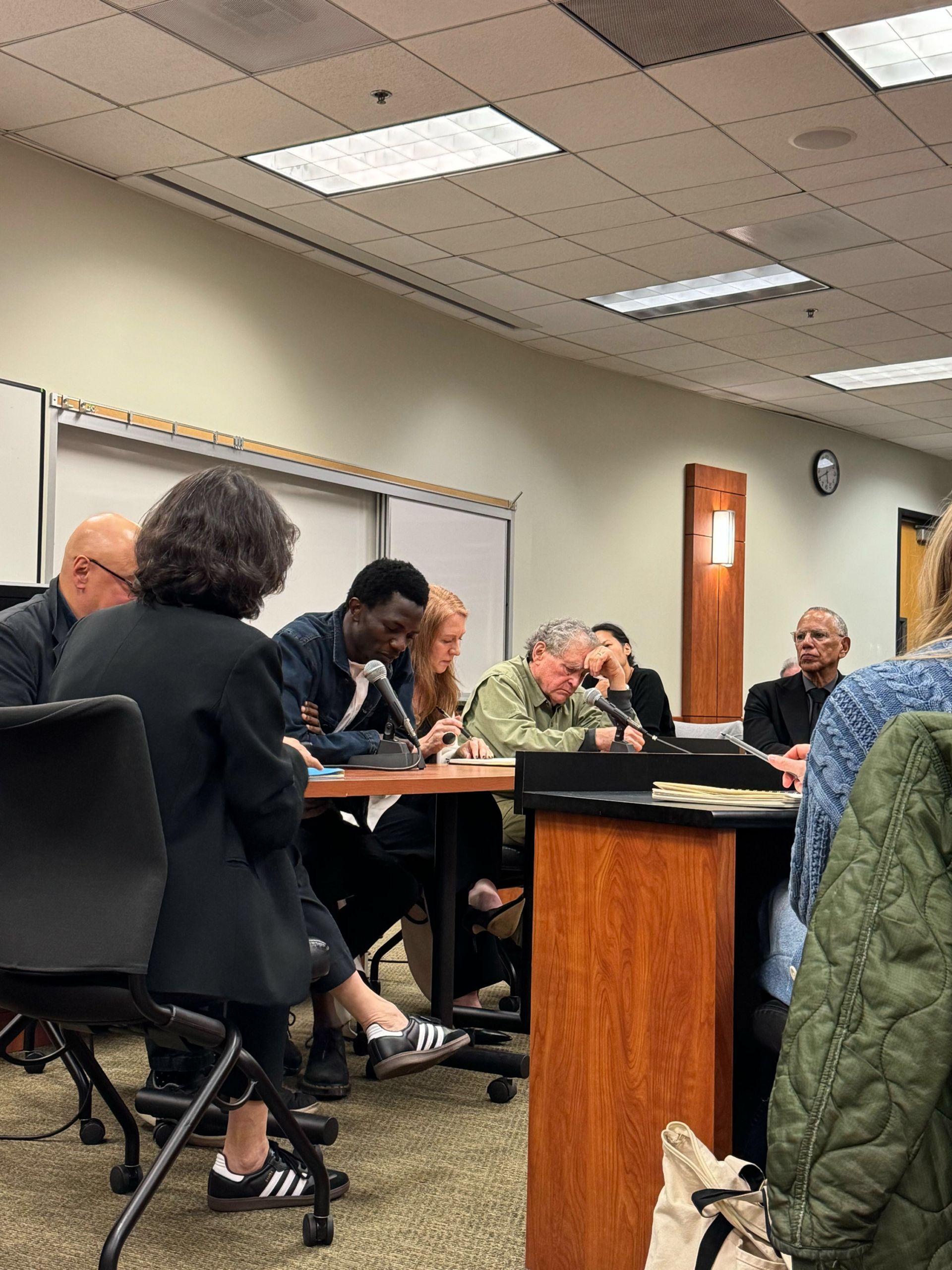

Journalists, professors and scholars of all kinds gathered in UCI’s School of Law for the Facts Under Fire: Reporting in Impossible Times conference on Feb. 7-8. Co-directed by UCI English Professor Amy Wilentz and Chancellor’s Professor of History Jeffrey Wasserstrom, the event examined how journalism adapts in a rapidly changing political environment.
The conference began Friday evening with Barry Siegel, director of the UCI Literary Journalism program, providing an overview of the weekend’s events accompanied by a glimpse of the questions that speakers would address. Siegel also introduced keynote speaker Dean Baquet, who served as executive editor of The New York Times from 2014 to 2022.
Baquet’s speech sought to answer some of today’s most pressing questions in journalism: How do we report on the Trump administration? How do we balance uncovering truth while reporting legitimate political actions without amplifying attempts to “flood the zone”? How do we preserve the public’s trust in the institution of journalism? How is the landscape of protected press freedom shifting?
“There is one discussion that, to my mind, is not being held often enough. One that runs the risk of slipping by as we turn our attention to more glittery objects, like the future of AI and the state of objectivity,” Baquet said. “There’s too much talk about framing, too much hammering about headlines that are off and not enough talk about the beauty and joy of open-minded, empathetic reporting — of going out into the world, unsure of where the story is headed, of banging on doors, of listening with open minds and an open heart.”
Baquet encouraged journalists to strengthen cords of communication with their readers. He recommended publishing stories that audiences may not like and emphasized honesty as the core reason behind publishing a piece. As an example of building trust, he referenced his editor’s note explaining The New York Time’s decision to release Donald Trump’s tax returns.
On Saturday morning, a panel on covering the American election discussed misinformation, the journalist’s role in preserving democracy, legal considerations and the question of who counts as a journalist?
The rise of social media, podcasts, blogs and other forms of digital content creation brought this question into the forefront of journalistic debate. Citizen journalism — where individuals create news content without formal affiliation with a newsroom — ignites questions about fact-checking, bias, sourcing and other aspects of journalistic standards. However, citizen journalists may have more direct access to breaking stories or the ability to cover events without the guiding hand of an editor and media organizations.
“I also want to touch on some of the things that were mentioned earlier today about what defines a journalist,” New York Times Writer and panel speaker Sheera Frenkel said. “And I would just make the argument that unlike the bar, or unlike [a] doctor, [who] has to pass the medical boards, we don’t have to pass a test to become a journalist, to become accredited that way. And that’s because there are so many different ways to be a journalist.”
This topic surfaced repeatedly throughout the conference, particularly in discussions of AI and journalistic integrity.
Following the American election panel, a group of international journalists — Polina Ivanova on Russia, Alan Weisman on the United States, Katie Stallard on China and Widlore Meráncourt on Haiti — tackled the topic of “Journalists as Targets.” The panelists shared personal experiences of danger and apprehension while reporting in the field.
Weisman described his experience being arrested, strip-searched and denied access to “his phone, voice recorder, notebooks, and prescription medications,” while covering a protest in Minnesota about the construction of a water pipeline on assignment for the Los Angeles Times.
“I was taken to Hubbard County jail; I was fingerprinted and strip-searched,” Weisman said. “I was given orange paper things to wear and promised that I could have a phone call; I was entitled to a phone call; I was never given that phone call. I was put into a solitary confinement cell with no windows. And if you’ve never gone through that before, it’s sort of like the first time you’re in an earthquake and the earth drops from underneath you and you don’t trust something so fundamental as the ground beneath you.”
Later in the day, a panel titled “Tech Challenges to Truth in the Age of AI and Algorithms” featured tech scholars including George Mason law professor Olufunmilayo Arewa, Frenkel, Lucy Hornby, senior associate at the Center for Strategic and International Studies, and UCI criminology, law and society professor Elizabeth Loftus.
During the discussion, panelists addressed generative AI, issues with AI-based fact-checking on social media and the role of large tech CEOs in government.
“I write a lot about social media, and right now, I think a lot about how we translate for our audiences words that are very jargon-y — misinformation, disinformation — a lot of people, kind of, their eyes glaze over,” Frenkel said. “And so, we’ve become very international about describing things as a conspiracy theory if it’s a conspiracy theory, describing things as propaganda if it’s propaganda, saying ‘this was a Russian-sponsored effort to pay an American to spread right-wing propaganda’ if that is what is happening. And we think spelling it out for our readers is incredibly important when it comes to technology.”
Students can find more information on future UCI Law School events here.
Annia Pallares zur Nieden is a Features Intern for the winter 2025 quarter. She can be reached at anniap@uci.edu.
Edited by Kaelyn Kwon and Jaheem Conley.

