


Editor’s Note: This review contains some graphic images for “Lowlife Princess: Noir” that may be triggering to some readers.
BIBI’s first full album “Lowlife Princess: Noir” invites listeners into a world of decadence — combining lush instrumentals with cinematic music videos to tell a story about a woman who wants to be loved.

BIBI is at the forefront of the Korean music scene that exists outside of the pristine world of K-pop. Although her physical albums come with collectible photo cards — a marketing device characteristic of the K-pop industry — her music often explores topics far darker and far more taboo than the usual sweet declarations of young love. She has sung about cigarettes and condoms and gambling — all scandal–worthy topics in the K-pop world — and isn’t afraid to swear every once in a while, which is a privilege usually reserved for idols well-established in their careers.
She’s quite bold outside of her music as well. During one performance of “The Weekend,” she walked up to the barricade and kissed a female fan on the lips. At the same festival, she threw cigarettes and condoms into the audience while performing “She Got It.” Her stage name — BIBI — is shortened from her Soundcloud handle, Nakedbibi, which is intended to be read as “naked baby.” This is a reference to a baby’s natural appearance as she intends to express her truest self through music.
She doesn’t give her truest self away so easily though: she shrouds it in personas and metaphors by filtering it through layers of imagery. The narrative of “Lowlife Princess: Noir” centers around the original character Oh Geum-ji,“who craves for the love that she couldn’t have growing up as an abandoned child” said Bibi. Based on the protagonist of Park Changwook’s 2005 revenge thriller Lady Vengeance, Oh Geum-ji is a woman made of paradoxes: she is the “lowlife princess” of the album’s title and the best of the worst not in a moral sense, but in the sense that she clawed her way to the top. BIBI herself acknowledges that “these two words are incompatible in their meanings,” but notes that they are the best expression of the emotions that this character was born from: “a mixture of anger and love.”
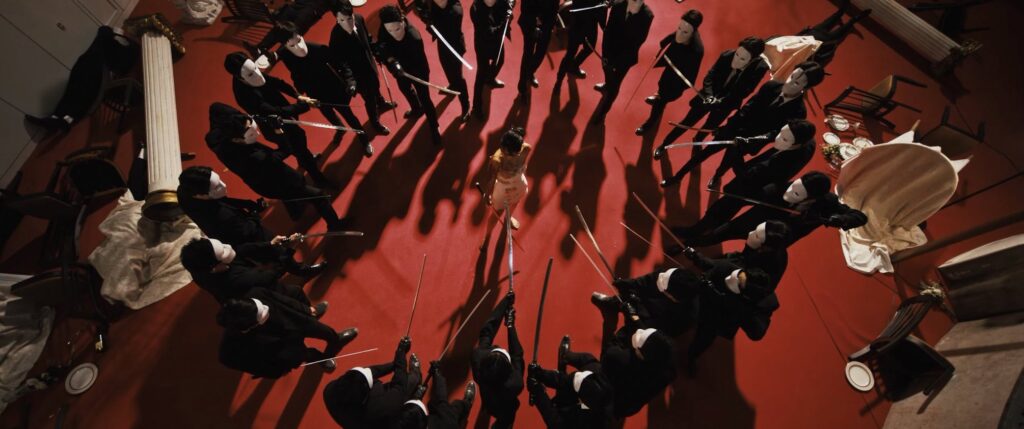
The music video for the pre-release single “Animal Farm” offers some reasons for these conflicting emotions. First, it begins with BIBI laid out on a dinner table. She is curled up and posed with an apple, like a pig about to be feasted upon by the masked men surrounding the table. However, she quickly subverts the scene, grabbing a katana and slicing off the head of the leader of the dinner party. By the end of the music video, she is sitting on the table surrounded by the corpses of the men who sought to eat her, singing, “The center of the grand feast / Under the big guillotine / To whom does the rolling head belong?”

The title track “BIBI Vengeance” takes on a similar tone, as she takes on the role of a crime boss who murders the men who have disrespected her. The song takes on a Latin-inspired sound as BIBI chants “Bad b****, just a rеal bad b****” in the bouncy rhythm of the chorus. In both “Animal Farm” and “BIBI Vengeance,” BIBI illustrates a world in which love is hard to come by: the men in “Animal Farm” view her as food and the men in “BIBI Vengeance” demean her — refusing to take her seriously. As much as the character may want love, there is no one in the lowlife who is worthy of giving it, and she must grow a thicker skin in order to protect her heart.
She expands upon this survivalist attitude in “Blade” in which she confidently croons her intentions over crawling synths. She doesn’t have to waste time explaining her perspective to her enemies when she has a blade. “Blade” is followed by the coy “BIBI Vengeance” and grandiose “Animal Farm,” which in turn leads us to the jazzy “Motospeed 24.”

“Motospeed 24” is the first track of the album that does not put BIBI in direct conflict with underworld lords. The sweetness in her voice shines through as she reminisces on memories of a lost relationship that flourished under the city’s moonlight. She continues this jazzy sound in the minute-long “Sweet Sorrow of Mother.” Her voice seems to rush ahead of her thoughts, breathlessly soaring through three verses about the pain of love. She takes on a more vulnerable side than in the previous tracks, declaring, “Even if you cut off a piece of me and fill your stomach / I’m willing to give [it] to you with no hesitation.”
She is joined by singer-songwriter Sam Kim on “Loveholic’s hangover,” a steady track about disproportionate reactions to the end of a relationship. Backed only by a piano and sparse percussion, BIBI and Kim showcase two contrasting perspectives, in which BIBI finds temporary relief in new lovers — “new arms” — while Kim repeatedly goes back to the same person — “familiar arms.”
Meanwhile, BIBI is haunted by her past lover in “Wet Nightmare,” bemoaning their repeated appearance in her dream over a sparse instrumental punctuated with screams.
In “Witch Hunt,” BIBI’s sweet voice regains the sharp edges it had in earlier tracks; in between heavy breathing and the sound of a cat yowling, she states, “They wanna kill me and have me / At the same time.” This frustrating relationship is not quite what love causes her to do, “Mess around this whole town ‘cause I’m f******* mad.”
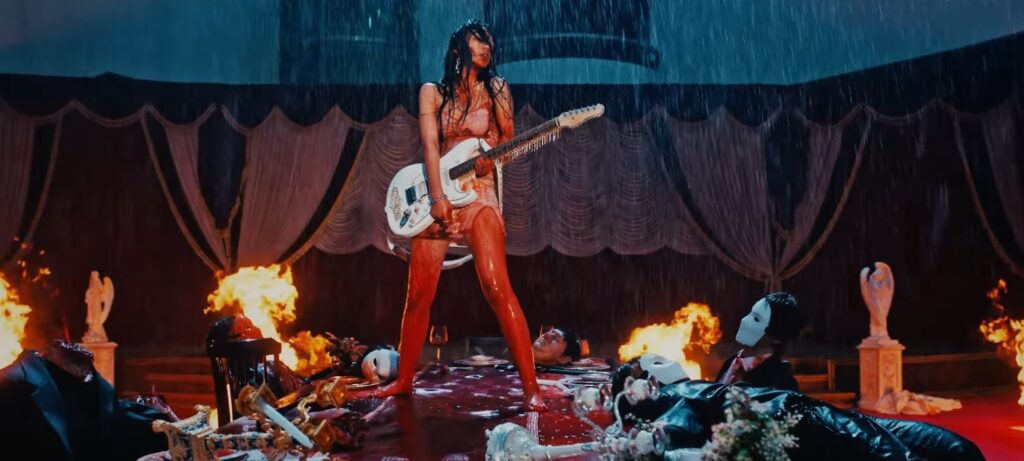
This leads into the sleazy “Lowlife Princess,” whose slouching synths serve as a soundscape to BIBI practically moaning, “Give me kiss, give me kissy-kissy-kiss, boys / Give me pills, pilly-pilly-pilly-pills, Doc.”
The breathless shouting of “Lowlife Princess” leads us into “JOTTO,” whose jazzy, guitar-backed sound is closer to the saccharine sound of “Sweet Sorrow of Mother” and “Loveholic’s hangover.” However, the lyrics and the music video are closer to the harsh Oh Geumji we were introduced to in “Blade” as she escapes an abusive relationship by stabbing her lover with a knife and when he survives and proceeds to throw him in a pool to drown him.
The album concludes with the cathartic “City Love,” a frenetic pop-punk track in which BIBI pleads, “Love me / Kiss me / Touch my body and look straight at me” and “Save me from this unknowable place.” It marks the end of BIBI’s story — leaving the listener to wonder if the lowlife princess will remain lonely forever.
BIBI shines in “Lowlife Princess: Noir,” using her R&B and K-hip-hop sound to introduce the harsh persona Oh Geum-ji has adopted, invites the commiserate with her loneliness, and then transitions back into a roughness tinged with regret as Oh Geumji continues to live out her low life. BIBI’s commitment to both character and artistry results in twelve tracks that are not only enjoyable in their own right but also come together to create a window into the world of a lowlife princess.
Teresa Pham is an Arts & Entertainment intern for the Fall 2022 quarter. She can be reached at teresaap@uci.edu.

